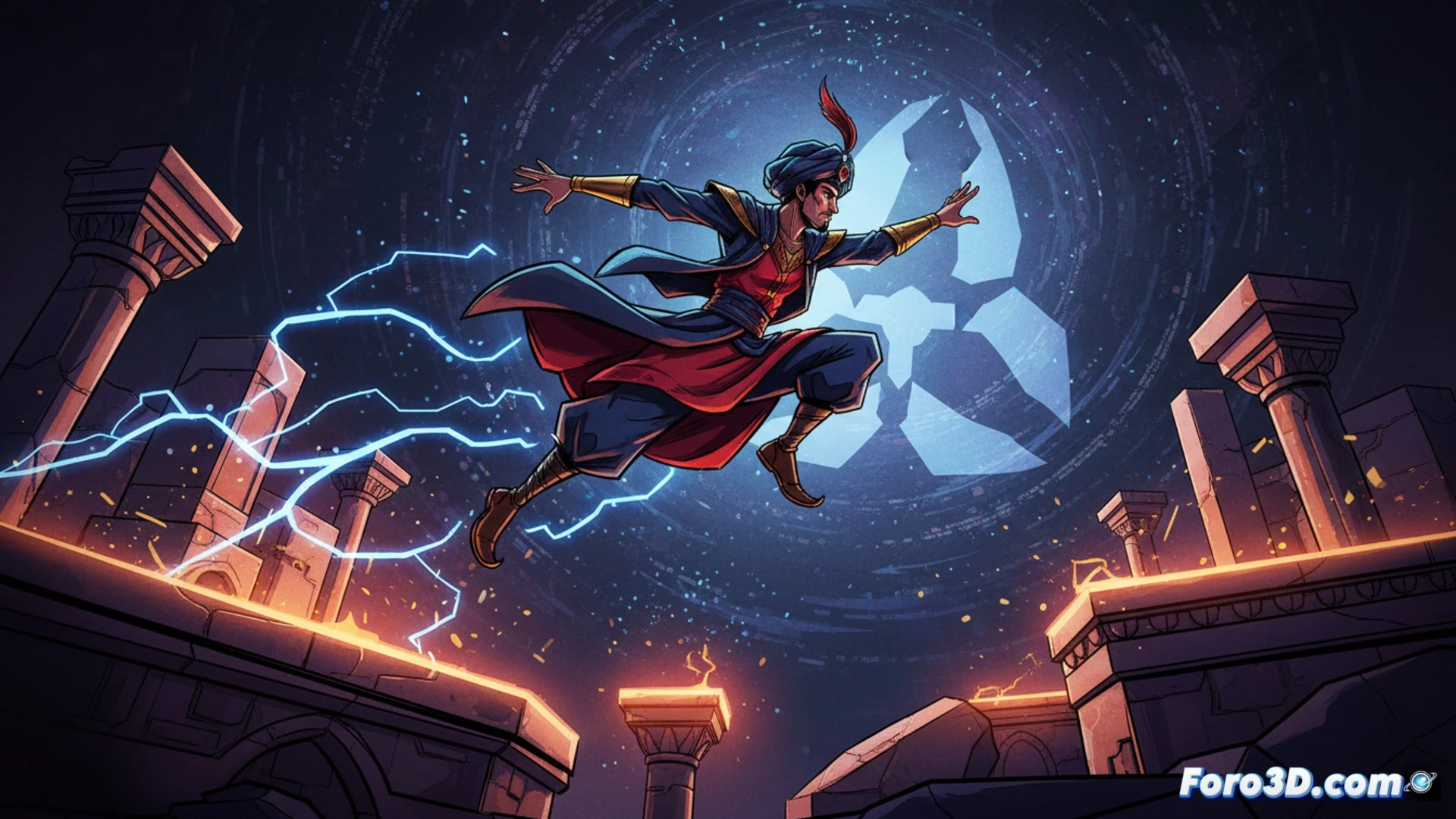
The Rogue Prince of Persia represents a bold visual shift for the franchise, adopting a Franco-Belgian comic style that moves away from the realism of its predecessors. Developed in Unity, the game combines fluid 2D animation with simplified 3D environments, creating a vibrant aesthetic that enhances the fast-paced action of the roguelite genre. This technical decision not only defines its artistic identity but also optimizes performance and visual clarity during procedural combat.
2D Animation Techniques on 3D Geometry in Unity 🎨
The development team has implemented hand-drawn 2D sprites for the protagonist and enemies, rendered as billboards or camera-facing planes within the Unity engine. This technique, known as 2D bone channel animation, allows for smooth transitions between jumps, attacks, and dodges without the computational costs of a full 3D model. The environments, modeled in 3D with simple geometry, use custom shaders in Unity to mimic the inking and flat textures of a comic. Adobe Photoshop serves as the primary tool for creating textures and color palettes, while internal animation tools manage keyframe synchronization. The vibrant palette, with high saturation and strong contrasts, is not just aesthetic: it improves readability amidst on-screen chaos, crucial for a roguelite where the player must react in milliseconds.
Lessons for Indie Developers: Visual Identity and Performance 🚀
The choice of Unity for The Rogue Prince of Persia demonstrates that technical limitations can become artistic virtues. By opting for 2D animation over simplified 3D environments, the studio achieves a unique visual identity that sets it apart in the saturated roguelite market. For indie developers, the lesson is clear: prioritizing a coherent and optimized style, using tools like Unity and Photoshop, allows for delivering a smooth experience without sacrificing ambition. The game is an example of how directional art and technical efficiency can merge to create a memorable product.
How is the smooth transition between jump and wall movements achieved in Unity to maintain the characteristic agility of Prince of Persia in a roguelite game
(PS: 90% of development time is polishing, the other 90% is fixing bugs)