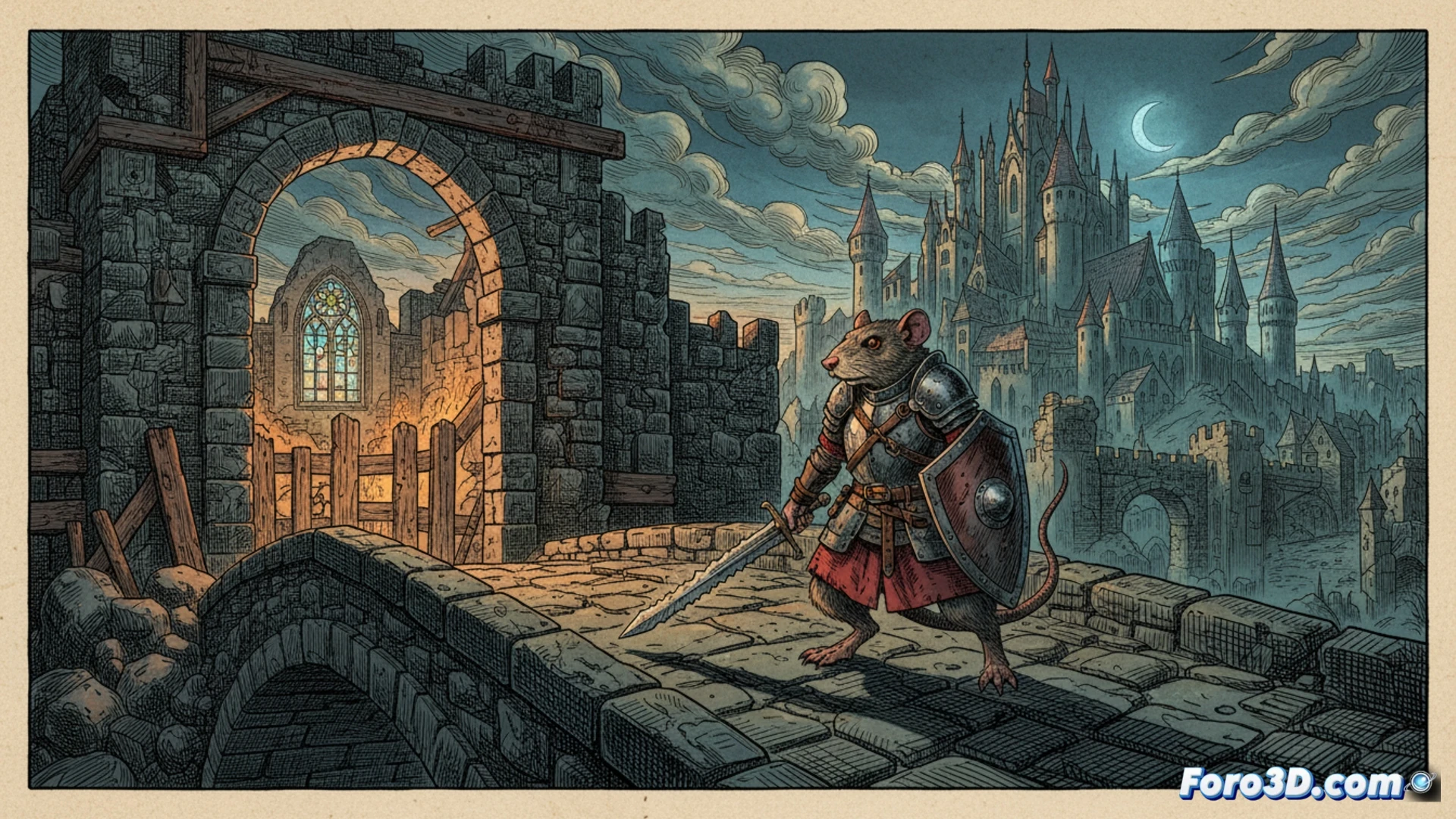
Tails of Iron, developed in Unity, demonstrates that hand-drawn 2D is not incompatible with visual depth. Its style, inspired by classic engravings, combines multiple parallax layers with atmospheric lighting that transforms each scene into a living painting. We analyze the artistic pipeline behind this work, from the stroke in Photoshop to its technical implementation in the engine.
Technical Pipeline: From Photoshop to Unity with Dynamic Layers 🎨
The process begins in Photoshop, where each element (backgrounds, characters, objects) is painted separately in layers with limited palettes and grainy textures that mimic inking. When exporting, sprites with alpha channels and specific resolutions are prioritized to avoid forced scaling. Inside Unity, parallax planes are configured using the camera's layer system or custom scripts that adjust each sprite's offset based on the camera's position. Atmospheric lighting is achieved with 2D lights from the URP (Universal Render Pipeline) system, placing directional and point light sources that cast soft shadows on the sprites. This creates a chiaroscuro effect that evokes engraving without the need for complex shaders, optimizing performance even on modest hardware.
Lessons for Indies: Visual Cohesion and Optimization 💡
The success of Tails of Iron lies in artistic discipline. By limiting the color palette and using low-resolution textures with point filtering, visual noise is avoided and the engraving aesthetic is maintained. The combination of parallax with 2D lighting not only adds depth but also guides the player's attention to key areas. For a small studio, this approach demonstrates that prioritizing a strong artistic direction and efficient rendering techniques can compensate for a lack of budget, achieving an immersive world without sacrificing performance.
As an indie developer, what dynamic lighting techniques in Unity do you recommend to achieve the depth and parallax effect in hand-drawn 2D sprites without losing the original artistic aesthetic like in Tails of Iron?
(PS: 90% of development time is polishing, the other 90% is fixing bugs)