The Balatro phenomenon has not only revolutionized the roguelike deck-builder genre but has also proven that retro aesthetics can be a powerful narrative vehicle. By analyzing its development, we discover that the secret lies not in graphical power, but in the clever combination of humble tools. The LÖVE framework, based on Lua, is the heart of the project, while Aseprite's pixel art and VS Code programming form the skeleton of an indie masterpiece. 🃏
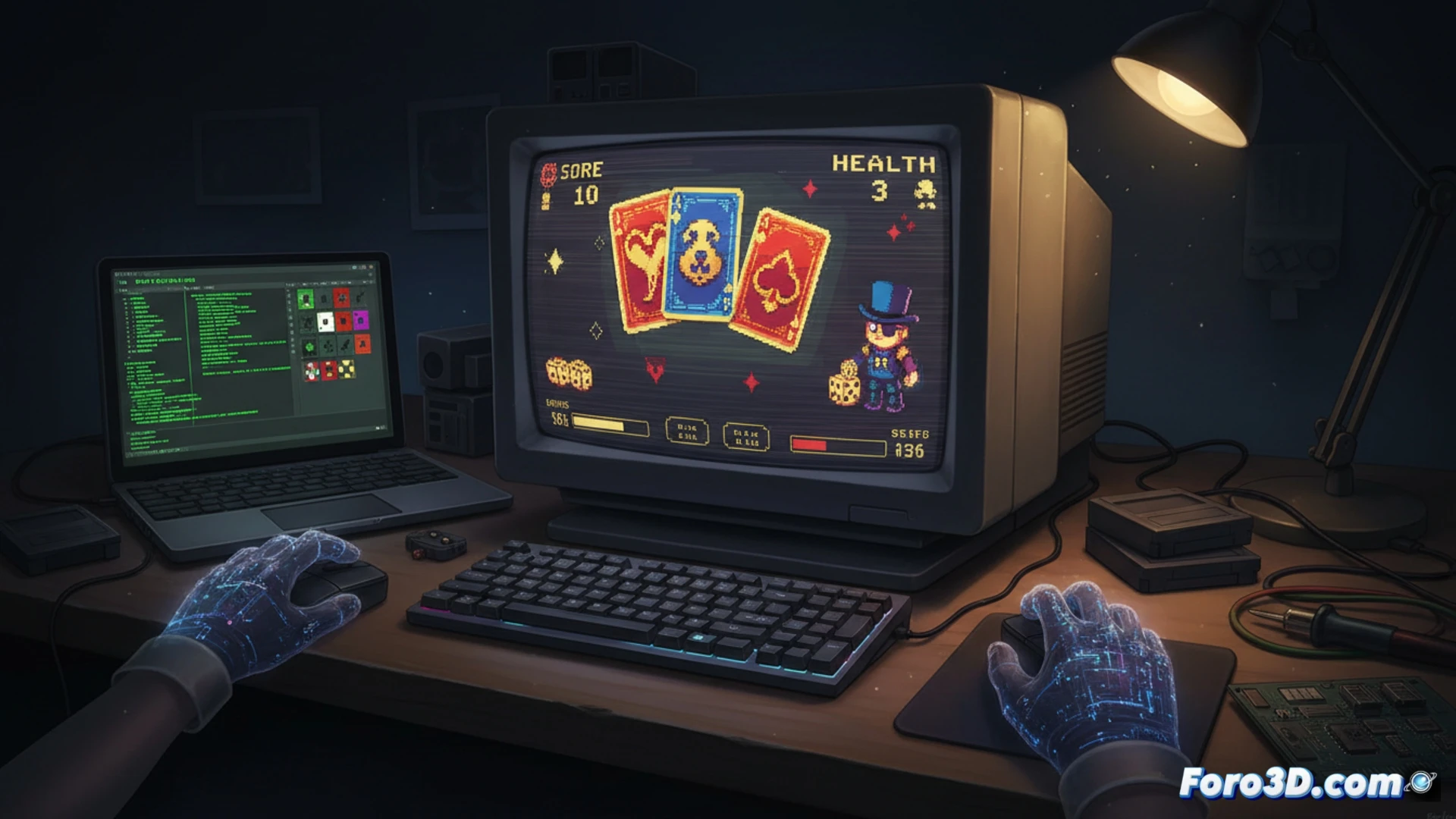
Shaders and CRT Simulation in LÖVE 🖥️
The CRT monitor effect in Balatro is not a simple filter; it is a layer of GLSL shaders applied directly to the LÖVE canvas. The developer uses fragment shaders to generate chromatic aberration, separating the red, green, and blue channels into adjacent pixels. Geometric distortion is achieved by mapping the texture to a curved grid, simulating the convexity of a cathode ray tube. The process is surprisingly lightweight: LÖVE handles the graphics pipeline natively, allowing these effects to run in real-time without penalizing performance. For pixel art, Aseprite exports sprites in limited palettes (typically 16 colors per tile), which are then scaled using LÖVE's nearest filter mode to maintain the sharpness of the square pixel.
Limitations as Creative Advantages 💡
The most inspiring aspect of the Balatro case is how it embraces constraints. The LÖVE framework does not offer complex physics engines or 3D lighting; however, the developer turned this limitation into a stylistic advantage. By programming in Lua from VS Code, they opted for shader-based animations instead of sequential sprites, achieving depth with minimal resources. For indie developers, the lesson is clear: you don't need Unreal Engine to create a visually striking world. Use Aseprite to design assets with reduced palettes, program distortion shaders in LÖVE, and remember that technical nostalgia, when well executed, can be your greatest artistic asset.
How is the digital CRT aesthetic achieved in Balatro using the LÖVE framework, and what programming techniques allow emulating the visual magic of retro monitors without sacrificing performance in video game development?
(PS: a game developer is someone who spends 1000 hours making a game that people complete in 2)