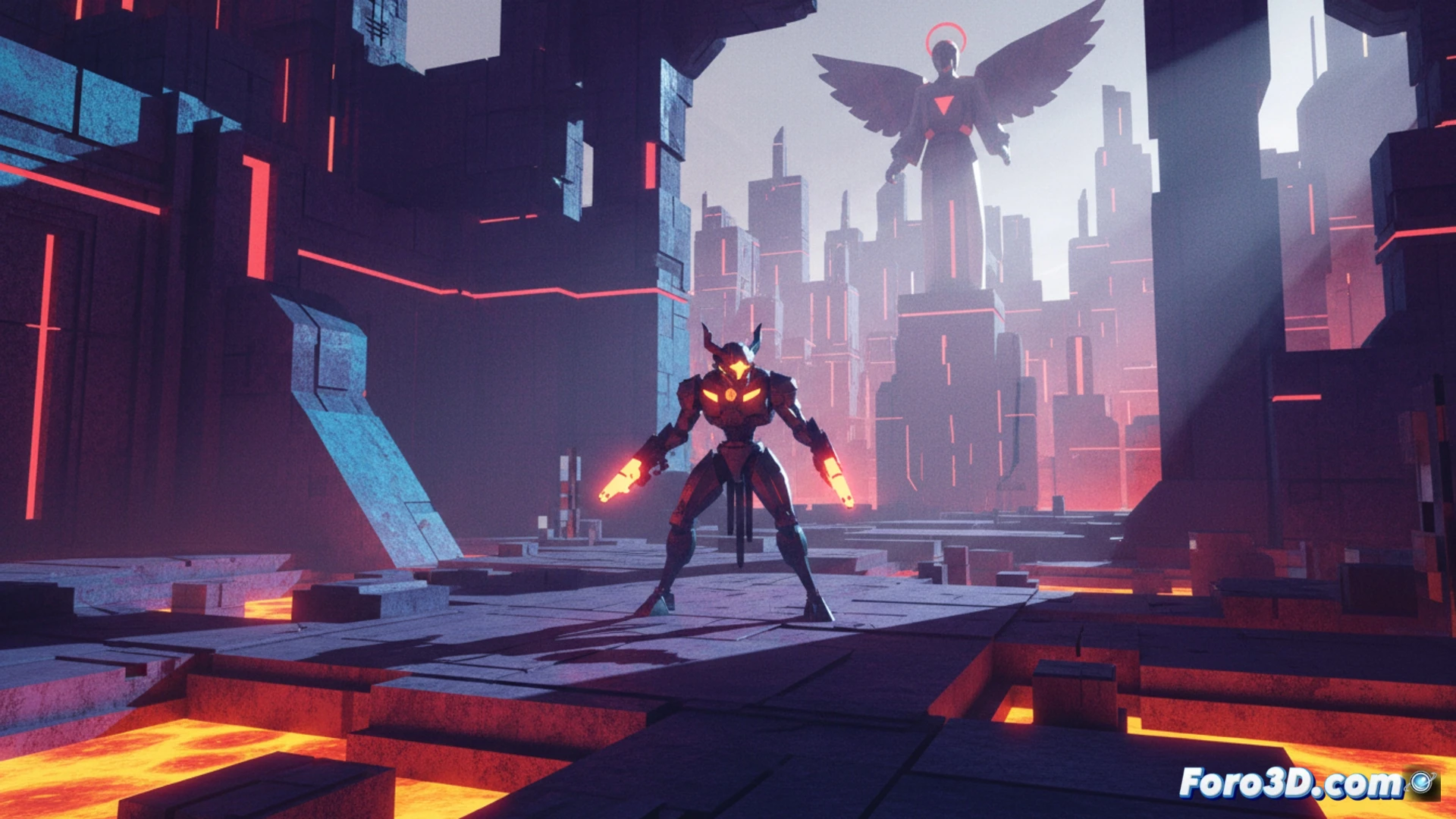
The visual success of Ultrakill lies not in graphical power, but in technical nostalgia. The Unity engine acts as a canvas for an aesthetic that faithfully replicates the shooters of the PlayStation 1 era. The key lies in a precise combination of low-poly modeling from Blender, chunky pixel texturing in Photoshop, and a saturated color palette that defies modern sobriety. For any indie developer, understanding this workflow is essential to capturing that essence without falling into simple visual sloppiness.
Technical Workflow: From Blender to Unity 🛠️
Modeling in Blender for Ultrakill prioritizes simple geometry. Enemies and weapons are built with the fewest polygons possible, avoiding smoothing or subdivisions. The golden rule is to visualize the asset as if it were rendered on a 32-bit console: flat faces and sharp edges. Subsequently, in Photoshop, low-resolution textures (generally 32x32 or 64x64 pixels) are applied with flat colors and no smooth gradients. The trick is to paint hard shadows directly on the UV map, simulating the vertex lighting of the era. When importing into Unity, texture compression must be disabled and Point filters should be used to avoid anti-aliasing, maintaining that characteristic pixelated look.
The Nostalgia Trap: Saturation and Geometry 🎨
Many developers fail when attempting this style because they add too many details. Ultrakill demonstrates that the PS1 aesthetic is not just low resolution, but a design philosophy. The color palette must be aggressively saturated to compensate for the lack of complex dynamic lighting. Furthermore, geometry must be angular and readable; a well-textured enemy of 50 polygons communicates better than one of 200 with blurry textures. For your indie project, prioritize visual contrast and clear silhouette over polygonal fidelity. The Unity engine will support it effortlessly, allowing you to focus on gameplay.
How does Unity manage to replicate the technical limitations of the PS1, such as vertex distortion and lack of texture filtering, to generate an authentic retro aesthetic without falling into mere superficial imitation?
(PS: a game developer is someone who spends 1000 hours making a game that people complete in 2)