A recent technical analysis has shown that a building with a curved facade, far from dispersing light, acted as a converging lens for a ground-based laser beam, redirecting its energy directly into the cockpit of an approaching aircraft. Using a combination of Rhino 3D, V-Ray, Blender, and solar simulation software, researchers managed to replicate the optical phenomenon and confirm the danger of certain urban architectures for aviation.
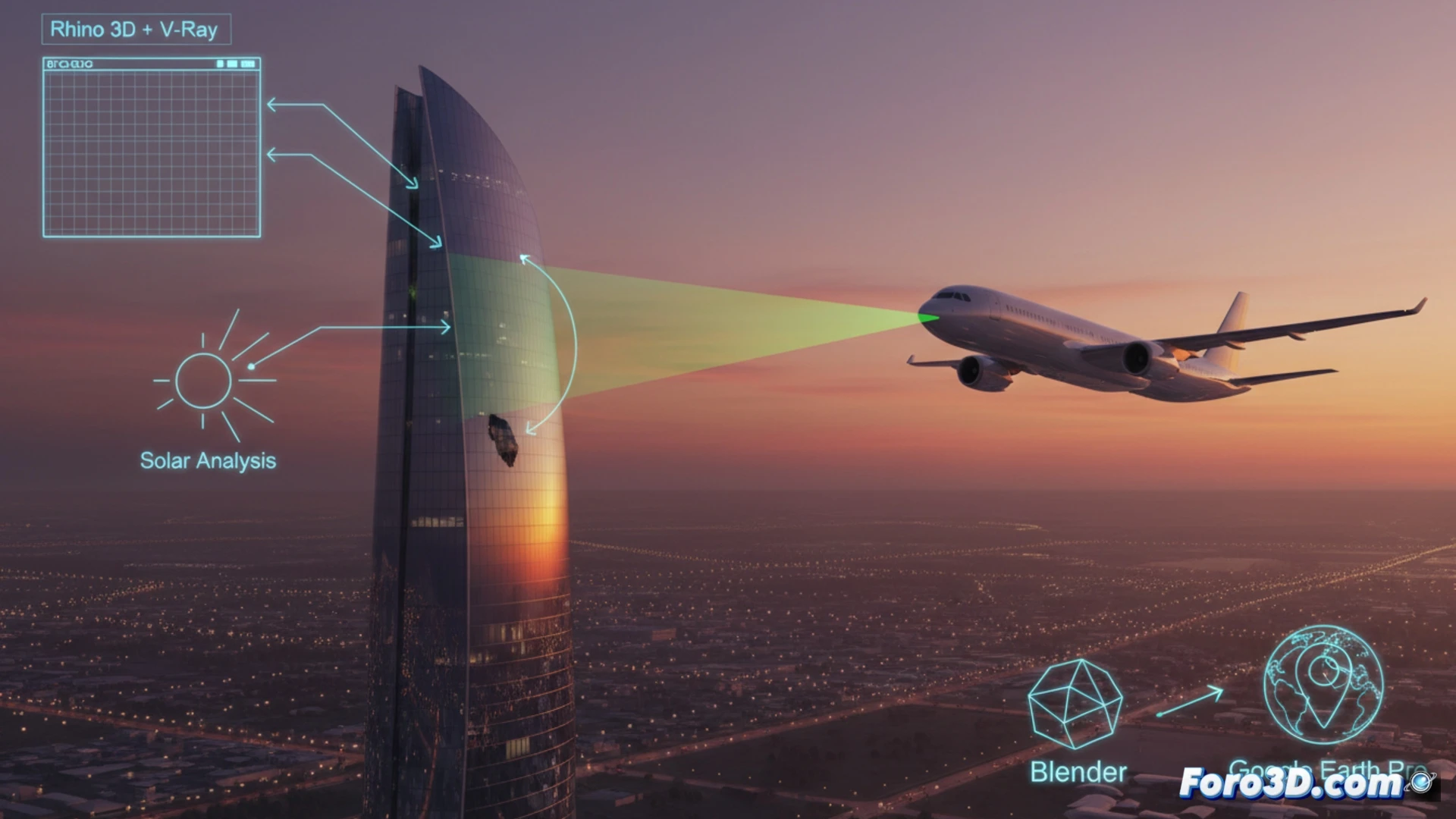
Multidisciplinary simulation: from Google Earth to ray physics 🛸
The workflow began with capturing geospatial data in Google Earth Pro to extract the exact geometry of the building and the aircraft's trajectory. Subsequently, the curved surface was modeled in Rhino 3D, applying physical properties of specular reflectivity in V-Ray. The critical point was the simulation of the beam reflection: the laser's angle of incidence, combined with the curvature of the glass, caused the rays not to scatter randomly, but to converge at a specific focal point. Blender was used to animate the trajectory and verify the temporal coincidence between the laser pulse and the aircraft's position, demonstrating that the building acted as an unintended concave mirror.
Passive protection: how 3D simulation saves lives 🛡️
This methodology allows for the design of early warning systems that identify buildings with critical curvatures in air approach zones. 3D models offer a verification tool for future urban lighting regulations, prohibiting laser installations near airports or requiring reflective impact studies for facades. For pilots and passengers, simulation is no longer just theory: it is visual proof that a city's geometry can become an unintentional weapon, and that prevention begins with accurate rendering.
Considering that the study showed the building's curved geometry concentrated the laser radiation, what architectural design measures or urban safety protocols would you propose to prevent this type of risk in spaces frequented by vulnerable groups such as pedestrians or ophthalmology patients?
(PS: protecting the military is like protecting your Blender file: back it up or cry later)