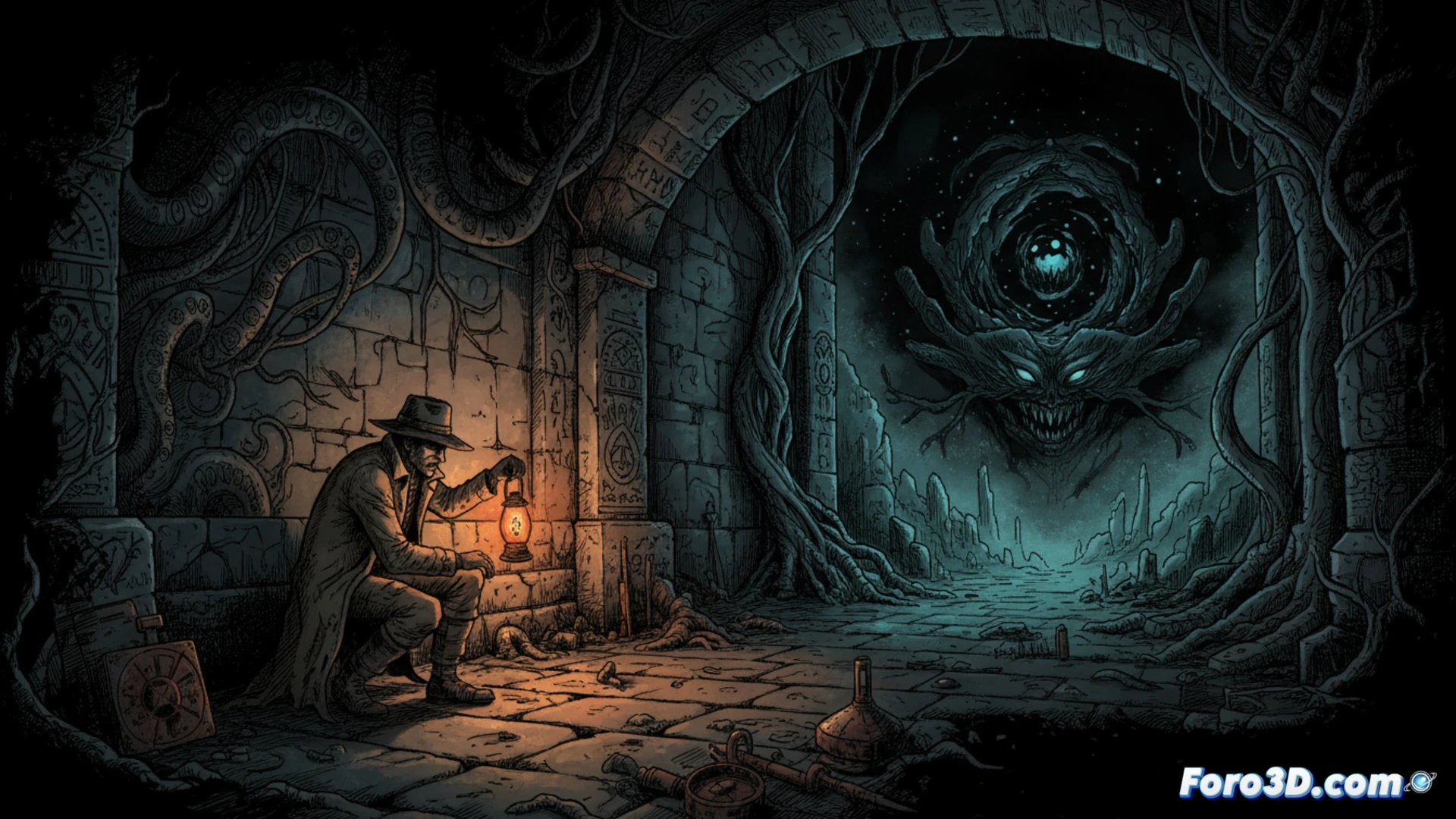
The indie survival horror game Edge of Sanity demonstrates how a small team can achieve an oppressive atmosphere using accessible tools. Developed in Unity, the game bets on a hand-drawn 2D style that evokes the classic illustrations of H.P. Lovecraft. The key to its visual success lies in an artistic pipeline that combines texture treatment in Photoshop with a dynamic real-time lighting system within the game engine.
Technical Pipeline: Photoshop and Shaders in Unity 🎨
To achieve the nightmarish aesthetic, artists digitize each sprite in Photoshop, applying textured brushes and desaturated color palettes that mimic the inking of old lithographs. The technical challenge arises when integrating these 2D images into Unity. Here, custom shaders are applied that simulate projected shadows and light gradients. Unity's 2D lighting system, enhanced with point and area lights, allows backgrounds to react in real-time to the player's flashlight position, creating an extreme contrast between darkness and illuminated elements, essential for the horror genre.
Visual Narrative and Real-Time Optimization 💡
Beyond technique, Edge of Sanity uses lighting as a narrative mechanism. Shadow areas not only hide enemies but also distort the perception of the scene, reflecting the protagonist's mental corruption. To maintain real-time performance, the team optimized sprites using texture atlases and limited the number of active lights per scene. This balance between the artistic fidelity of hand-drawn art and the engine's demands demonstrates that 2D horror can be as immersive as any triple-A production.
As an indie developer, what 2D lighting techniques in Unity do you recommend to achieve an oppressive Lovecraftian atmosphere without sacrificing performance in small projects?
(PS: 90% of development time is polishing, the other 90% is fixing bugs)