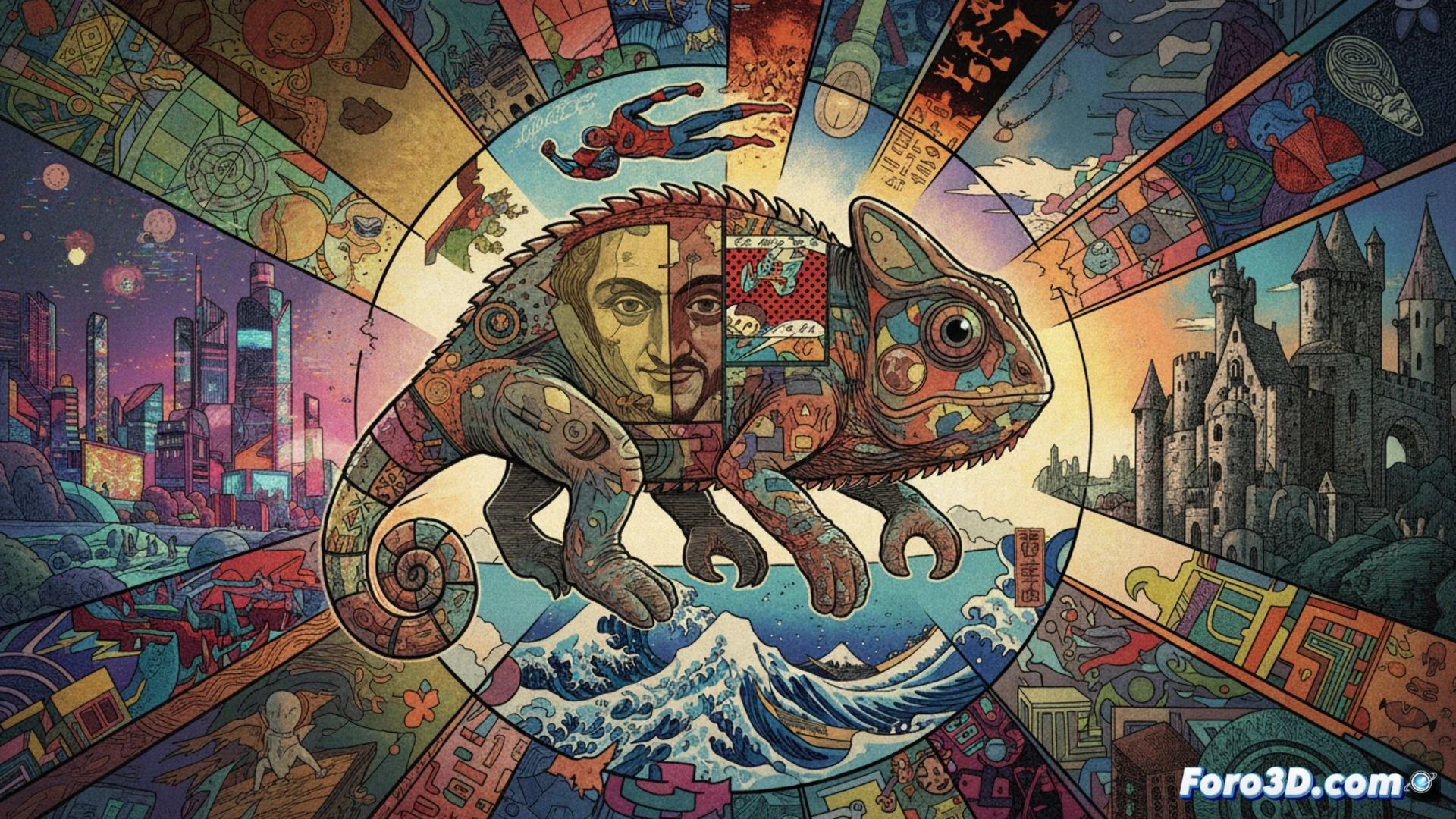
The work Echolands, created by J.H. Williams III and W. Haden Blackman, presents a narrative premise as ambitious as its graphic execution: a young thief must escape from a tyrant wizard in a city where pirates, robots, and vampires converge—in other words, all eras of fiction. However, the true protagonist is the visual language. Williams III deploys his chameleonic ability to mutate artistic styles within a single page, breaking the traditional homogeneity of comics. This decision is not mere technical showmanship but a statement of principles about the hybrid nature of contemporary art.
Stylistic mutation techniques: from brush to digital modeling 🎨
Williams III uses an approach reminiscent of layer composition in 3D software like Blender or ZBrush. In a single panel, he can alternate between a clear line of flat inks, a digital oil painting finish, and textures that imitate wood engraving. This is not random: each style corresponds to a character or faction. Robots appear with a hard, metallic render, vampires with a Baroque chiaroscuro, and pirates with a worn watercolor aesthetic. The transition between them is achieved through brush gradients and layer masks—techniques any digital artist recognizes as part of a non-destructive workflow. The page thus becomes a canvas where vectors, bitmaps, and material simulations coexist, challenging the rigidity of the printed format.
Aesthetic activism: the comic as a manifesto of visual diversity ✊
This explosion of styles is not a simple exercise in virtuosity. In the context of digital art and activism, Echolands functions as a manifesto. It rejects the idea that an artist must have a single visual voice, instead embracing multiplicity as a tool of resistance against market homogenization. Williams III demonstrates that digital technology does not impoverish art but allows for the hybridization of historical techniques (etching, watercolor) with modern processes (3D modeling, post-production). It is a cry for complexity in an era that often rewards viral simplicity. The work invites the reader to be an archaeologist of styles, to recognize that each stroke is a political and aesthetic choice that expands the boundaries of what a comic can be.
How does J.H. Williams III's visual chameleonism in Echolands function as an artistic manifesto for digital activism, challenging the narrative and aesthetic conventions of traditional comics?
(PS: at Foro3D we believe all art is political, especially when the computer freezes)