Nvidia Earth-2 represents a qualitative leap in the world of digital twins. While most of these models are limited to replicating factories, turbines, or cities, Earth-2 builds a virtual replica of the entire planet Earth. Its goal is to simulate global climate with unprecedented precision and speed, combining massive supercomputing with neural networks trained on petabytes of satellite and historical data.
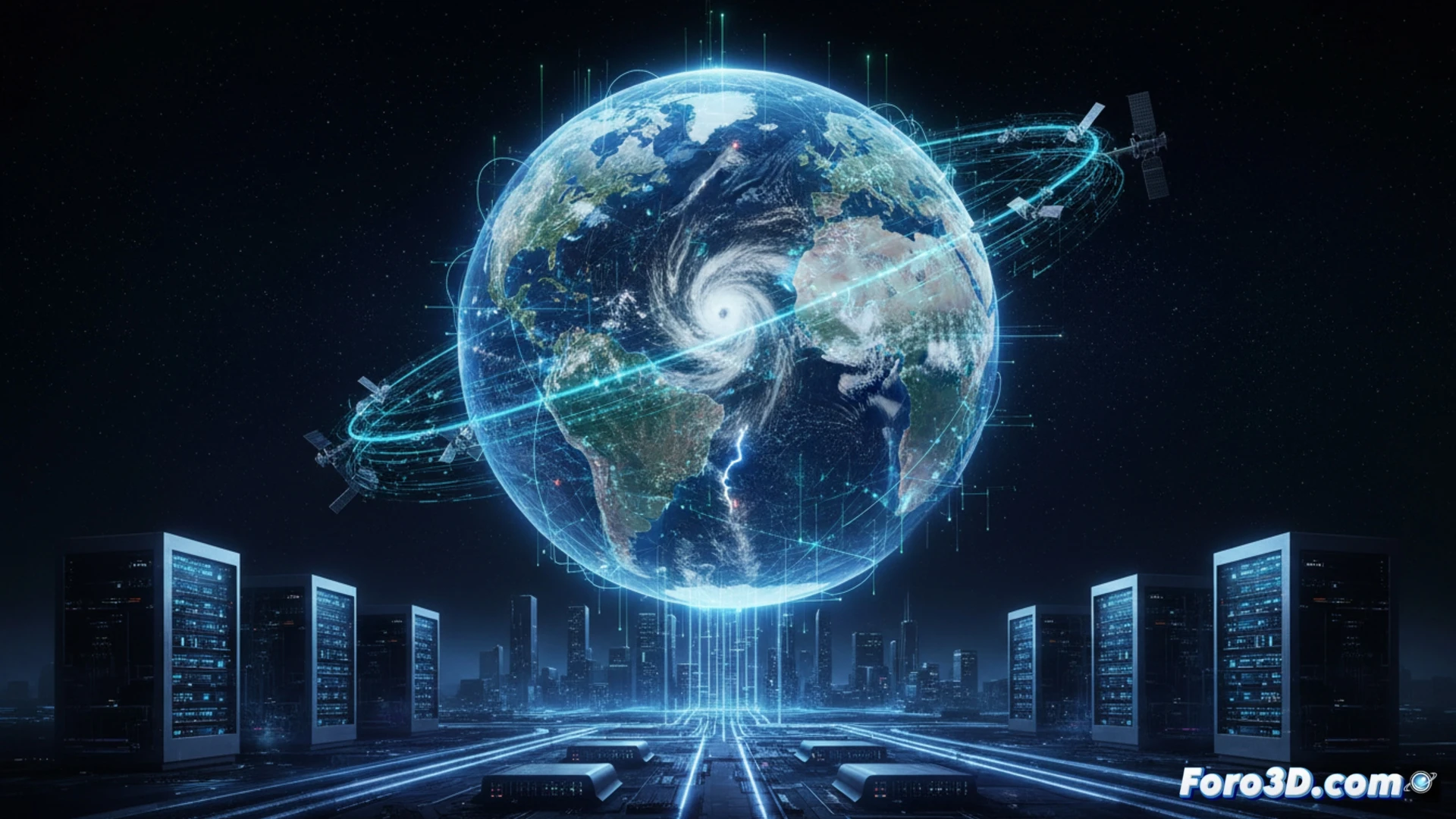
Technical architecture and model scalability 🌐
The platform relies on Nvidia's Modulus simulation engine and the DGX GH200 supercomputer. The technical key lies in the use of Physics-Informed Neural Networks (PINNs), which integrate the physical equations of the atmosphere directly into the AI training. This allows Earth-2 to solve climate predictions at a resolution of 2 kilometers per pixel, a detail 40 times higher than traditional models. Additionally, inference is accelerated through the Earth-2 Inference (E2I) framework, capable of generating 30-day forecasts in seconds, a process that previously required hours of computation.
From industrial twin to planetary twin: implications ⚡
Unlike a digital twin of an assembly line, the Earth twin must deal with chaotic and non-linear variables. Earth-2's true innovation is its ability to perform massive ensemble simulations, running thousands of climate scenarios in parallel. This has direct applications in disaster prevention, allowing governments and insurers to model hurricane trajectories or drought patterns with a lead time and reliability that redefines urban planning and water resource management.
As a digital twin developer, what technical and scaling barriers does the implementation of a model like Earth-2 face to achieve hyperlocal real-time climate predictions, and how does its generative AI architecture compare to traditional weather simulations?
(PS: My digital twin is right now in a meeting, while I am here modeling. So technically, I am in two places at once.)