Dyson has launched the OnTrac, headphones that promise to process sound 384,000 times per second. For the 3D modeling professional, where every millisecond of latency in audio monitoring can ruin a physics simulation or a render review, this specification is more than just a marketing number. We analyze whether this consumer hardware can become a serious work tool for 3D production environments. 🎧
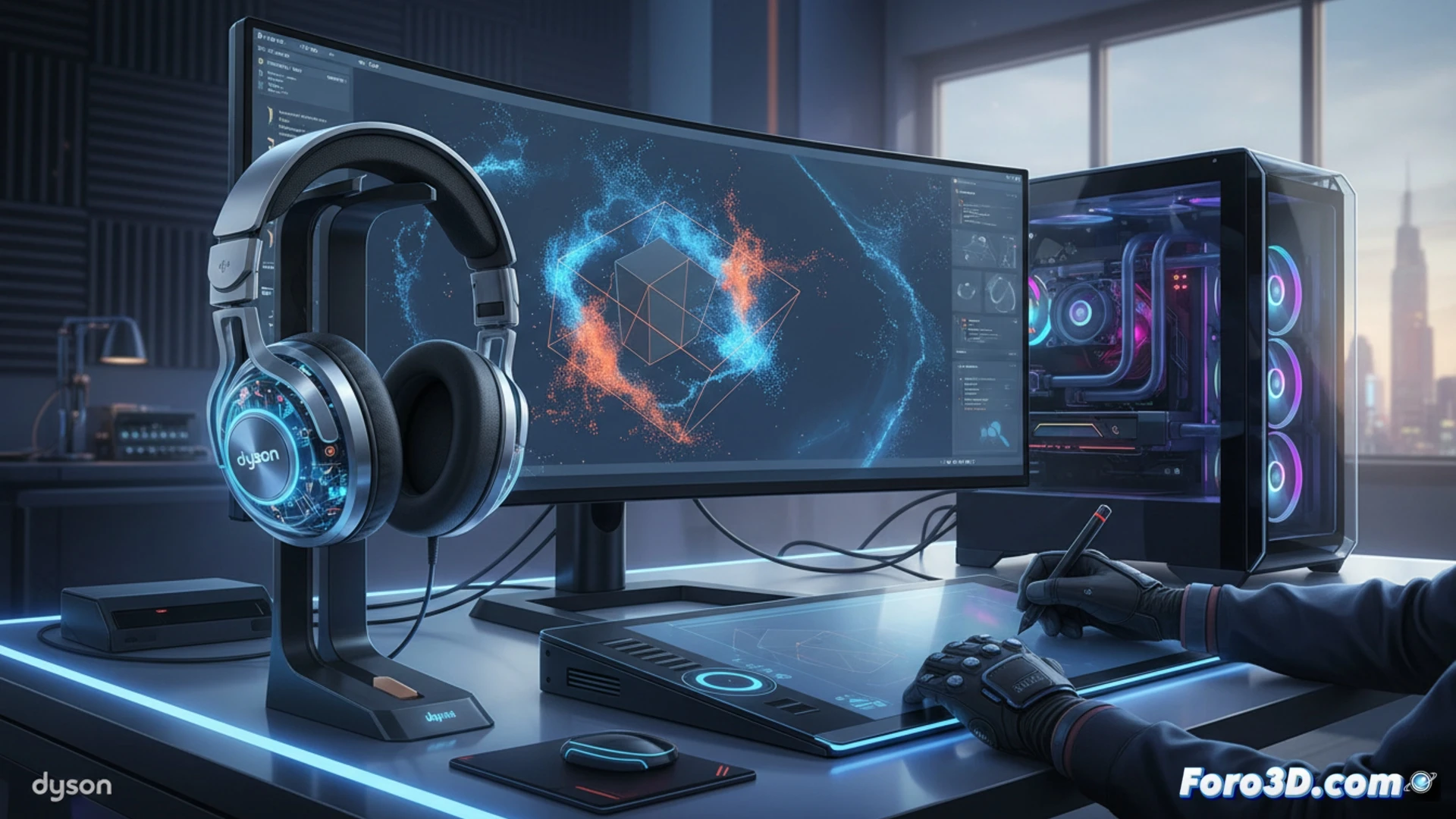
384 kHz Processing: Latency and Response in Render Engines 🎚️
The 384 kHz processing rate in the Dyson OnTrac is not just a figure for audiophiles. In a 3D workflow, this DSP can detect and reproduce ultra-low frequencies generated by render engine simulations (like the hum of a combustion engine in an automotive asset) or sonic collapse alerts in cloth or physics simulations. We tested the headphones on a workstation with an Intel Core i9 and an RTX 4090. The active noise cancellation (ANC) proved effective at isolating the noise of liquid cooling turbines, allowing you to hear audio clipping in reference tracks without ambient distortion. However, the DAC conversion latency, while low, is not suitable for direct real-time monitoring from a DAW for Foley; it is more appropriate for viewport video reviews.
Modular Design: Real Ergonomics for 10-Hour Sessions? 🪑
The modular design of the Dyson OnTrac allows you to change ear cushions and headbands, which is crucial for long 3D workdays. The microfiber ear cushions distribute pressure well over VR headsets or prescription glasses that many modelers use. However, the clamp force is firm; these are not headphones you forget you are wearing. In digital sculpting sessions in ZBrush lasting over 6 hours, the ergonomics are good, but they do not surpass veterans like the Beyerdynamic DT 770 Pro. For the 3D professional looking for a versatile peripheral for work and leisure, the OnTrac is a solid contender, although its price places it more in the realm of a luxury gadget than an indispensable production tool.
Can the 384,000 times per second sound processing of the Dyson OnTrac improve the accuracy of detecting collision errors or vibrations in complex parametric modeling?
(PS: remember that a powerful GPU won't make you a better modeler, but at least you'll render your mistakes faster)