The Dyson AirLight Pro represents a technological leap in hair dryer design, integrating infrared light and high-pressure air to minimize thermal damage. From a 3D product design perspective, this device offers a fascinating case study: its engineered casing, airflow optimization, and LED integration require precise modeling and photorealistic rendering to communicate its innovation in marketing campaigns and virtual prototyping.
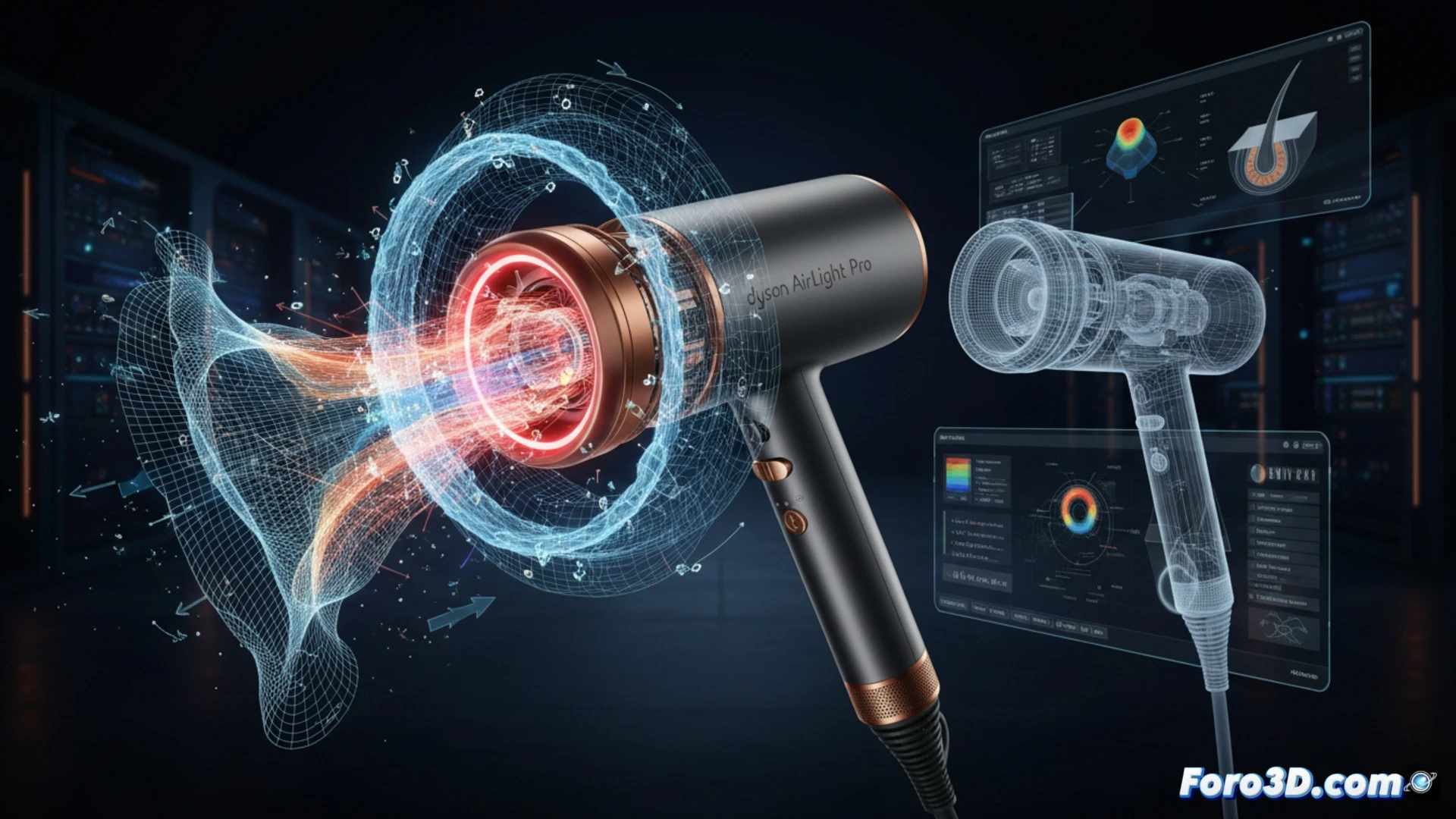
Casing modeling and 3D airflow simulation 🔧
Modeling the Dyson AirLight Pro requires mastering complex, organic surfaces. Its cylindrical body and aerodynamic nozzle benefit from NURBS modeling in software like Rhino or SolidWorks, enabling Class A curves that reflect light uniformly. CFD (Computational Fluid Dynamics) simulation is key to replicating high-pressure airflow and infrared light dispersion. Tools like Ansys or SimScale allow visualization of how hot air is channeled without dead zones, optimizing ergonomics and reducing virtual weight before mold manufacturing. Compared to traditional dryers, the AirLight Pro requires finer meshing on the intake grilles to capture controlled turbulence.
Photorealistic rendering and virtual thermal validation 💡
To present the product in digital catalogs, photorealistic rendering with engines like KeyShot or V-Ray must simulate the satin gloss of high-performance plastics and the metallic texture of infrared LEDs. HDRI lighting helps recreate a salon environment, while IOR (Index of Refraction) material mapping for the light lens ensures accuracy. This 3D approach allows thermal efficiency validation: by simulating residual heat on a virtual hair model, designers adjust the safety distance and surface temperature, ensuring the final product protects the hair cuticle without costly physical prototypes.
How would you model in 3D the integration of the infrared light source with the airflow in the Dyson AirLight Pro to simulate its thermal and aerodynamic behavior?
(PS: Designing a product in 3D is like being an architect, but without having to worry about the bricks.)