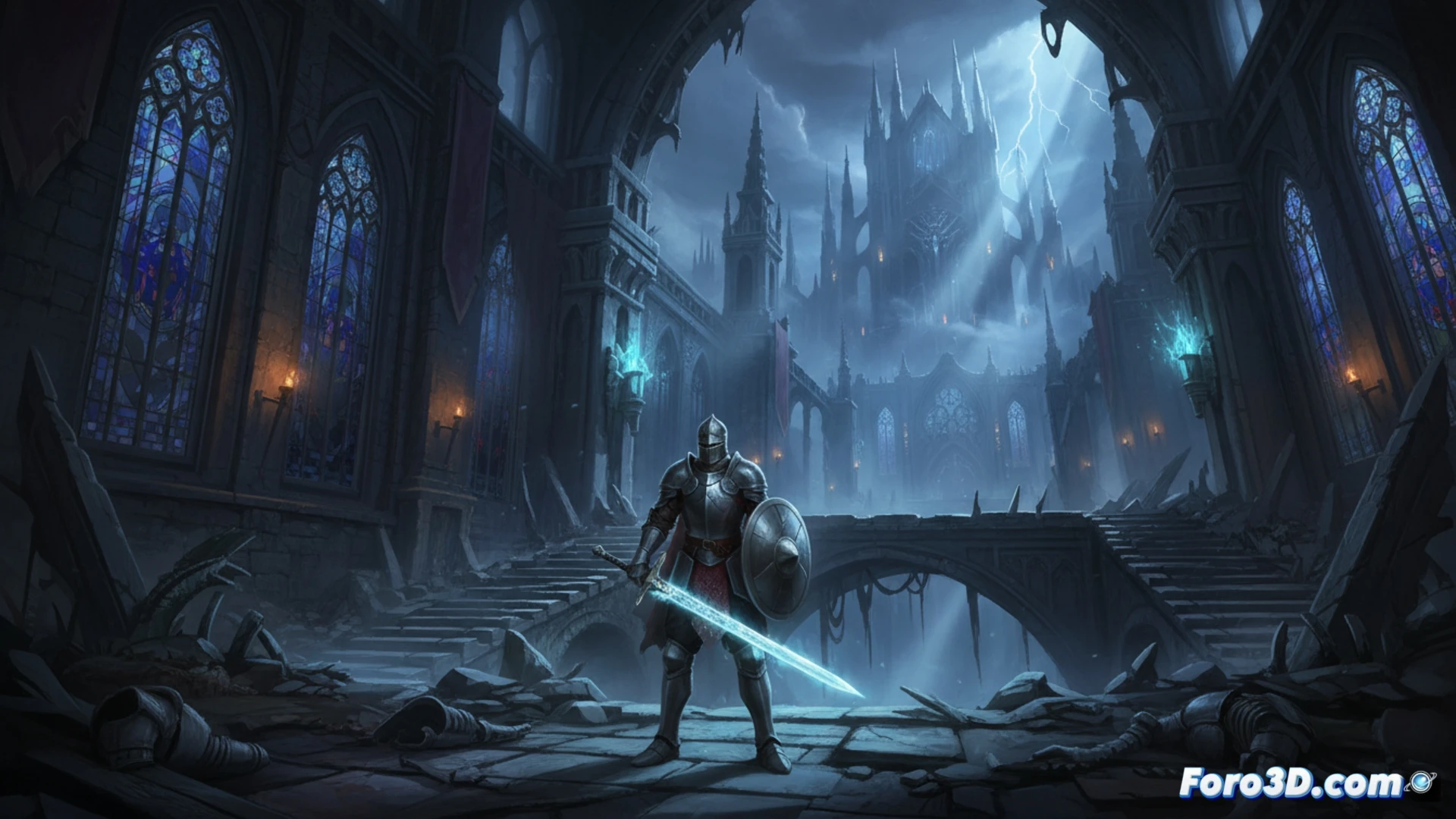
Mithril Interactive has released Dungeonborne, a first-person dungeon crawler that demonstrates how Unreal Engine 5 can be used to create oppressive atmospheres. The title stands out not only for its gameplay but also for an artistic direction that fully exploits the Lumen dynamic lighting system. Below, we analyze the tools and techniques used to achieve that extreme contrast between light and shadow, a pillar of the Gothic style.
Technical Implementation of Lumen and Substance 3D 🎮
The visual core of Dungeonborne lies in the use of Lumen for real-time global illumination calculations. Instead of relying on baked static lights, the team configured Lumen with aggressive occlusion values. This allows a single candle in a dungeon to generate deep, elongated shadows, while reflections on metallic surfaces (such as armor) update instantly. For textures, Adobe Substance 3D Designer was used. Stone and rotten wood materials were designed with very high roughness maps and low metallic values, ensuring that light bounces realistically but absorbently. A technical tip for indies: when configuring Lumen, reduce the number of light bounces to 1 or 2. This sacrifices a bit of physical realism, but enhances dramatic contrast and improves performance in closed scenes.
Spatial Audio as an Immersive Pillar 🔊
Immersion depends not only on visuals. Dungeonborne implements advanced stereophonic spatial audio. The developers used positional audio plugins within Unreal Engine to simulate the reverberation of footsteps in stone vaults and the echo of doors closing. Technically, this is achieved by assigning very short attenuation curves for nearby sounds and low-pass filters for distant sounds. For an indie, it is key not to saturate the mix: prioritize ambient sounds (water dripping, creaks) over music, as silence and sonic contrasts reinforce the visual tension of the shadows.
How Mithril Interactive has optimized the use of Lumen and Nanite in Dungeonborne to maintain stable performance without sacrificing dynamic lighting and geometric detail in its Gothic aesthetic in Unreal Engine 5
(PS: 90% of development time is polishing, the other 90% is fixing bugs)