The facade cleaning industry, anchored in 19th-century manual methods, is being replaced by autonomous drones in China. With more than half of the world's tallest skyscrapers, the country faced a critical logistical and safety challenge. The state plan Robot+ has driven this transformation, where drones not only reduce the risk of fatal falls for workers but also optimize operational costs. At Nanchang train station, these robots already perform complete glass cleaning, marking a milestone in high-risk industrial automation.
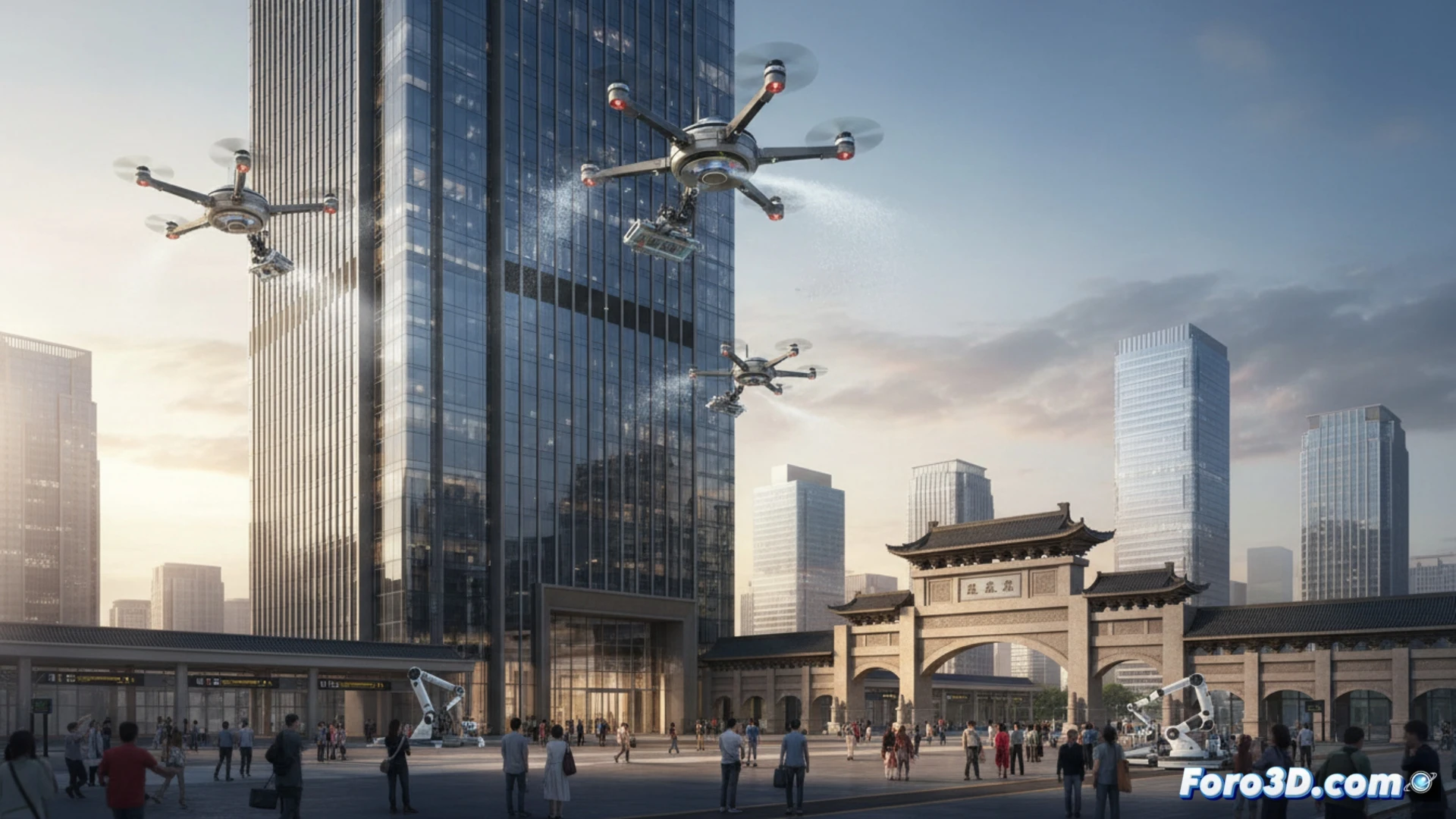
3D modeling and trajectory simulation for cleaning drones 🚁
From a robotics perspective, the integration of these drones requires a precise technical workflow. The first step is 3D modeling of the drone, including its chassis, rotors, and cleaning fluid tanks, as well as the attachment system for vertical facades. Subsequently, trajectory simulation is performed in virtual environments that replicate real skyscrapers. Using polygonal meshes of the building, optimal sweeping routes are calculated that avoid obstacles such as window frames or ledges. This simulation phase allows testing collision avoidance algorithms and adjusting the pressure of robotic brushes without risking the actual structure. Tools like Blender or Unity are ideal for rendering these animations and validating process efficiency before physical deployment.
The future of vertical work and collaborative robotics 🤖
The replacement of human window cleaners by drones is not just a matter of efficiency, but a paradigm shift in workplace safety. By removing the human factor from dangerous environments, collaborative robotics redefines the operator's role, transitioning from executor to supervisor and maintainer of the drone fleet. The challenge now is to standardize these systems for different skyscraper architectures and climates. The question that arises is whether future cities will design their facades with autonomous drones in mind, integrating them as part of the smart urban landscape, or whether adaptation will remain a task of reactive engineering.
What implications does the replacement of manual skyscraper cleaning by autonomous drones in China have for precision engineering and UAV design?
(PS: Simulating robots is fun, until they decide not to follow your orders.)