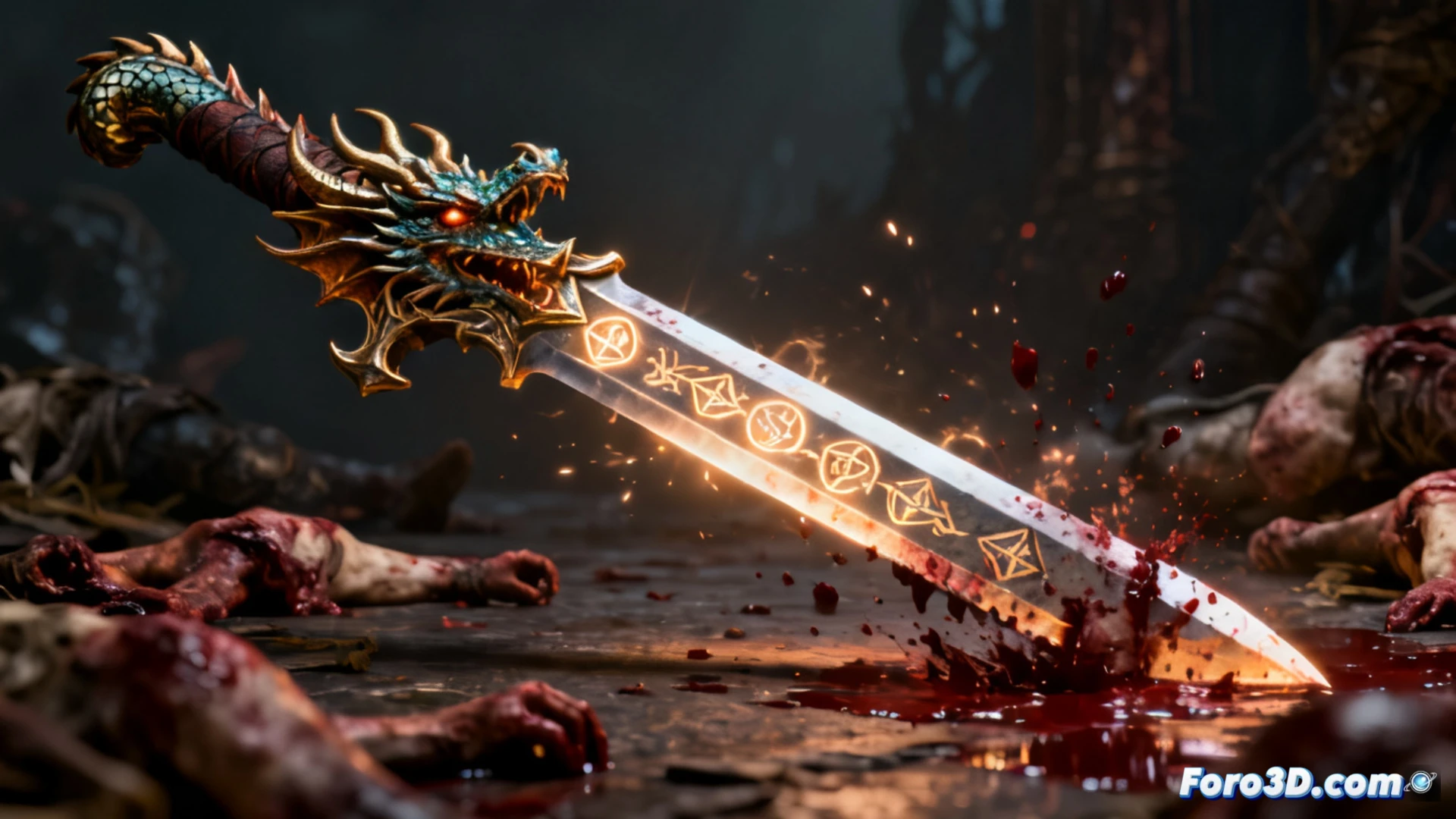
Hound 13 studio has unveiled Dragon Sword, an action RPG that redefines graphic violence through the use of Unreal Engine 5. The title stands out for its dynamic dismemberment system and impact physics, achieving a level of photorealism that competes with AAA productions. The key to this realism lies in a technical pipeline that combines high-fidelity 3D scanning, digital sculpting in ZBrush, and the power of UE5's microgeometry.
Technical Pipeline: Scanning, ZBrush, and Impact Physics 🛠️
To achieve the organic detail of enemies, the team uses 3D scanning of real models as a base, capturing textures of skin, armor, and fabrics. This data is refined in ZBrush, where fracture points and layers of muscle, tendon, and bone that will be exposed after dismemberment are sculpted. UE5's physics engine handles calculating the weight, inertia, and resistance of each severed limb, applying torsion and cutting forces in real-time. Blood particles and armor fragments are generated using the Niagara system, while the Chaos bone system allows limbs to separate cleanly without breaking the animation of the rest of the body.
Implications for Action RPG Development 🎮
The implementation of these techniques in Dragon Sword raises the immersion standard for the genre. For developers, the challenge is not just graphical but also optimization: maintaining stable 60 fps with multiple enemies dismembered simultaneously requires efficient use of dynamic LODs and geometry culling. Furthermore, integrating realistic impact physics forces a rethinking of combat design, where each blow must have visible consequences on the opponent's model. Dragon Sword demonstrates that photorealism and reactive gameplay can converge without sacrificing performance.
How does Dragon Sword achieve, through Unreal Engine 5, the balance between photorealistic dismemberment and fluid gameplay without sacrificing optimization on mid-range hardware?
(PS: optimizing for mobile is like trying to fit an elephant into a Mini Cooper)