On April 14, 1935, the sky over the American Midwest turned black. A mass of dust 300 meters high buried Oklahoma and Texas in darkness, causing dust pneumonia in the population. For a VFX pipeline, this phenomenon represents a complex technical challenge: simulating the density of an aerosol that blocks sunlight, combining fluid dynamics and atmospheric chemistry in real time.
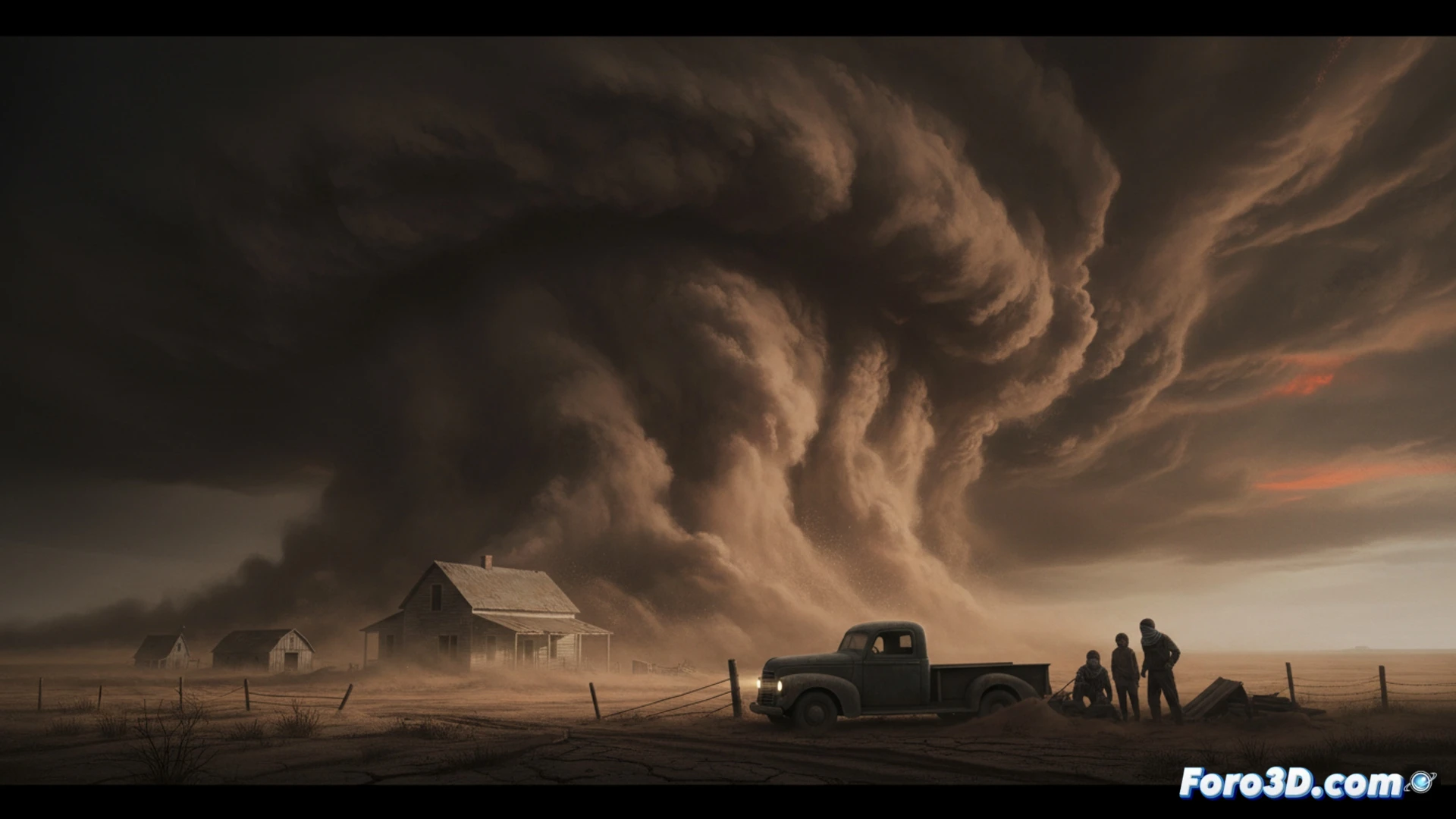
Fluid dynamics and chemical modeling for massive aerosols 🌪️
Accurate recreation begins in Houdini with an aerosol-based smoke and particle simulation. Using the Pyro solver, an extremely high particle density (millions of points) is configured with a velocity field mimicking winds up to 100 km/h. The key lies in the drag force and anisotropic turbulence so that fine silt particles behave like a dense fluid. For scientific precision, data from WRF-Chem, an atmospheric chemistry model that measures PM10 particle concentration, is integrated. These values are translated into scattering and absorption attributes in Houdini, allowing the dust fog to have a realistic ochre color rather than a simple gray.
Volumetric lighting and the moment the day goes dark 💡
The critical moment is the transition from daylight to pitch darkness. In Unreal Engine 5, this is achieved with an exponential volumetric fog system combined with a layered dust material. The key is to use Lumen for dynamic global illumination, but with extreme scattering that cancels out direct light. A blueprint is programmed so that, upon reaching a certain particle density, it reduces the Directional Light intensity to nearly zero. The result is a render where the dust is not merely decorative, but the main actor transforming the scene into a hell of suspended particles.
What do you think about this advancement?