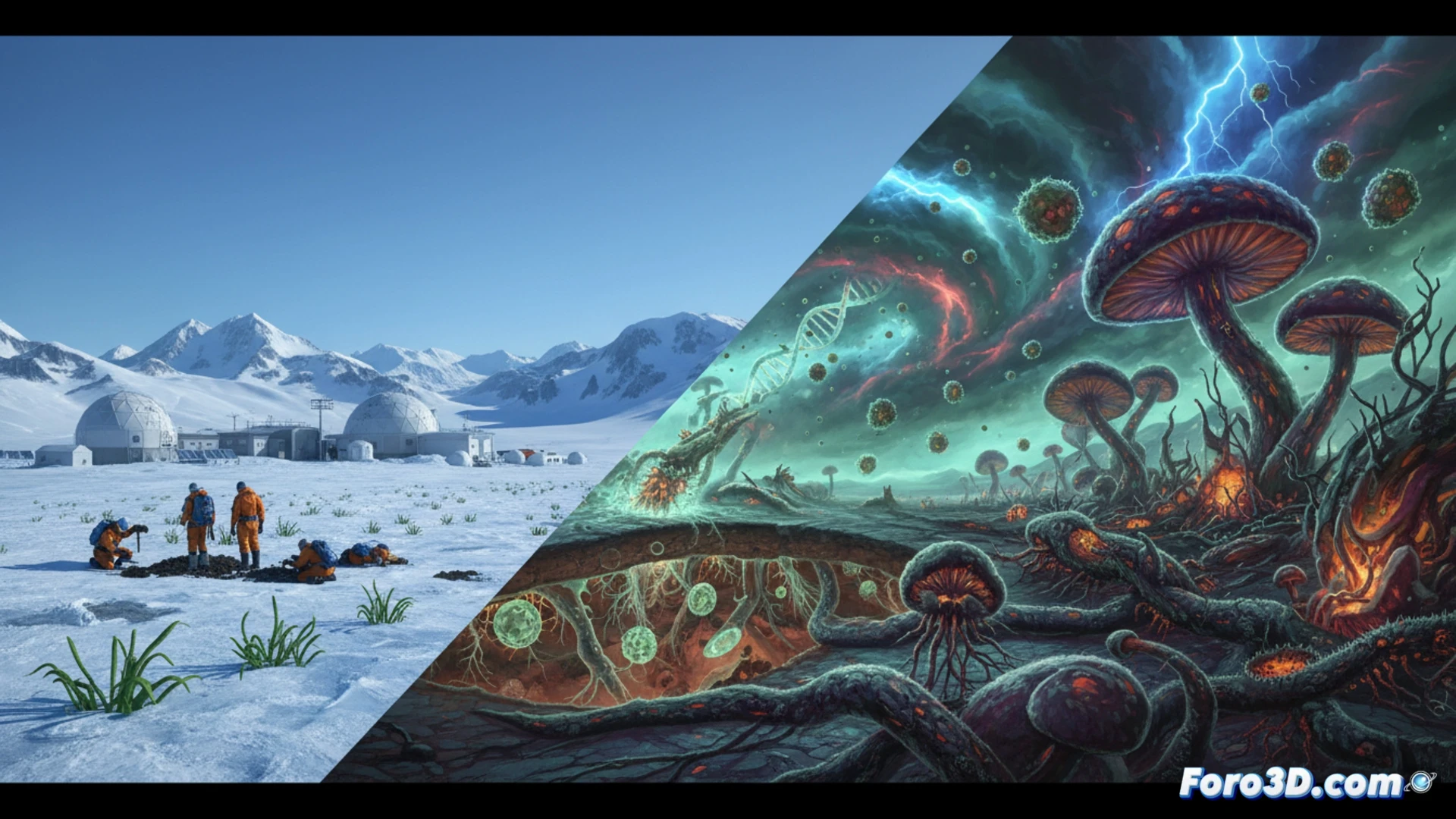
A recent study in Global Change Biology reveals that global warming not only melts Antarctic ice but also activates a silent threat: pathogenic fungi. Researchers from the British Antarctic Survey analyzed fungal DNA in over 50 soil samples from Chile to the Antarctic Peninsula, demonstrating that higher temperatures lead to greater abundance and diversity of these organisms harmful to native plants.
3D Modeling of Fungal Data and Projections for 2100 🧊
To visually represent this phenomenon, we propose an interactive 3D visualization of the Antarctic Peninsula with three overlapping layers: surface temperature, distribution of fungal colonies, and vegetation cover. The model should include an adjustable timeline from the present to 2100 under high-emission scenarios. As time advances, the growth of pathogenic fungal colonies (represented as spheres or organic meshes in red and orange) would be animated over the expanding ice-free soil. Fungal abundance data would double in coastal areas, while native vegetation (such as Antarctic grass) would be shown in decline or with visible damage.
Visual Lessons from Past Catastrophes 🍄
The potential impact of a single new pathogen on a defenseless ecosystem is devastating. For context, the visualization can include comparative panels with historical cases: chestnut blight in North America (which eliminated billions of trees) and Dutch elm disease in Europe. These examples, represented in 3D as maps showing the advance of necrotic patches, would help the viewer understand the real risk faced by Antarctic flora, an isolated ecosystem with no evolutionary adaptation to these emerging fungi.
How can the dispersal mechanisms of fungal spores in the Antarctic atmosphere be modeled in 3D to predict their advance under different climate scenarios?
(PS: fluid physics for simulating the ocean is like the sea: unpredictable and you always run out of RAM)