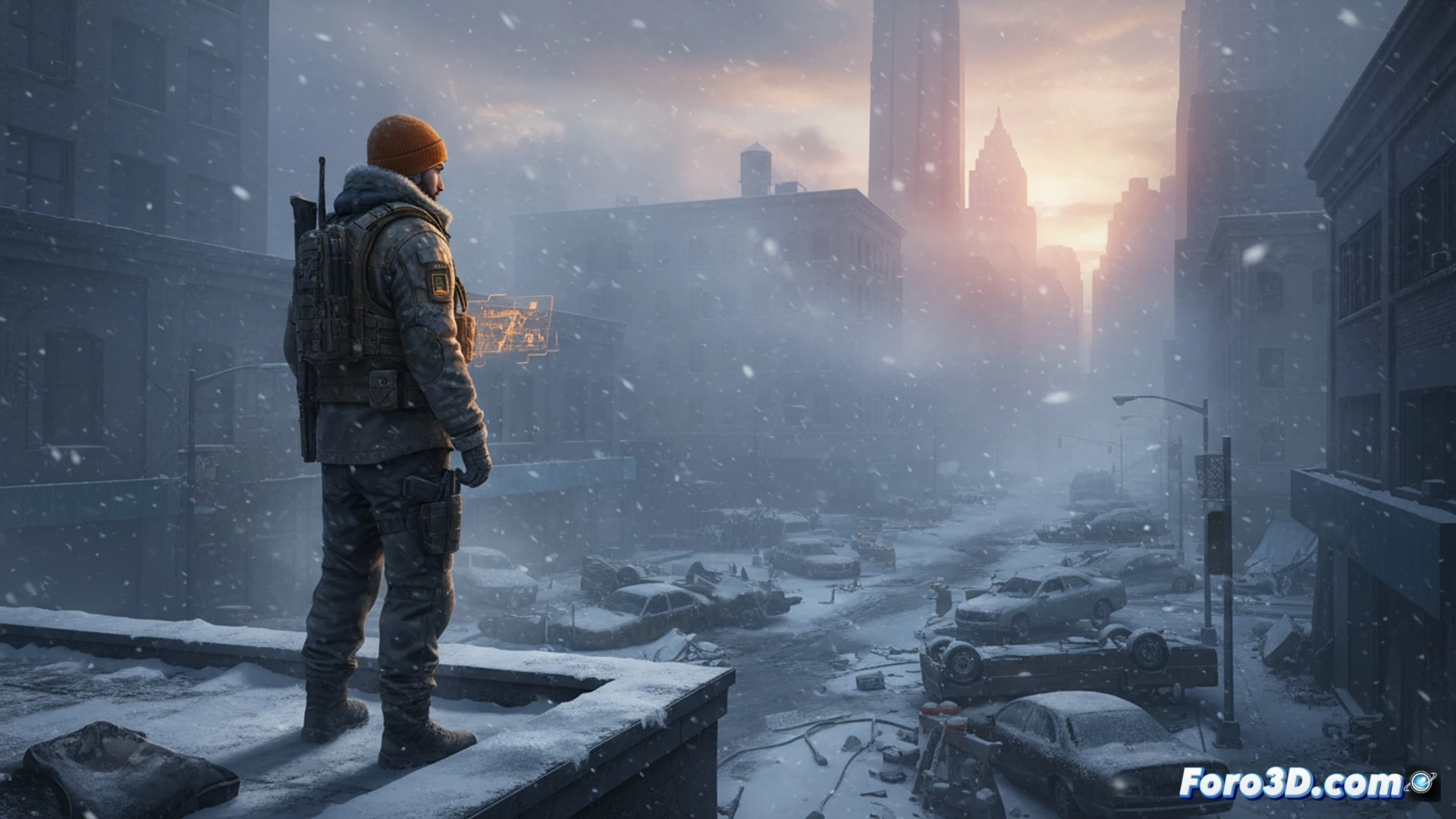
The launch of The Division Resurgence for mobile devices has reopened the debate on the technical limits of Unreal Engine 4 on limited hardware. Ubisoft has achieved a milestone by bringing the dense winter atmosphere of New York to smartphones, maintaining the dynamic snow and volumetric fog that characterize the saga. The inevitable question for any developer is: how did they manage to compress a console open world into a mobile chip without losing the visual identity.
Real-time particle and geometry optimization 🎮
The development team implemented an aggressive polygon reduction system for building and vehicle models, going from meshes of 50,000 to 8,000 triangles for objects closest to the player. For volumetric fog, they replaced global scattering calculations with a system of overlapping translucent planes that simulate depth with a 60% lower computational cost. Real-time snow was optimized using compressed textures in ASTC format with resolution reduced by 50% on distant particles, and specular reflections on wet surfaces were sacrificed to maintain stable 30 fps. Developers confirmed in interviews that the biggest challenge was synchronizing dynamic lighting with the fog without generating aliasing artifacts on lower pixel density screens.
Portability lessons for indie studios 💡
Ubisoft's strategy demonstrates that the key is not to replicate graphical power, but to prioritize atmospheric coherence over individual detail. When comparing screenshots of the mobile version with the console one, a notable loss is observed in snow particle density and fog render distance, but the final result retains the feeling of cold and abandonment. For small studios, the message is clear: it's better to invest time in low-cost shaders and a limited color palette than to force high-fidelity assets. Volumetric fog, if implemented with fake planes and a well-calibrated opacity gradient, can fool the human eye even on a mid-range processor.
How does the Division Resurgence team manage to implement volumetric fog on mobile devices using Unreal Engine without sacrificing real-time performance?
(PS: a game developer is someone who spends 1000 hours making a game that people complete in 2)