A helicopter pilot suffered a fatal accident after misjudging the distance to the ground during a night landing. The initial investigation pointed to human error, but forensic analysis revealed a more subtle cause: a defect in the night vision goggle (NVG). Using a pipeline that combined 3D scanning, optical simulation, and virtual recreation, it was demonstrated that the anti-reflective coating on the lenses had an irregular thickness, acting as a prismatic lens that shifted the pilot's visual horizon. 🚁
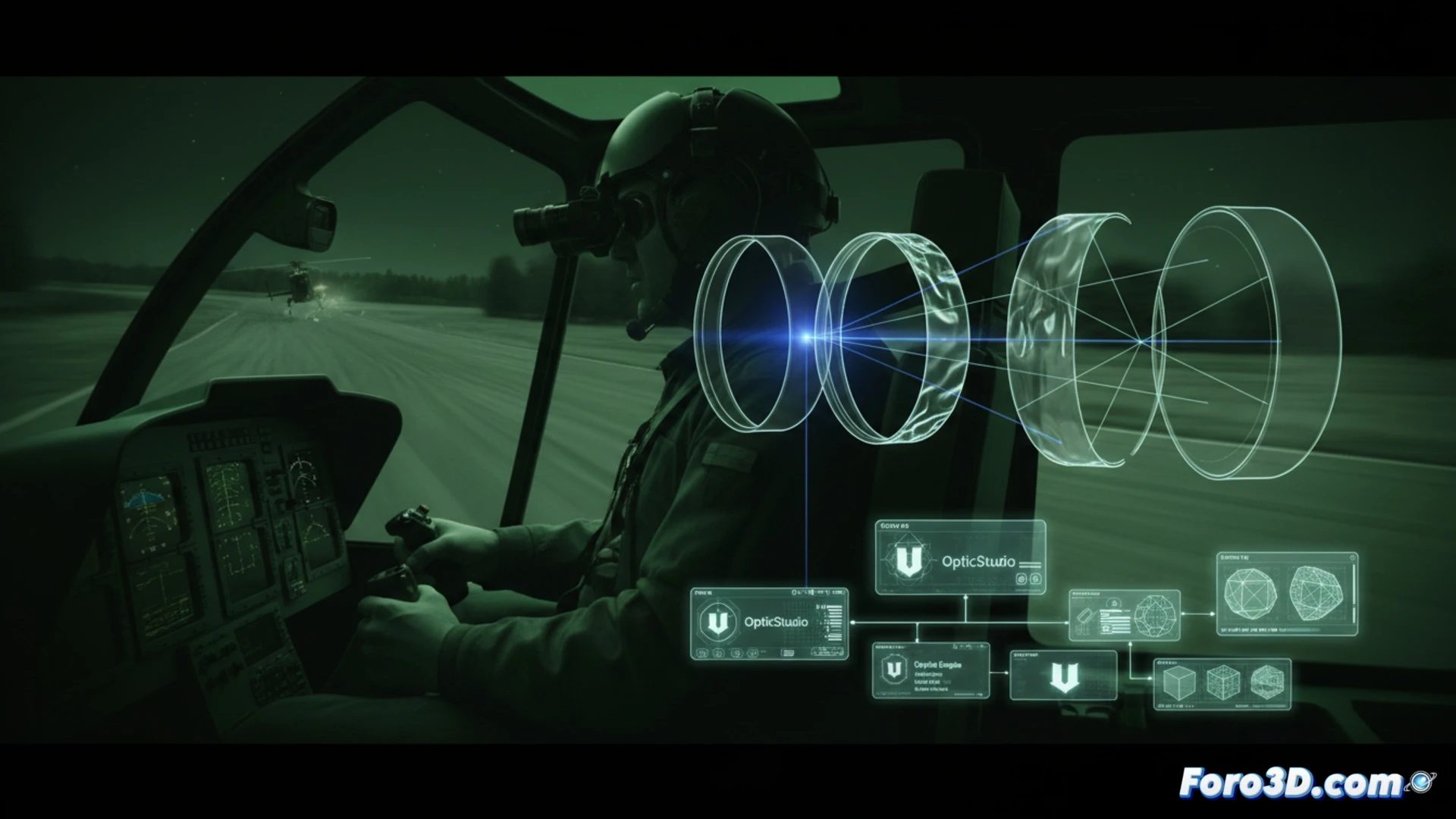
Forensic Pipeline: Scanning, Modeling, and Ray Tracing 🔬
The process began with digitizing the NVG lenses using a high-precision scanner, generating a point cloud that was imported into Rhino to reconstruct the exact surface geometry. This mesh was integrated into Code V and OpticStudio, where inverse ray tracing was applied. The model revealed that variations in coating thickness, mere microns, caused asymmetric refraction. This generated an angular displacement of the incoming light beam, equivalent to a 0.3-degree tilt in the horizon perceived by the pilot. The digital evidence was directly linked to the recorded flight path.
Visual Recreation and Lessons for Safety 🎮
To validate the finding, the optical model was exported to Unreal Engine, recreating the accident scene from the pilot's perspective. The simulation showed how the defect made the ground appear farther away than it actually was, triggering the erroneous maneuver. This case demonstrates that the forensic pipeline, combining 3D scanning, optical simulation, and virtual environments, is essential for identifying design flaws in critical equipment. The methodology not only clarifies causes but also establishes more rigorous standards for quality control in optical manufacturing.
How it can be determined whether a defect in the anti-reflective coating of a night vision goggle (NVG) generates an optical distortion dangerous enough to alter depth perception in low-altitude flight conditions.
(PS: don't forget to calibrate the laser scanner before documenting the scene... or you might be modeling a ghost)