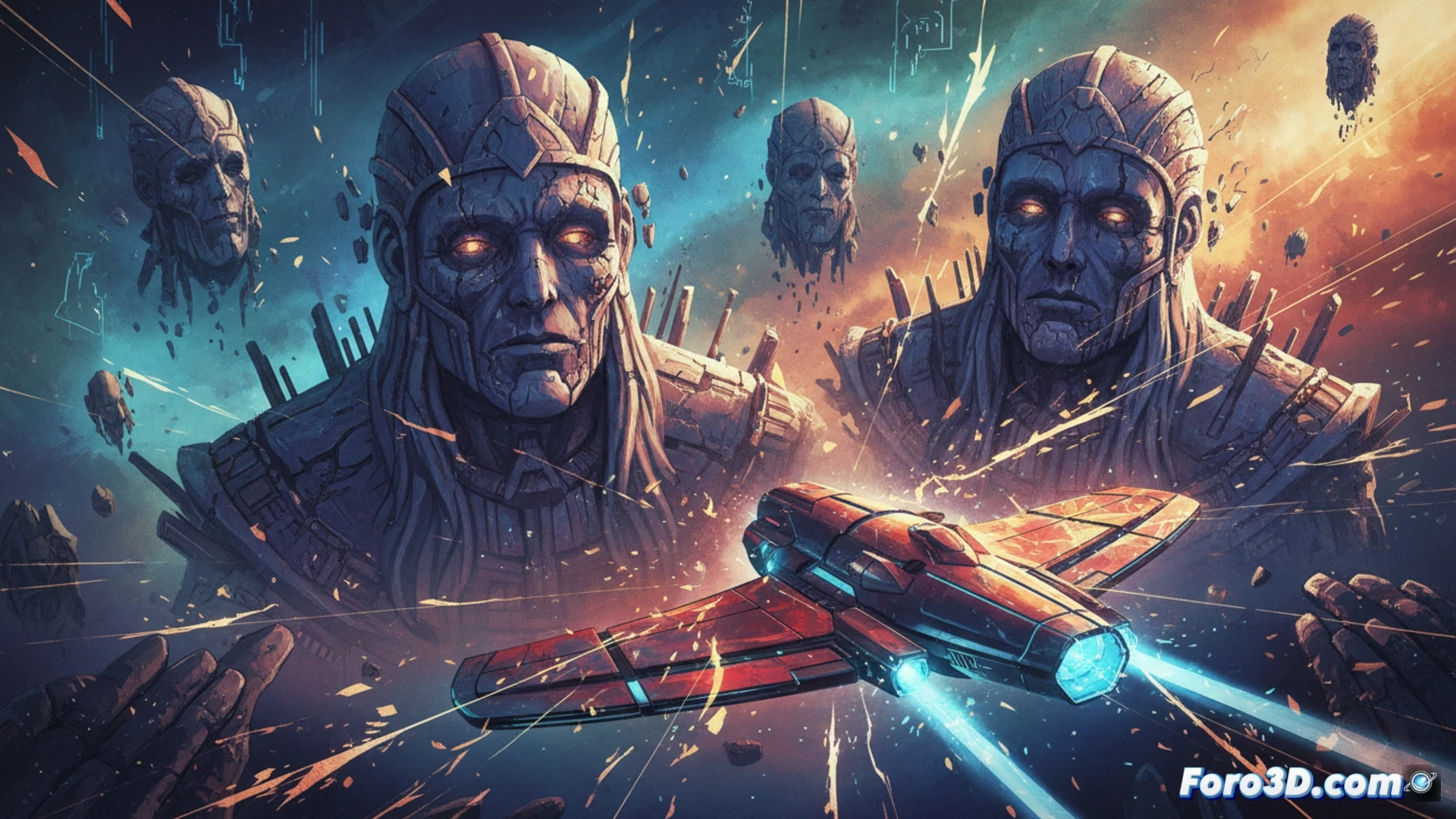
In We Only Find Them When They're Dead, writer Al Ewing and artist Simone Di Meo build a cosmos where humanity exploits divine corpses to survive. But the true revolution lies not in the existential plot, but in the visual execution. Di Meo breaks away from the traditional comic grid using digital tools to generate organic compositions and a psychedelic palette that transforms each page into a sensory experience. This article analyzes how the work expands the language of comics through digital colorimetry and 3D modeling techniques.
Digital colorimetry and breaking the classic grid 🎨
Di Meo's aesthetic relies on an aggressive use of digital color reminiscent of early net.art experiments and glitch aesthetics. Instead of filling panels with flat colors, the artist overlays gradients, pixelated textures, and extreme saturations that distort the perception of space. Page compositions abandon the rectangular grid: panels warp, merge into each other, or float over abstract backgrounds. This technique is not merely decorative; it reflects the instability of the narrative universe, where the divine and the industrial collide. The use of 3D tools to model ships and creatures allows for impossible angles that reinforce the sense of cosmic scale.
The visual activism of an exploited cosmos 🌌
Beyond the chromatic spectacle, the work presents a critique of extractivism and the reification of the sacred. The psychedelic aesthetic functions here as an act of visual resistance: by distorting forms and colors, Di Meo denies the reader a passive reading. Each page demands rereading, forcing one to question the relationship between humanity and the resources it consumes. In a context of digital art and activism, this comic stands as a visual manifesto demonstrating how digital tools can serve to dismantle hierarchical narratives and propose new ways of seeing the world.
How does Simone Di Meo use digital color to resignify the iconography of dead gods in We Only Find Them When They're Dead, and what implications does this have for digital art and activism in constructing new visual symbols of resistance?
(PS: digital political art is like an NFT: everyone talks about it but no one really knows what it is)