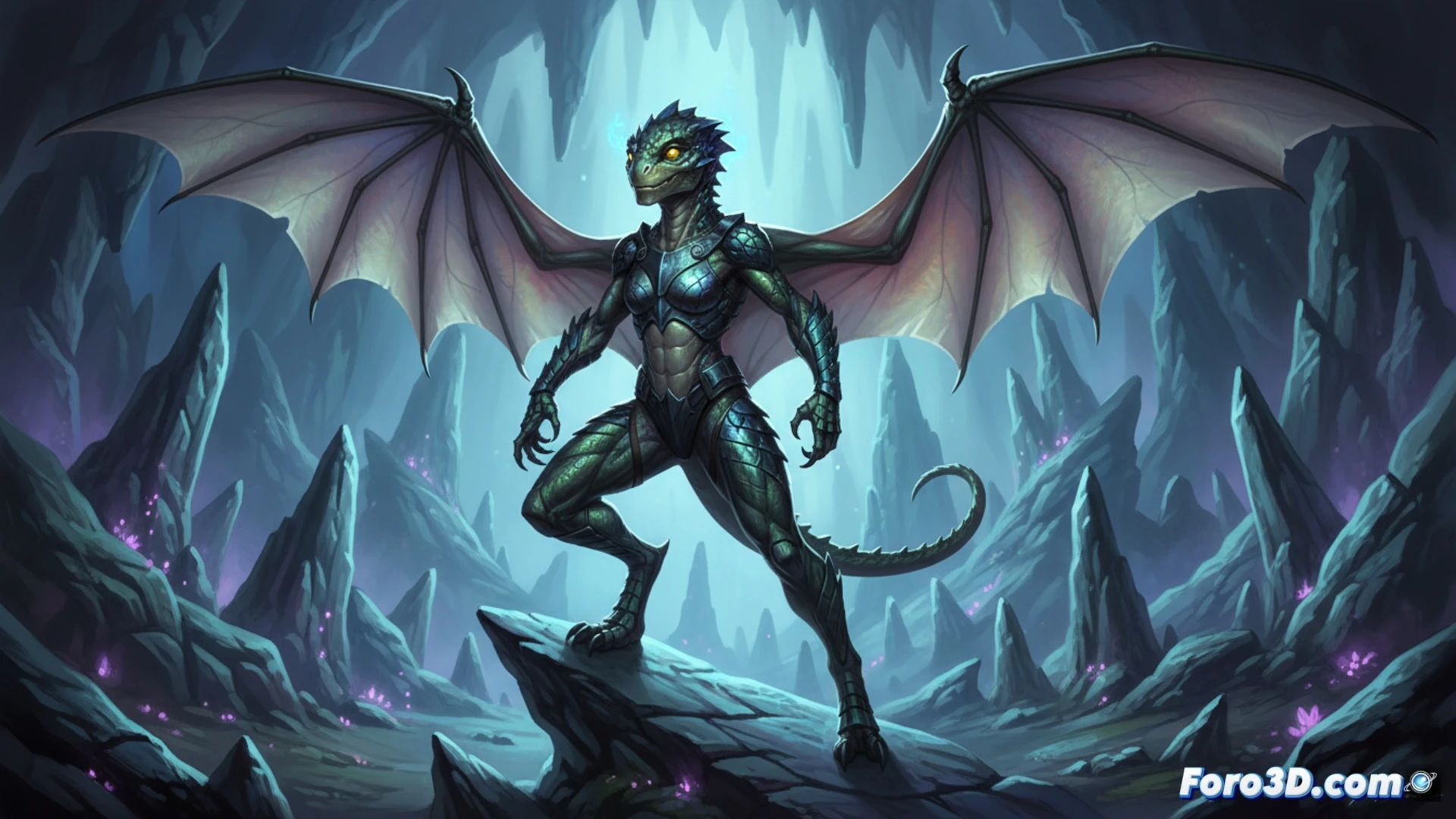
The design of Dinah Soar, created by John Byrne, represents a fascinating technical challenge for digital modeling. This Marvel character combines a humanoid base with reptilian features, pterodactyl wings, and an ultrasonic communication system. For creators of digital humanoids, analyzing its hybrid anatomy offers keys to integrating scales, wing membranes, and empathetic expressions into a single asset, optimized for film and video games.
Modeling, Rigging, and Texturing of Scales 🦎
The base of the model starts from a standard human mesh, but requires specific deformations in the skull and ribcage to accommodate the wings. The wing rigging must mimic the biomechanics of a pterosaur, using control bones with rotation constraints in the metacarpal joints. For texturing, scales are generated with displacement maps in ZBrush, prioritizing flex zones like the neck and armpits. Ultrasonic communication is visually represented with spherical wave shaders or particles emanating from the mouth, synchronized with real-time audio. Empathetic facial animation requires blendshapes that combine human expressions (eyebrows, mouth) with reptilian movements (lateral eyelid blink, vertical pupil dilation).
Application in Simulation and Entertainment 🎮
In a production pipeline, Dinah Soar demonstrates how a non-human character can retain audience empathy. For video games, its design forces optimization of the LOD for wings and scales, avoiding visual popping. In simulations of fictional fauna, its empathetic bond translates into AI systems that react to the player's emotional state through grooming or alert animations. The biggest challenge remains communication: translating ultrasonic frequencies into visual signals without breaking immersion, using animated spectrograms in the interface or synchronous flashes on the model.
What is the most effective strategy for integrating reptilian wing animation with the fluidity of a humanoid biped in Dinah Soar, considering the limitations of rigging and real-time mesh deformation?
(PS: check the rigging before recording, so we don't end up like with the textures without UVs!)