A magnetic levitation train lost braking capacity during a high-speed test, triggering a technical forensic investigation. To determine the root cause, engineers turned to ultra-precision laser scanning with Leica Cyclone to map the geometry of the coils on the track. This digital model was imported into Ansys Maxwell to simulate Lorentz forces in 3D, seeking millimeter deviations that could nullify the braking field.
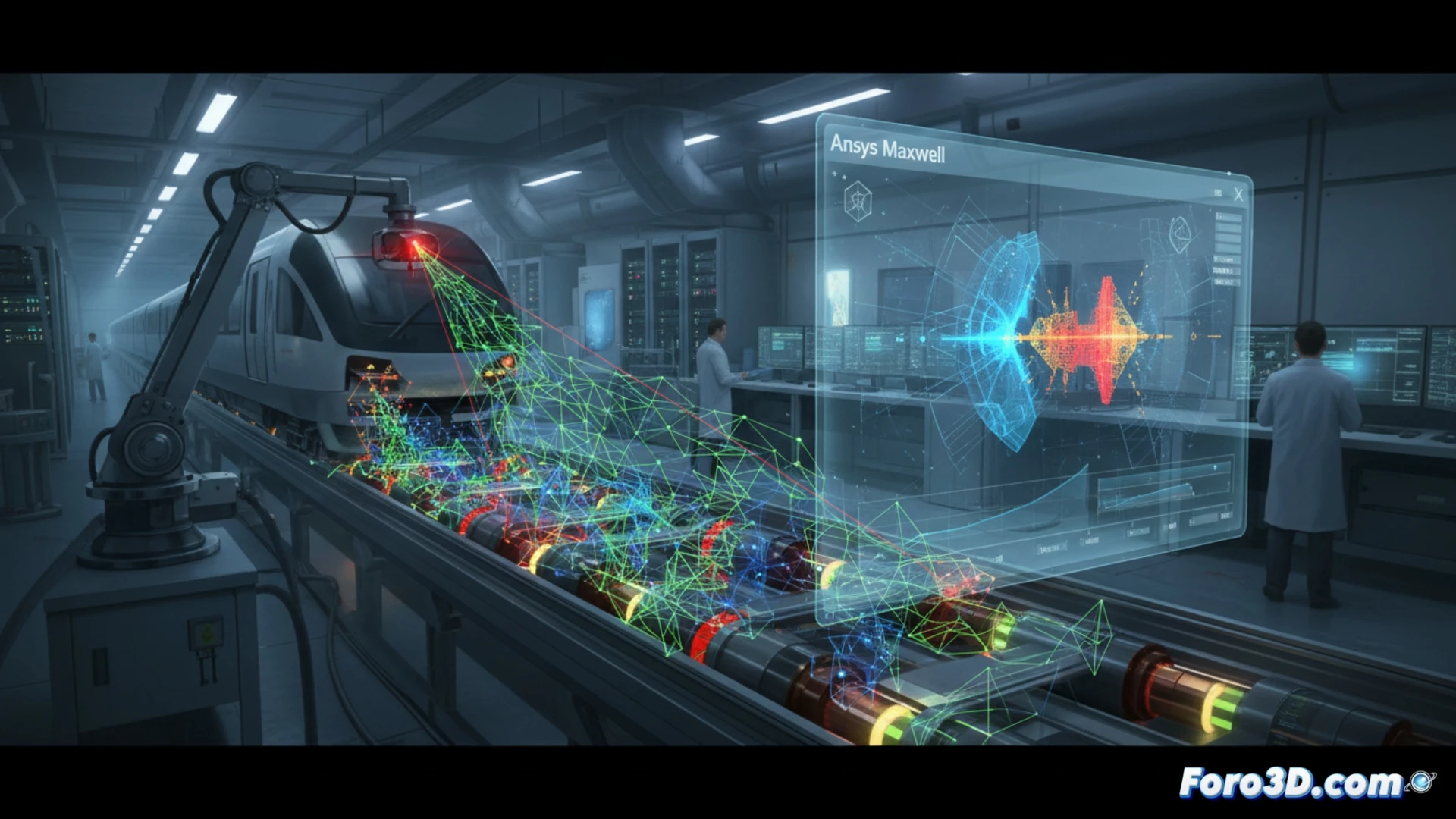
Millimeter deviation analysis in regenerative braking coils 🧲
The process combined point clouds from the Cyclone scanner with Maxwell's finite element solver. By overlaying the ideal model against the actual scan, a 2.3 mm deviation was detected in the alignment of three adjacent coils. The electromagnetic simulation revealed that this tolerance, although small, generated a phase shift in the magnetic flux that reduced the Lorentz force by 34%, insufficient to stop the train. This methodology is directly applicable to fault diagnosis in regenerative braking systems of electric vehicles, where stator and rotor alignment is critical.
Lessons for modeling critical systems in automotive 🚗
The case demonstrates that 3D simulation is not just for design, but an indispensable forensic diagnostic tool. In the automotive sector, where systems like ADAS or electromagnetic brakes depend on sub-millimeter tolerances, combining precision scanning with electromagnetic analysis allows identifying hidden faults without disassembling components. The open question is whether current predictive maintenance protocols integrate enough geometric sensitivity to anticipate these deviations before a failure occurs.
How can the integration of 3D simulations with laser scanning data reveal hidden defects in Maglev train braking systems that are not detected with conventional inspection methods
(PS: ADAS systems are like in-laws: always watching what you do)