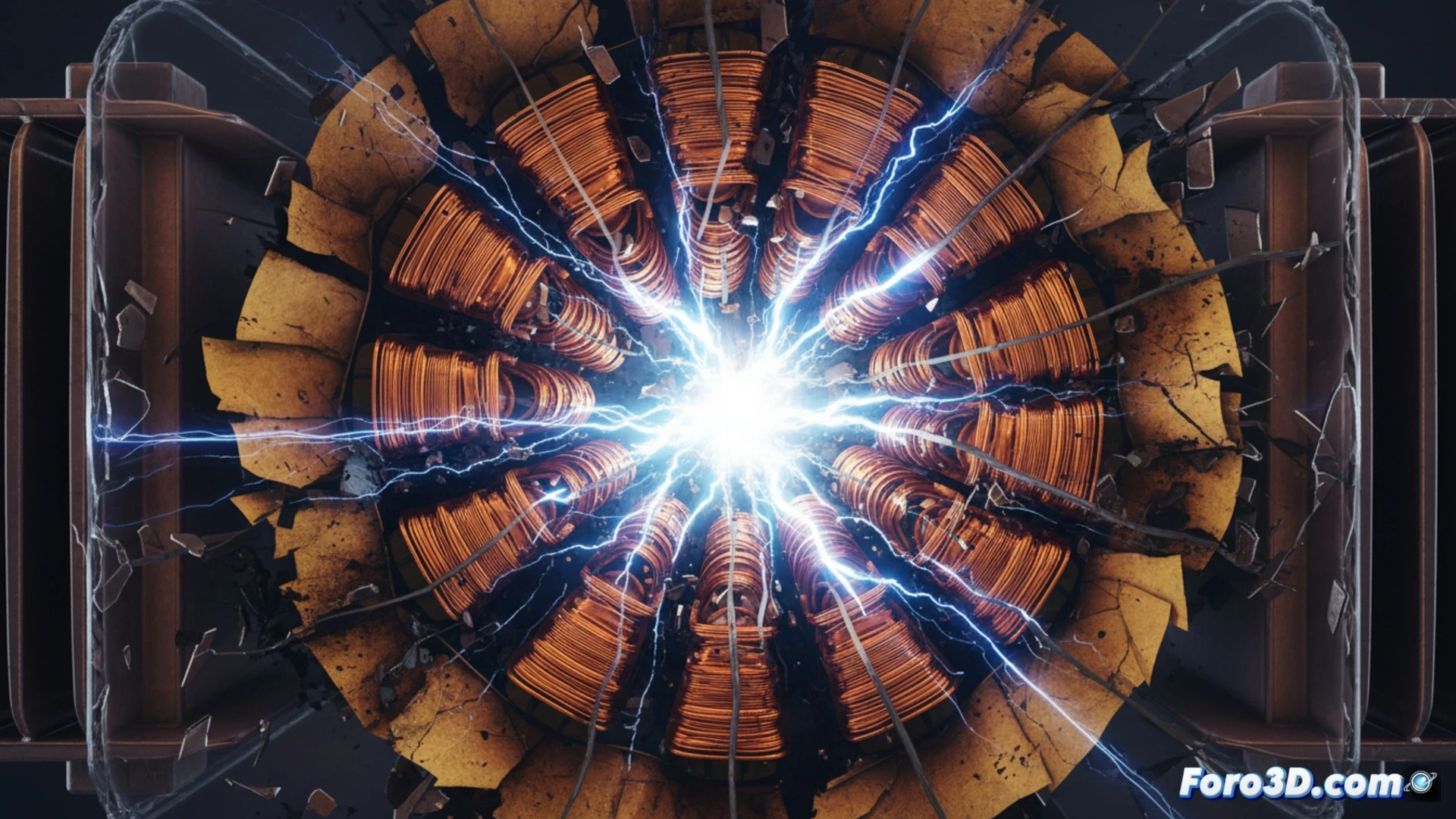
A high-power network transformer has catastrophically failed after a voltage surge. The 3D reconstruction of the tank's interior, using Industrial CT and ultrasound, revealed that massive electromagnetic forces physically displaced the copper windings. This violent movement tore the paper insulation, causing an internal short circuit and the final explosion of the equipment.
Electromagnetic Simulation and Copper Fatigue in ANSYS Maxwell ⚡
Using ANSYS Maxwell, the transient magnetic field during the short circuit was modeled. The results show that fault currents generate Lorentz forces exceeding 500 kN on the outer windings. These cyclic forces, although brief, induce plastic displacement in the annealed copper. Material fatigue manifests as permanent deformations that compress and tear the Nomex insulating paper, reducing its dielectric strength to the point of breakdown.
Lessons from the 3D Failure Reconstruction 🔍
The 3D reconstruction with SolidWorks, based on CT data, allowed visualization of the axial collapse of the windings. The analysis reveals that the original design underestimated the axial stiffness of the assembly, a common error in fatigue simulations that ignore copper hysteresis. For future designs, it is recommended to integrate ANSYS Maxwell with cyclic strain fatigue models, always validating with industrial tomography to detect micro-displacements before the insulation fails.
How the redistribution of internal stresses in displaced windings affects the fatigue life of copper and insulation after a short circuit in a high-power transformer reconstructed in 3D
(PS: Material fatigue is like yours after 10 hours of simulation.)