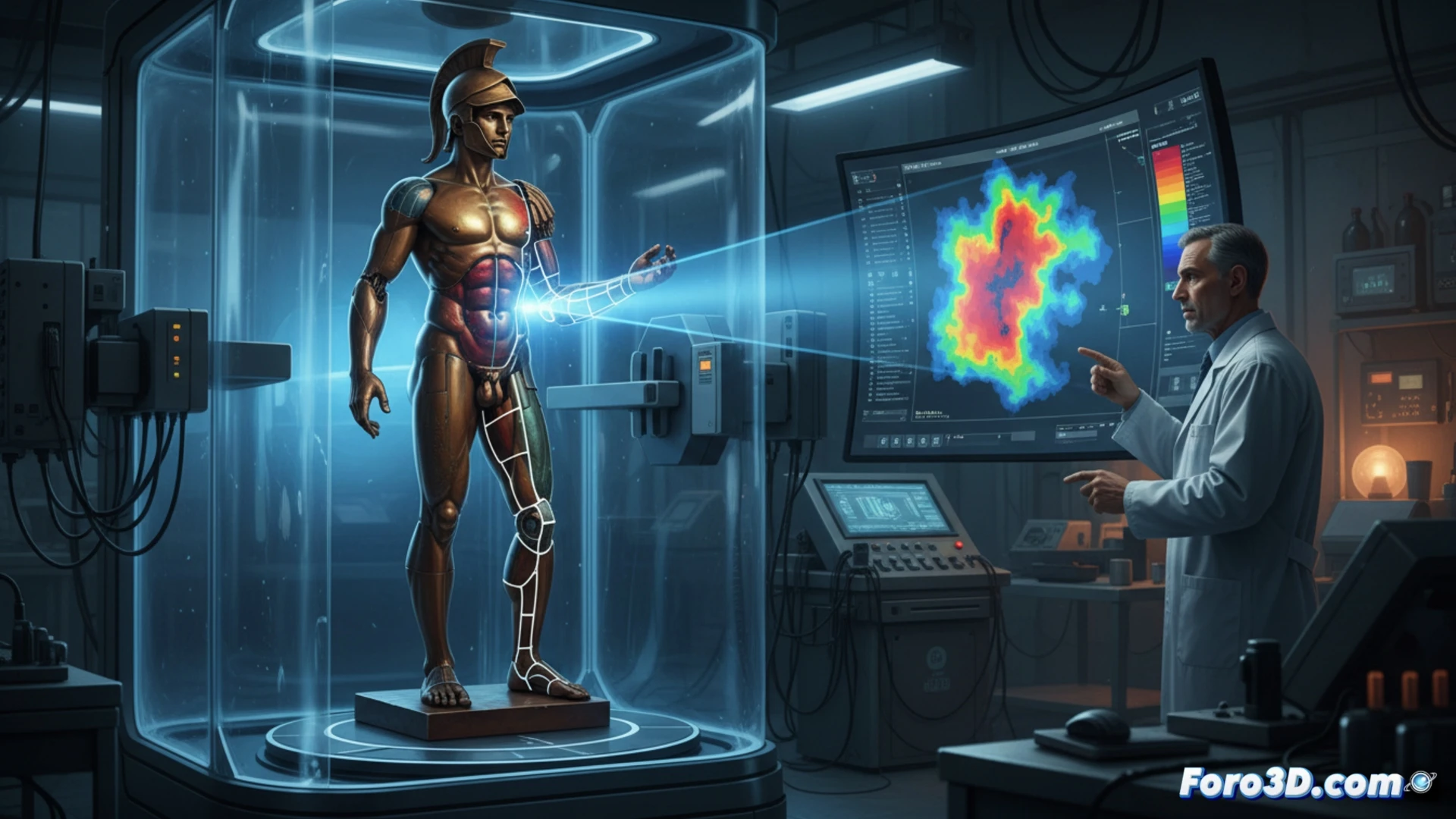
The authentication of bronze antiquities has entered a new era thanks to 3D computed tomography. When a statue suspected of being an assembly of parts from different periods arrives at the lab, industrial X-ray scanning reveals what the human eye cannot see: the exact density of the alloy in each section and the internal welding seams. This non-destructive technique allows for unmasking forgeries without damaging the piece, exposing the hidden joints that betray an artificial assembly.
Technical analysis: densities, welds, and digital morphometry 🔬
The process begins with an industrial CT scanner that generates a volume of voxelized data. By analyzing the relative densities of the alloy, discrepancies are detected: an arm may have a different copper and tin composition than the torso, indicating separate origins. Internal welding techniques, visible as areas of high density or trapped gas bubbles, are impossible to observe from the outside. Subsequently, the 3D model is exported to MeshLab for alignment and morphological comparison against databases of authentic pieces. ZBrush enables detailed surface analysis, identifying inconsistent wear patterns or anachronistic tool marks that confirm the Frankenstein assembly.
Implications for digital archaeology and the antiquities market 🏛️
This approach changes the rules of the game in cultural heritage authentication. Real cases, such as the detection of Roman statues reconstructed with medieval fragments, demonstrate that 3D CT is the ultimate tool against fraud. For the collector and the museum, the expert's eye is no longer enough; digital evidence is irrefutable. Digital archaeology not only preserves but protects historical integrity by exposing the lies hidden beneath the patina of time.
How does 3D computed tomography manage to differentiate original joints and welds from modern ones in an ancient bronze Frankenstein assembly?
(PS: If you dig at a site and find a USB, don't plug it in: it could be malware from the Romans.)