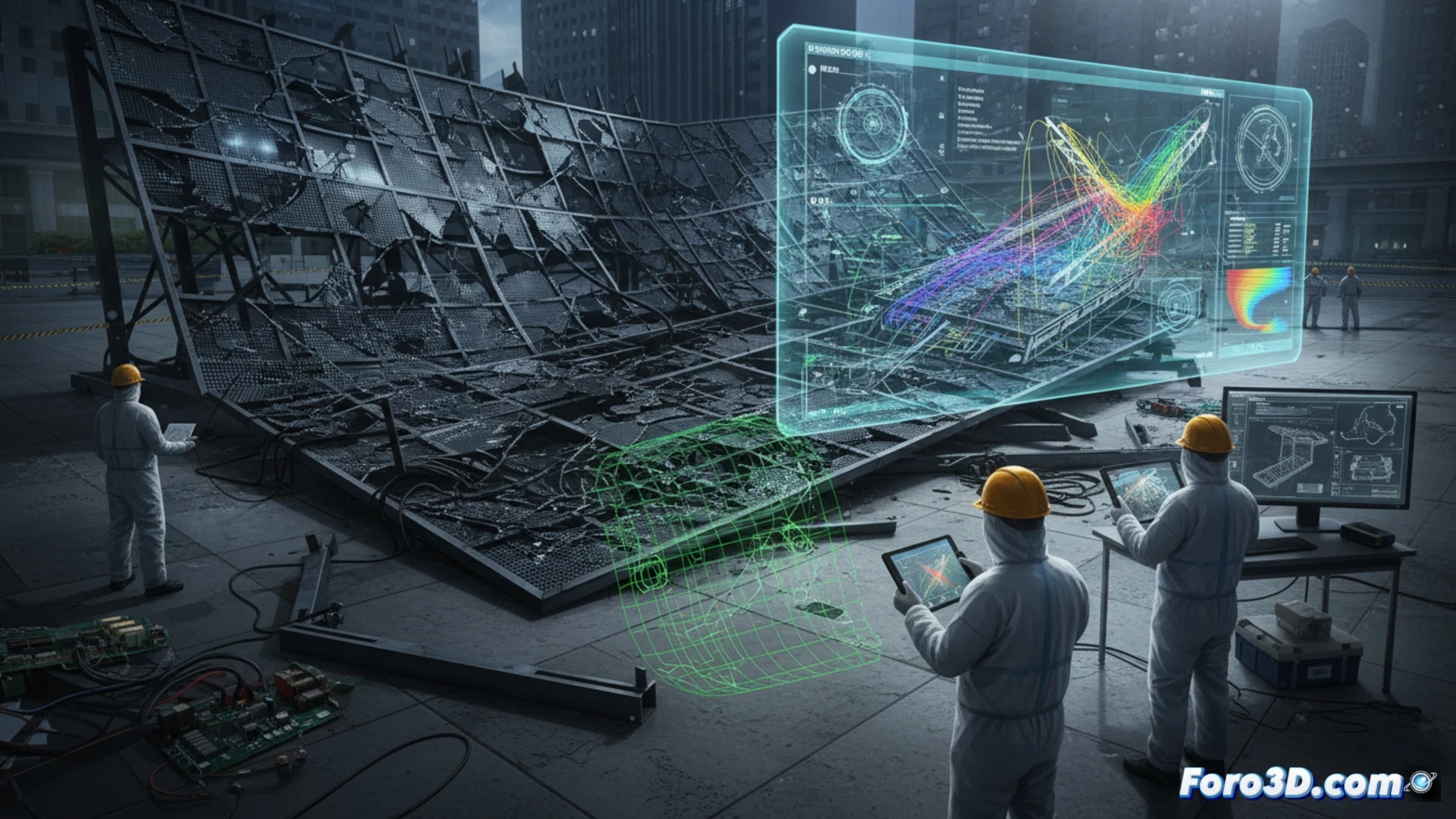
The collapse of a giant LED screen under wind gusts has reopened the debate on the integrity of temporary structures. In this case, the forensic team did not limit itself to observing the debris; it implemented a reverse engineering methodology combining 3D scanning, thickness verification, and computational simulation. The central objective was to determine whether the supplied material met the design specifications or if a dimensional deviation caused fatigue and catastrophic failure.
Debris Survey and Thickness Verification 🔍
The process began with scanning the collapsed structural profiles using a high-precision handheld scanner. The captured data was processed in Artec Studio to generate a clean mesh aligned with the original geometry. Subsequently, this point cloud was imported into Geomagic Control X to perform a comparative dimensional analysis. The tool allowed comparing the actual thickness of the sheets and tubes against the workshop drawings, identifying areas where the gauge was below the nominal value. These discrepancies were marked as critical points for the structural model. Next, the framework was reconstructed in Tekla Structures, integrating the actual measurements to reflect the exact structural weakness the screen exhibited before the collapse.
Wind Simulation and Failure Determination 💨
With the realistic geometric model ready, a computational fluid dynamics (CFD) simulation was executed in Ansys Fluent. The wind conditions recorded in the area during the incident were defined, including gusts and urban turbulence. The results showed that the pressure exerted on the screen exceeded the load-bearing capacity of the anchor points, especially at those joints where the thickness was deficient. The conclusion was clear: the failure was not due to an extreme weather event, but to a fatal combination of insufficient material and a poorly calculated wind load during the design phase.
Is it possible to accurately model the wind-structure interaction of a temporary LED screen using CFD to predict its collapse without needing to scale the gusts in a physical wind tunnel?
(PS: Simulating a collapse is easy. The hard part is making sure the program doesn't crash.)