Low-speed magnetic levitation trains rely on support wheels to move until reaching the critical levitation speed. However, premature and asymmetric wear has been observed in these tires, a problem that compromises the system's service life and operational reliability. To investigate the root cause, a workflow combining high-precision metrology with electromagnetic simulation has been implemented, seeking unbalanced lateral forces that could be acting on the running surface.
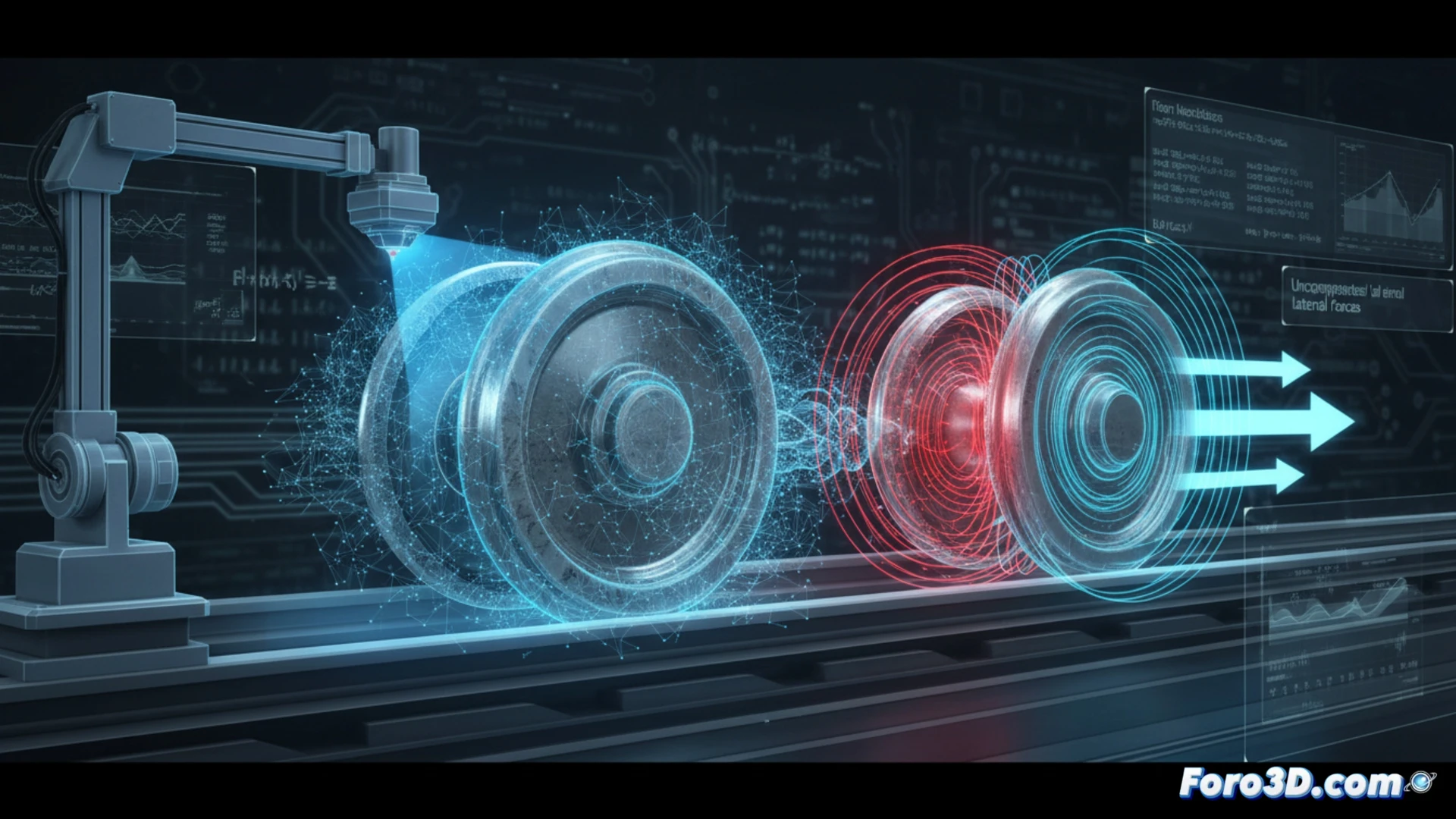
Workflow: from point cloud to EM simulation 🔬
The process begins with high-resolution 3D scanning of the magnetic guide and the worn wheels. The captured data is processed in PolyWorks to generate a metrology model that reveals geometric deviations and wear patterns. This model is imported into Siemens NX to reconstruct the virtual assembly, including actual tolerances. Subsequently, the model is transferred to CST Studio Suite to perform a high-fidelity electromagnetic simulation. The results show that small irregularities in the guide generate asymmetries in the magnetic field, inducing lateral forces that the wheel must counteract, which accelerates wear in specific areas.
Hidden fatigue: the price of magnetic asymmetry ⚡
This case demonstrates that material wear does not always respond to obvious mechanical causes. The interaction between real geometry and electromagnetic fields reveals a complex fatigue mechanism, where a lateral force of just a few Newtons can deviate the wheel's trajectory and erode its tread unevenly. Optimizing the design of guides and wheels now requires a multidisciplinary approach that integrates electromagnetic tolerance with mechanical strength to mitigate this phenomenon.
What role does the surface topography detected by 3D scanning play in predicting the service life of support wheels under asymmetric wear conditions in low-speed Maglev systems, and how can this data be integrated into electromagnetic simulation models to improve the accuracy of fatigue analysis?
(PS: Material fatigue is like yours after 10 hours of simulation.)