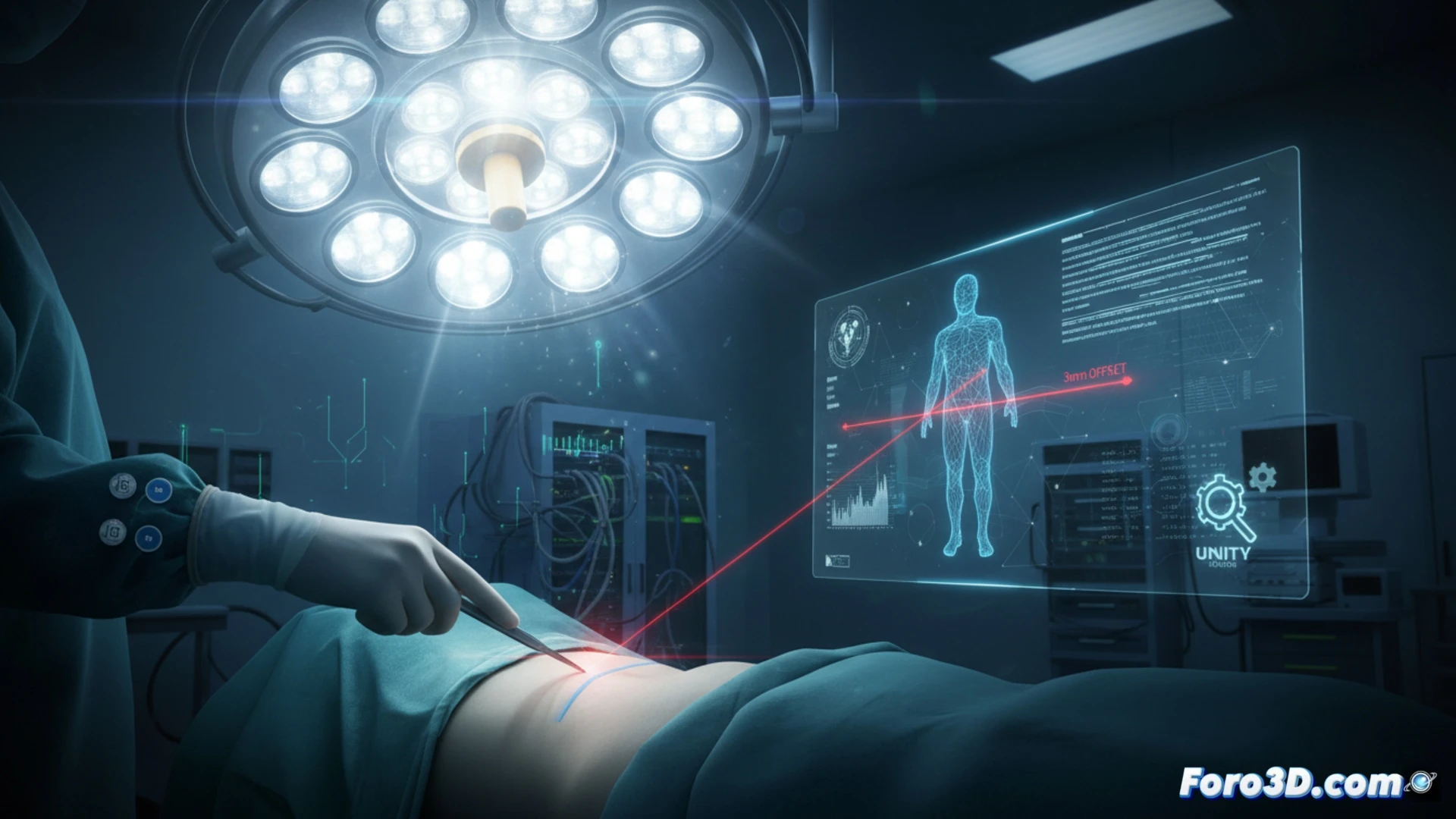
A recent surgical incident has called into question the reliability of Augmented Reality in critical environments. During an operation guided by AR overlay, the surgeon made an erroneous incision. The 3D reconstruction of the operating room (Digital Twin in Unity 3D) and the analysis of Vuforia Engine logs revealed the cause: a 3mm offset caused by interference from the ceiling LED lights on the optical tracking markers.
Technical Analysis: Optical Interference and System Decalibration 🩺
The error was not random, but a systematic spatial registration failure. The surgical LED lights, with a high-frequency spectrum and flicker invisible to the human eye, saturated the optical sensor filters of RealityCapture. Vuforia Engine, when interpreting the reflective markers, confused the LED flashes with reference points, shifting the 3D mesh. The result was a 3mm drift on the Z-axis, enough for the virtual guide to indicate an incorrect trajectory. The Digital Twin recorded the event as a noise spike in the transformation matrix, but the system did not activate redundancy due to a lack of dynamic tolerance thresholds.
Lessons for AR Design in Hostile Environments 🔧
This case demonstrates that static calibration is not sufficient. For operating rooms, a redundant sensor architecture is required: combining optical tracking with inertial (IMU) and band-pass filters that block specific LED frequencies. Additionally, dynamic calibration must readjust the overlay in real-time, detecting registration anomalies greater than 1mm. The lesson is clear: in surgical AR, a millimeter lost to environmental noise can be the difference between success and a critical error.
Is it possible that the variation in the flicker frequency of the operating room LED lights is interfering with the AR visual positioning systems, or does the problem lie exclusively in the mechanical calibration of the tracking head?
(PS: AR applied to maintenance allows you to see where the fault is... before the machine explodes.)