The phenomenon of debonding in glass joints under extreme frequencies represents a critical challenge in materials engineering. When a panel or screen is subjected to ultrasonic or resonant vibrations, stress waves propagate non-linearly, generating stress concentration points at the edges of the adhesive bond. This process, imperceptible to the naked eye, accumulates micro-damage that eventually leads to complete separation of the material.
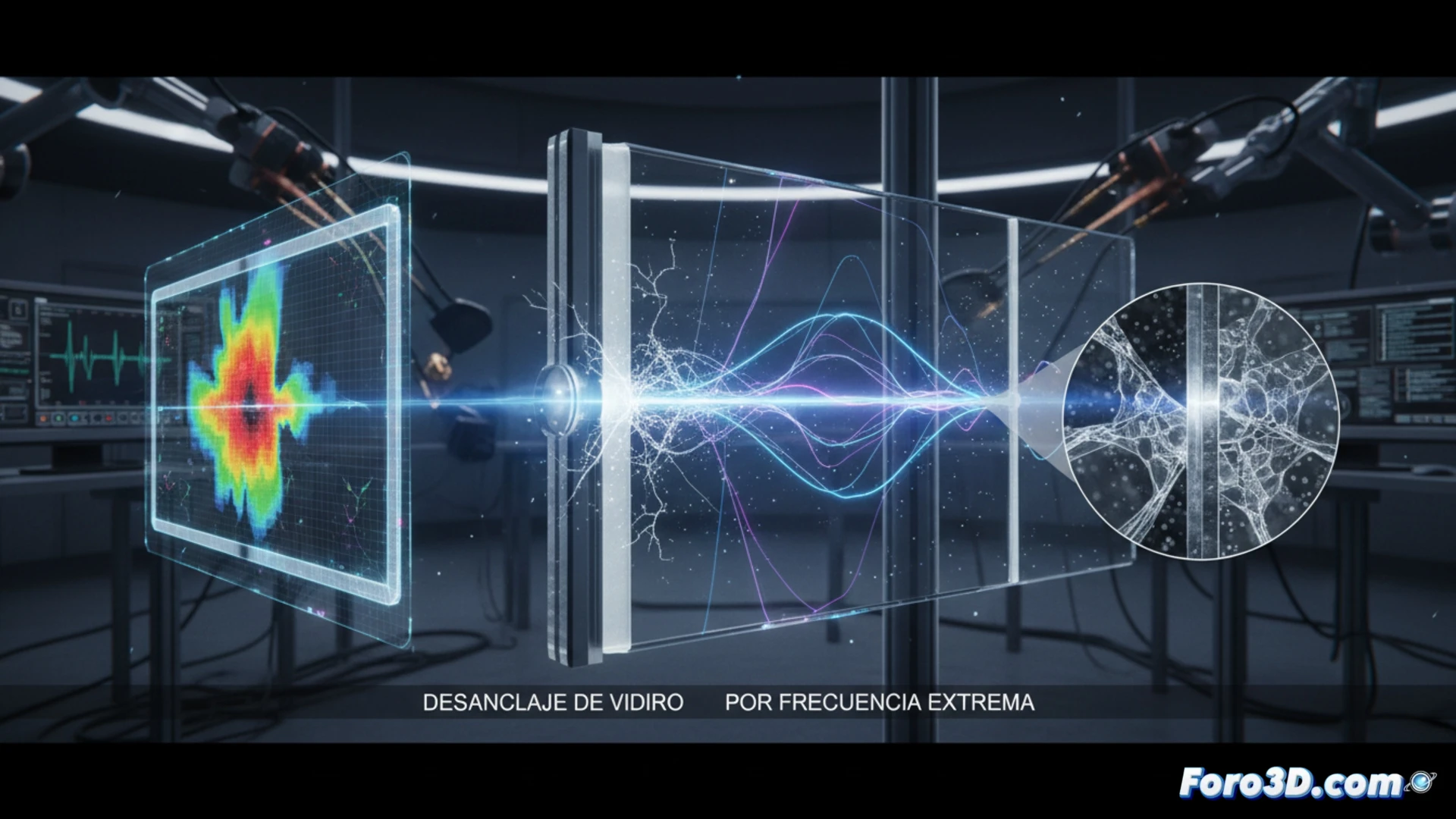
Modeling Wave Propagation and Accumulated Fatigue 🔬
To simulate this progressive failure, it is essential to build a 3D model representing both the glass substrate and the bonding layer (adhesive or sealant). The simulation must include a modal analysis to identify the resonant frequencies of the assembly. Subsequently, cyclic loads are applied at those frequencies, evaluating stress distribution using finite elements. The fatigue algorithm calculates the estimated service life, showing how high-frequency waves induce localized wear in the anchoring zones, accelerating delamination even under moderate vibration amplitudes.
Lessons for Designing Robust Joints 🛠️
Understanding debonding due to extreme frequency forces us to rethink the geometry of joints in modern devices. Simulations reveal that small variations in adhesive thickness or glass corner radius can drastically mitigate stress concentration. This knowledge enables the development of more robust designs, where the joint not only withstands static stress but also effectively dissipates the energy of resonant vibrations, prolonging the structural integrity of the system.
Which 3D simulation parameters are most critical for accurately predicting glass debonding under extreme frequencies, and how do they compare with experimental fatigue tests?
(PS: Material fatigue is like yours after 10 hours of simulation.)