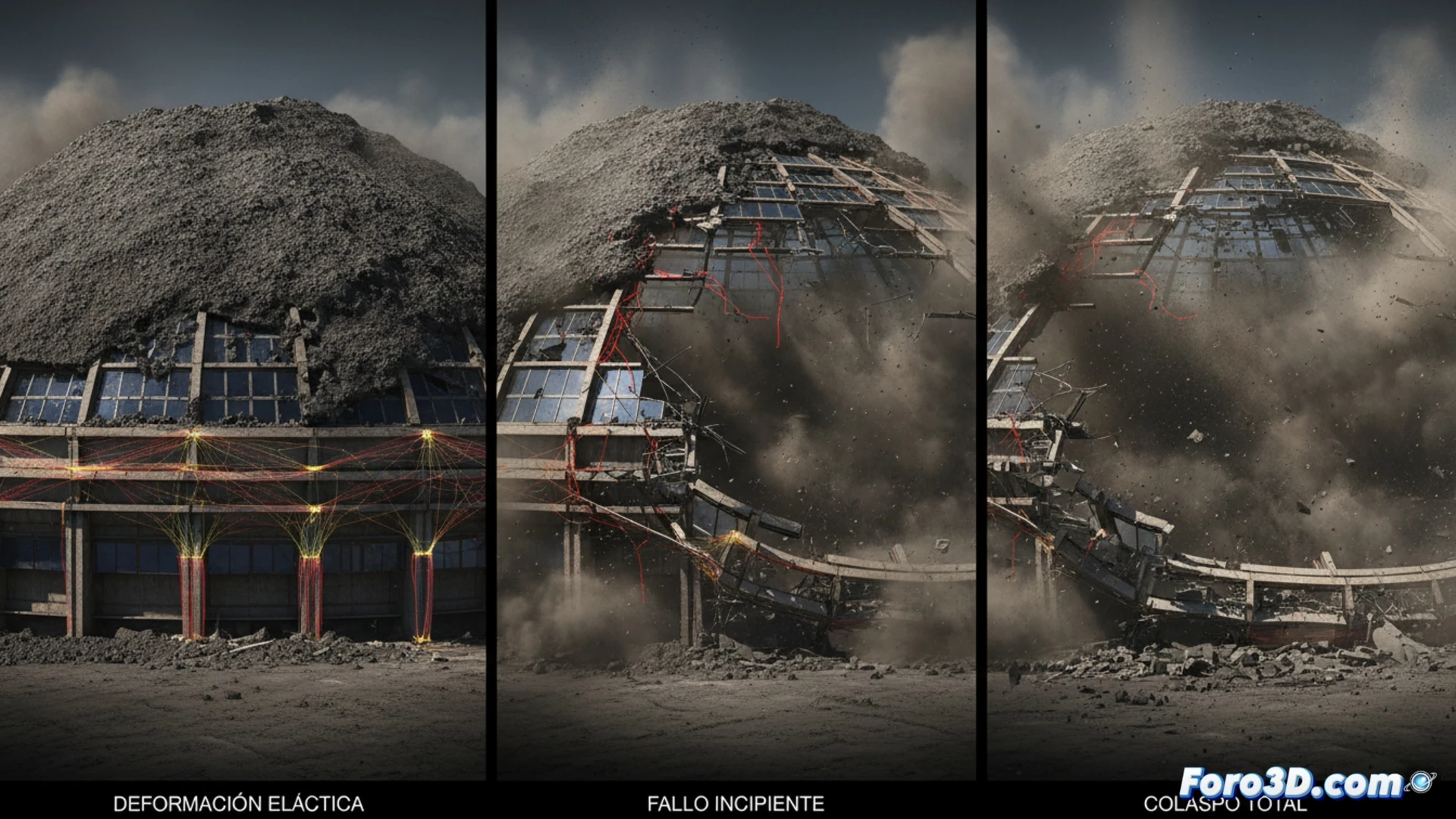
The recent collapse of a structural dome under the accumulated weight of volcanic ash has brought to light one of the most silent threats of eruptive activity. Unlike lava or pyroclastic flows, the progressive loading of particulate matter on curved roofs can exceed design limits without visible warning. This event represents a critical case study for forensic engineering, where 3D simulation becomes the primary tool for understanding the exact sequence of failure, from initial elastic deformation to the total collapse of the element.
Finite Element Modeling: Predicting the Breaking Point 🏗️
To replicate the incident, a parametric model of the dome has been developed using finite element analysis (FEA) software. The simulation introduces an incremental load of volcanic ash, considering a density of 1.2 tons per cubic meter and an accumulated thickness of up to 80 centimeters. The structural meshing reveals that the maximum stress points are concentrated in the perimeter compression rings and steel joints, areas that in the virtual model reach a Von Mises stress exceeding 450 MPa before buckling. When cross-referencing this data with real images of the collapse, it is confirmed that the failure mode was not a symmetrical collapse, but a progressive chain fracture initiated in the southern sector of the structure, where ash accumulation was 15% higher due to the prevailing wind.
Structural Lessons for Catastrophe Prevention ⚠️
The validation of the virtual model against real data demonstrates that 3D simulation not only explains the past but redefines safety protocols. The study suggests that domes in active volcanic zones should incorporate real-time load sensors integrated with early warning systems. The ability to predict the exact breaking point allows establishing evacuation thresholds with a safety margin of 30% over the calculated critical load. This methodology, applied to future constructions, could drastically reduce the risk of casualties in events where the silent weight of ash decides the fate of a structure.
Considering that traditional seismic design does not account for progressive dead loads of this type, what additional safety factor should be implemented in domes located in active volcanic zones to prevent collapse from ash accumulation without compromising the economic viability of the structure?
(PS: Simulating catastrophes is fun until the computer melts down and you are the catastrophe.)