Precision agriculture promises efficiency, but when a drone sprays a crop, the microdroplets don't always land where they should. A neighbor reports herbicide contamination. Legal liability no longer depends solely on witnesses, but on computational physics. This article breaks down the technical workflow that turns a rotor's aerodynamics into irrefutable expert evidence, using Star-CCM+, RealityCapture, and Blender. 🚁
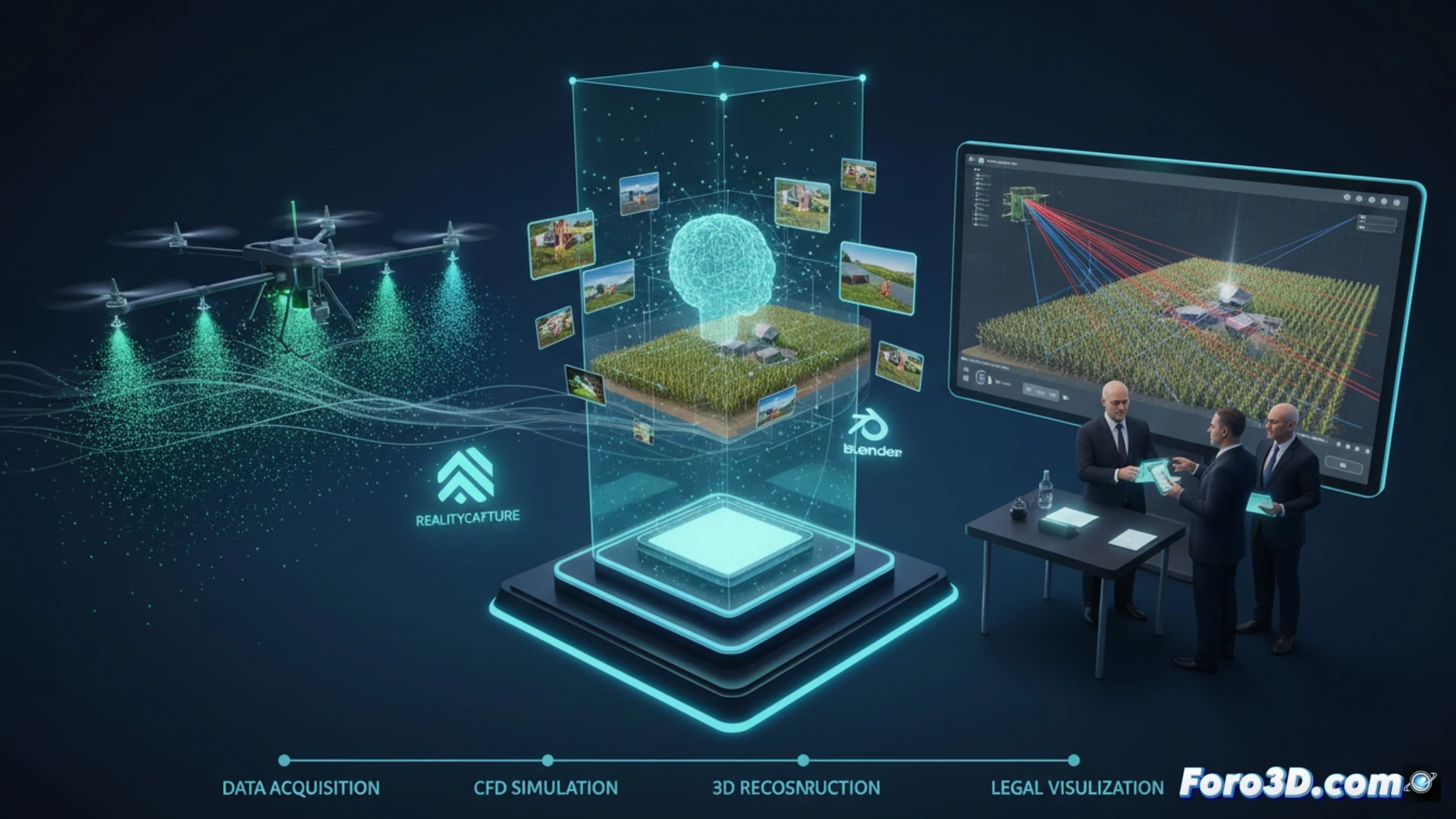
Simulation pipeline: from flight to droplet 🔬
The process begins with photogrammetry of the affected field. RealityCapture generates an accurate 3D model of the terrain, including the exact height of neighboring crops and nearby buildings. This model is exported as a polygonal mesh to Star-CCM+, where a fluid domain is configured. The Lagrangian Particle Tracking (LPT) model is implemented to simulate drift. Boundary conditions include the local wind profile (velocity and direction measured on-site) and the flow field generated by the drone's rotors (based on the actual geometry of the propellers). The simulation calculates the trajectory of thousands of particles, from the spray nozzle to the impact point on the neighboring crop, solving Navier-Stokes equations for the air and drag forces for the droplets.
Forensic animation as visual evidence 🎥
The raw output from Star-CCM+ consists of coordinates and velocities. This is where Blender comes in. The terrain geometry is imported, and the trajectory data is used to animate the microdroplets as a particle system. The final video shows, in slow motion, how the wind and rotor wake divert the herbicide towards the neighboring plot. This visualization is not just a technical report, but visual evidence that a judge or an insurance company can understand without needing a PhD in fluid dynamics. The precision of the virtual trajectory turns uncertainty into legal certainty.
How is herbicide drift digitally modeled in a 3D environment to demonstrate legal liability in an agricultural lawsuit?
(PS: Simulating trajectories is like playing billiards, but without having to clean the table afterwards.)