Beneath the Cappadocia region in Turkey, the city of Derinkuyu extends across 18 underground levels, reaching a depth of 85 meters. Designed to house up to 20,000 people, this marvel of ancient engineering features vertical ventilation systems and rolling stone doors that functioned as defense. Documenting such a structure without altering it is a challenge that digital archaeology can solve through massive capture technologies.
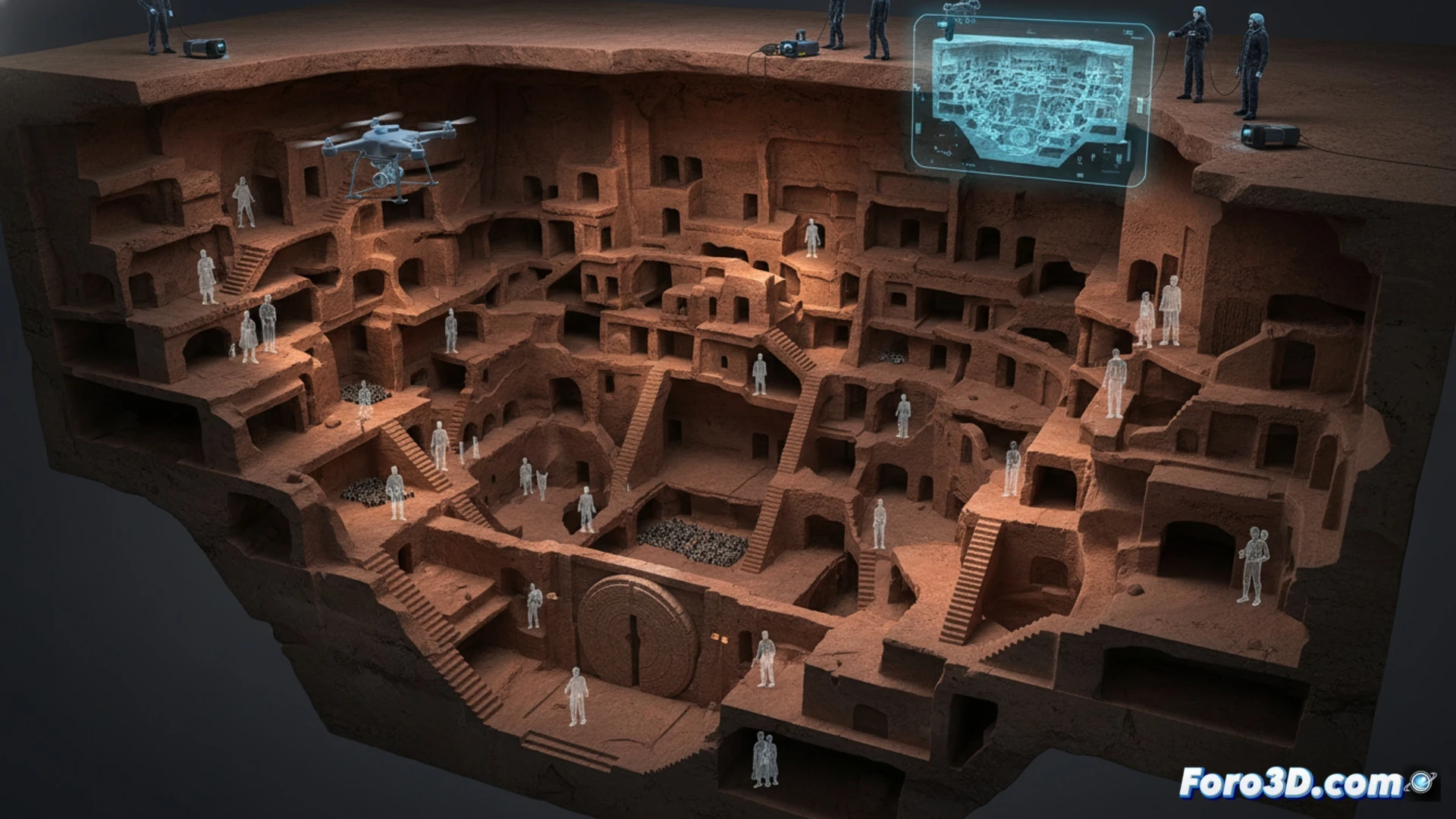
Laser scanning and photogrammetry for mapping 18 levels 🏛️
The comprehensive documentation of Derinkuyu requires combining terrestrial laser scanning (LiDAR) with high-resolution photogrammetry. LiDAR would capture the exact geometry of the tunnels, rooms, and ventilation shafts, generating a point cloud that records every structural detail. Photogrammetry, on the other hand, would provide the color and texture of the volcanic rock walls, allowing the reconstruction of the original environment. The result would be a navigable digital twin, where researchers could study the airflow of the 52 ventilation ducts or simulate the closing of the defense doors without the need for physical intervention. This model would also serve to create immersive virtual tours, reducing tourist wear on the actual site.
Virtual preservation for a heritage without natural light 🔦
The main advantage of a 3D model of Derinkuyu is the ability to perform non-destructive analysis. For example, one could simulate how the ventilation system distributed oxygen to the deepest levels, or calculate the resistance of the granite doors against a possible siege. Furthermore, digitization allows sharing this heritage with the entire world through interactive web platforms, democratizing access to a city that, due to its fragility, only a few can visit each year. Digital archaeology not only preserves the memory of Derinkuyu but also turns it into a virtual laboratory for understanding the engineering of our ancestors.
What technical and methodological challenges arose when capturing and modeling the 18 underground levels of Derinkuyu in 3D, and how were the limitations of lighting, access, and geometric precision resolved in such a complex and deep space?
(PS: If you dig at a site and find a USB, don't plug it in: it could be Roman malware.)