The home laser hair removal device market has exploded with promises of permanently removing hair from home. However, there is an insurmountable gap between marketing and technical reality: safety regulations limit the power of these devices to levels so low that they are incapable of permanently destroying the hair follicle. We analyze the legal and technical conflict behind this misleading advertising.
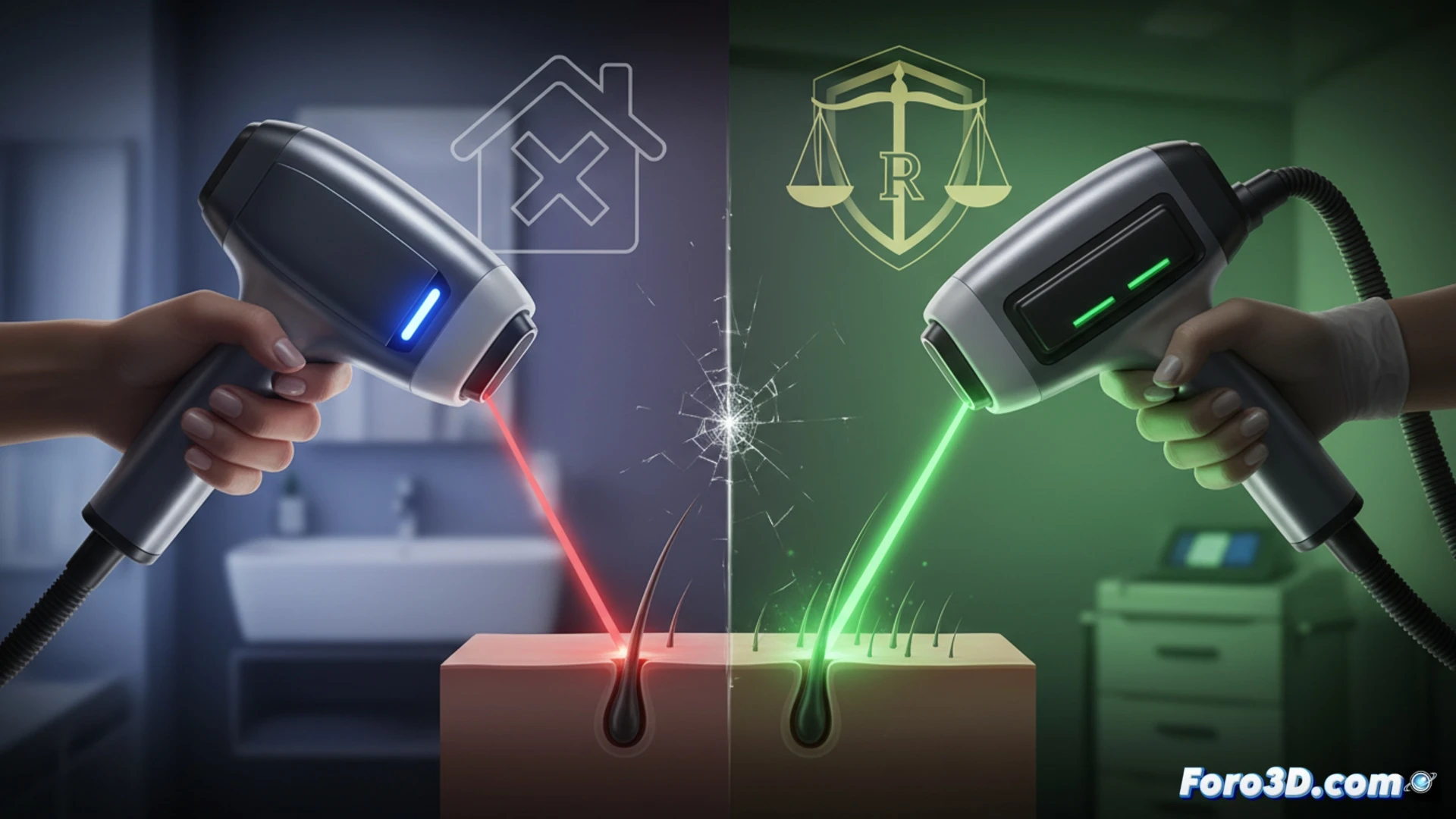
Technical analysis: the energy barrier of the follicle versus the regulatory limit ⚡
To achieve irreversible destruction of the follicle, an energy density greater than 5 J/cm2 in the dermis is required. However, home devices, classified as class 1 or 2 under IEC 60825-1, are limited to a maximum irradiance of 4 J/cm2 on the surface to avoid risks of burns or eye damage. Visualizing the process in 3D, the effective energy that penetrates to the hair bulb is insufficient: it barely achieves temporary heating that weakens the hair, but does not eradicate it. The result is a visible short-term reduction that disappears after the hair growth cycle.
Compliance risks for manufacturers and sales platforms ⚠️
Manufacturers that label their products as professional power or with permanent results engage in misleading advertising under the General Consumer Protection Law. Sales platforms, by not verifying these technical claims, can be considered co-responsible for distributing false information. The compliance risk is high: from financial penalties to mandatory product withdrawal. For brands, the solution lies in adjusting commercial messaging to technical reality, promising only temporary reduction and not definitive removal.
What legal and civil liability implications does a manufacturer of home laser hair removal devices face for promising professional results without complying with safety regulations and maximum allowed power for home use?
(PS: at Foro3D we know that the only compliance that works is the one tested beforehand, not afterwards) 🔍