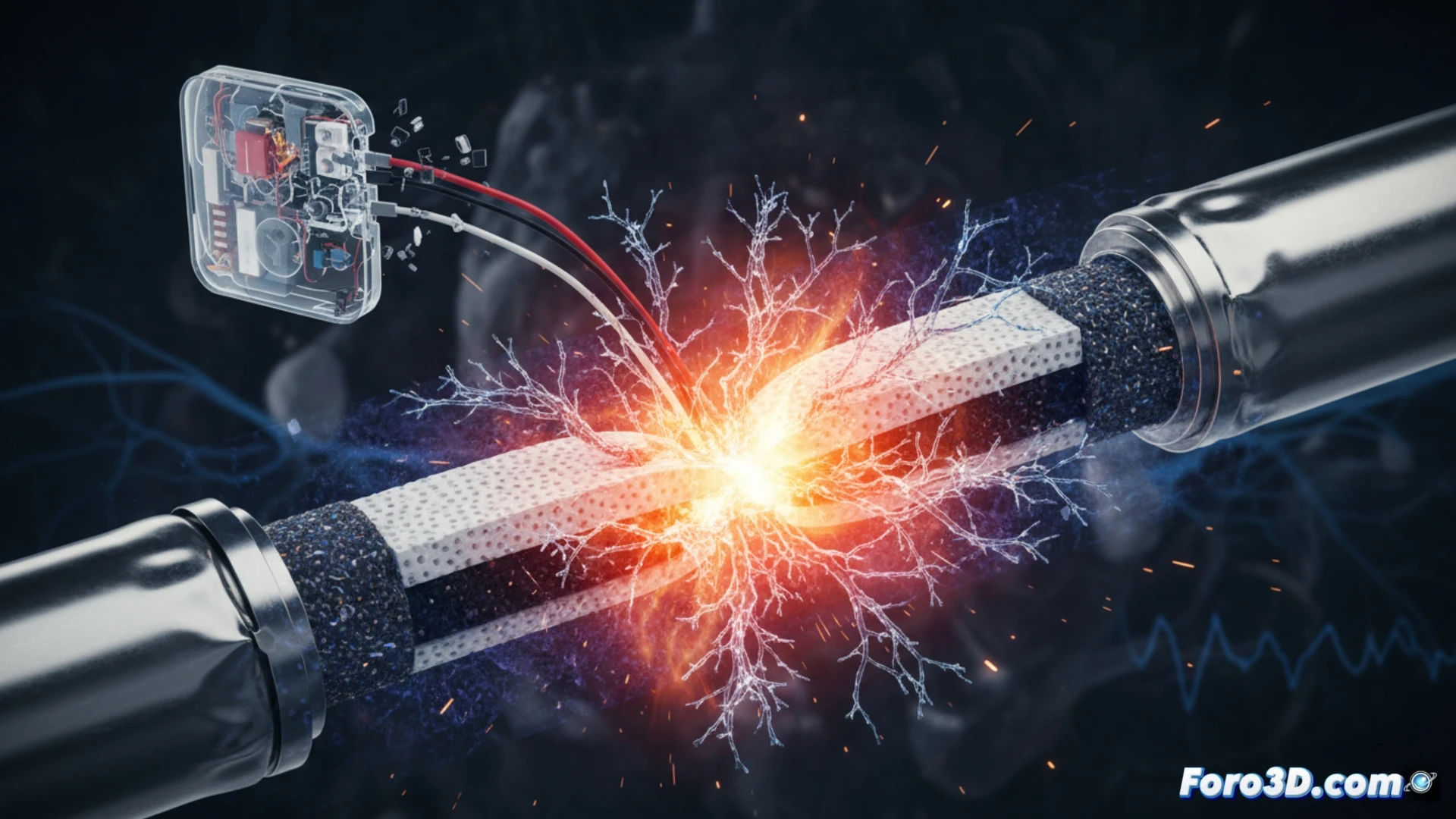
A next-generation smart pacemaker has critically failed, putting the patient's life at risk. The cause was not a software error or normal wear and tear, but a microscopic explosion inside its battery. Forensic analysis using computed tomography (CT) has revealed the presence of lithium dendrites that pierced the separator, triggering a nanoscale thermal short circuit.
CT Analysis and Segmentation in Dragonfly and VGSTUDIO MAX 🔬
To locate the failure, engineers turned to X-ray microtomography. With a resolution of less than 1 micron, the scanner captured the internal structure of the cell. The volumetric data was processed in Dragonfly, where deep learning-based segmentation was applied to isolate the metallic lithium formations. These structures, with a needle-like morphology, grew from the anode towards the cathode. Subsequently, a porosity and separator thickness analysis was performed in VGSTUDIO MAX, confirming the perforation. The 3D reconstruction allowed visualization of the exact path of the dendrite that caused the short circuit.
Thermal Simulation and the Future of Microfabrication 🔥
The next step was to import the dendrite geometry into Altium Designer for a transient thermal simulation. The results showed a localized temperature peak of over 300 degrees Celsius at the contact point, enough to vaporize the electrolyte. This case demonstrates that 3D visualization is not only useful for documenting failures, but also for redesigning separators and anodes with structures that inhibit dendritic growth. The semiconductor industry for medical devices must integrate these analysis tools into its quality control processes.
Since 3D microfabrication allows creating electrodes with three-dimensional architectures to improve energy density, what specific design and material deposition challenges must be overcome to prevent the nucleation and growth of lithium dendrites in implantable pacemaker batteries?
(PS: simulating a 200mm wafer is like making a pizza: everyone wants a slice)