The EcoFlow Delta Pro Ultra system represents a significant advancement in residential energy storage, but its true potential unfolds when we model it as a digital twin. By creating a precise virtual replica of its components, solar panels, inverters, and battery cells, we can simulate the energy flow within a home in real time. This approach not only allows us to visualize in 3D how solar energy is captured, stored, and distributed, but also enables the prediction of failures and the optimization of consumption before they occur in the physical world.
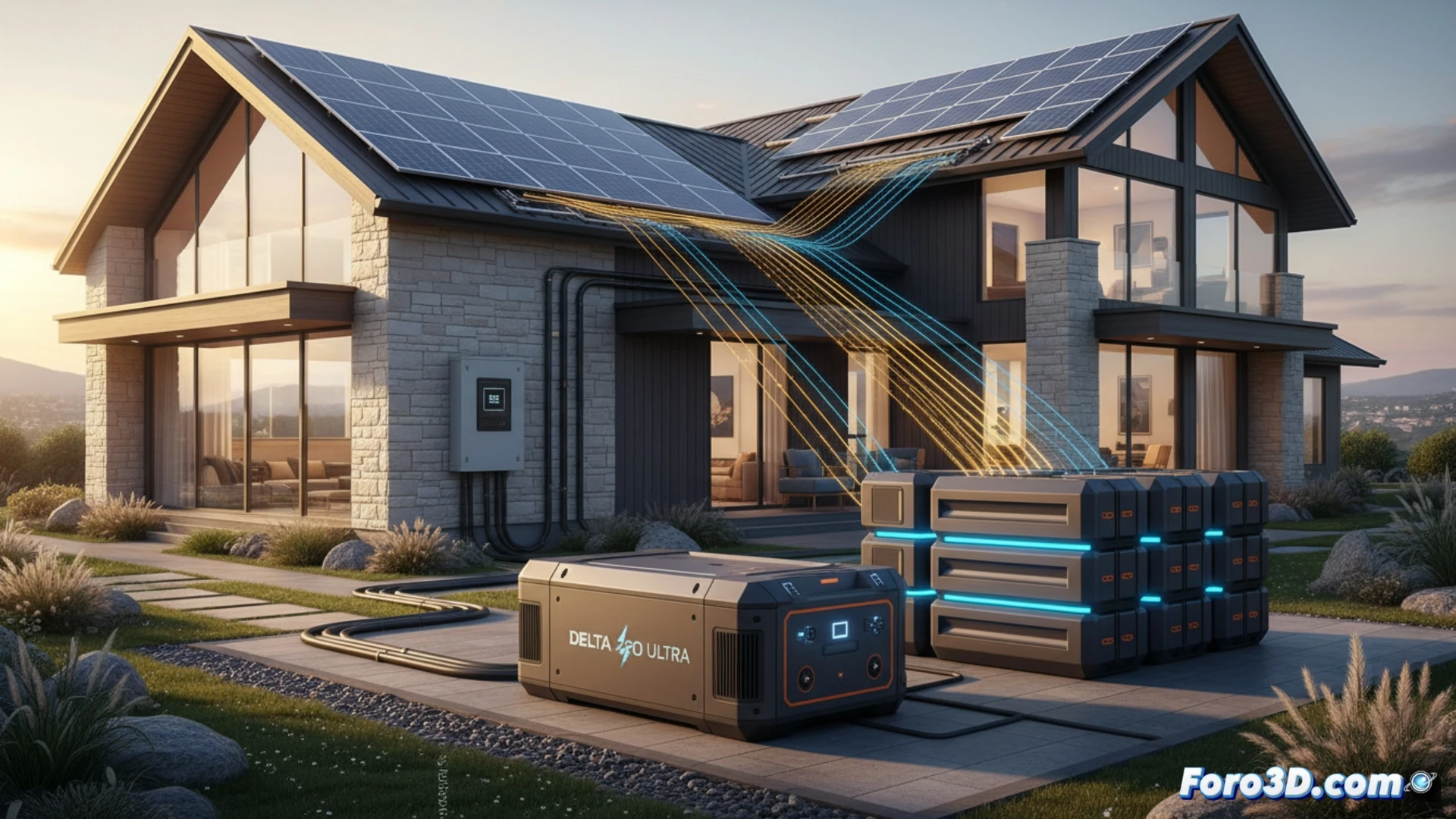
Digital twin architecture and 3D flow visualization 🔋
To build the digital twin of the Delta Pro Ultra, it is necessary to integrate IoT sensors that capture voltage, current, and temperature data from each battery module. This data feeds a simulation model that replicates the electrochemical behavior of the LFP cells. The 3D visualization of the system allows real-time observation of energy paths: from solar capture on the roof to battery charging and distribution to appliances. Tools like Unity or Unreal Engine can render these flows as animated particles, showing remaining capacity, charge rate, and demand peaks. This graphical representation facilitates the detection of bottlenecks and the planning of discharge strategies to maximize autonomy during blackouts.
Towards predictive and decentralized energy management ⚡
By adopting the Delta Pro Ultra as a digital twin, the user no longer has a simple backup generator but possesses an intelligent energy control system. The simulation allows predicting cell degradation, optimizing charge cycles based on electricity rates, and simulating extreme weather scenarios. This model, when shared on open-source platforms, could be integrated with digital twins of the local power grid, creating self-regulating energy communities. The next step is the standardization of these models so that any home can visualize and manage its energy footprint with surgical precision.
How can the Delta Pro Ultra be integrated as a digital twin to model a home's energy efficiency in real time and optimize consumption in response to power grid fluctuations?
(PS: My digital twin is right now in a meeting, while I am here modeling. So technically, I am in two places at once.)