Delamination in a Formula 1 carbon fiber steering wheel is not always the result of a direct impact. In this case, the failure originated from a defective curing of the epoxy resin, which generated areas with low load transfer between layers. When torque was applied during driving, the layers progressively separated, reducing the component's torsional stiffness to a critical point of structural failure.
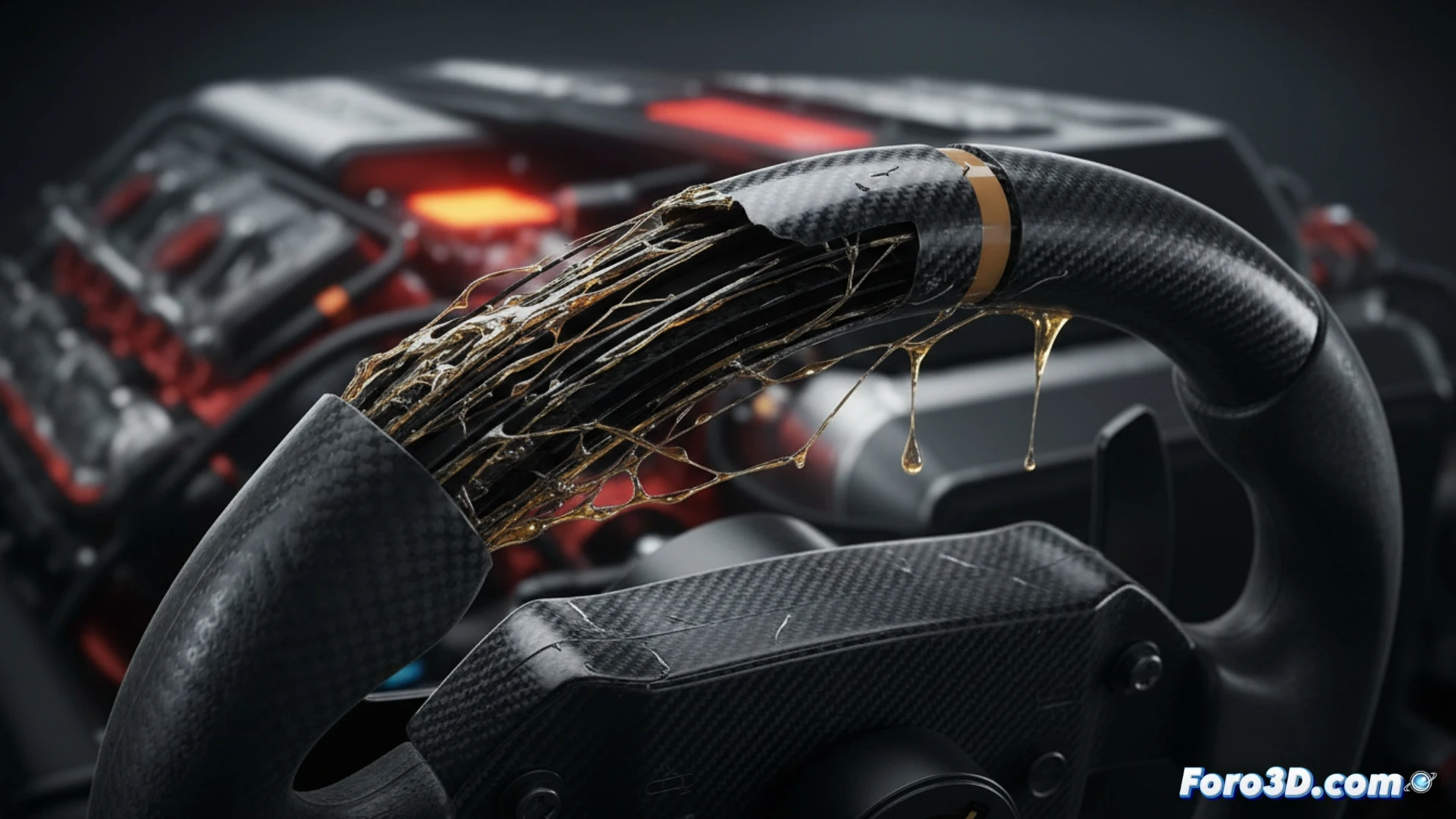
Failure simulation in Volume Graphics and HyperMesh 🛠️
Using Volume Graphics, a tomographic scan of the defective steering wheel was performed to identify regions with excessive porosity and lack of resin impregnation. The data was exported to HyperMesh, where a finite element model was generated with degraded orthotropic properties in the affected areas. The simulation in Siemens NX showed that, under cyclic loads of 50 Nm, interlaminar stresses exceeded the values of an optimal cure by 40%, confirming that delamination initiated at the periphery of the rim and propagated radially towards the center.
Fatigue as the silent judge in competition ⏳
This case demonstrates that fatigue analysis should not only focus on the service life of the base material, but on the integrity of the resin-fiber bond. An incomplete cure turns a high-performance component into a progressive stiffness trap. For racing teams, simulating these scenarios in pre-production with HyperMesh and validating with Volume Graphics allows critical areas to be detected before the steering wheel fails on the track, safeguarding both performance and driver safety.
How can it be distinguished, through finite element simulation, whether the delamination observed in an F1 steering wheel is caused by defective epoxy resin curing or by cyclic mechanical overload?
(PS: Material fatigue is like yours after 10 hours of simulation.)