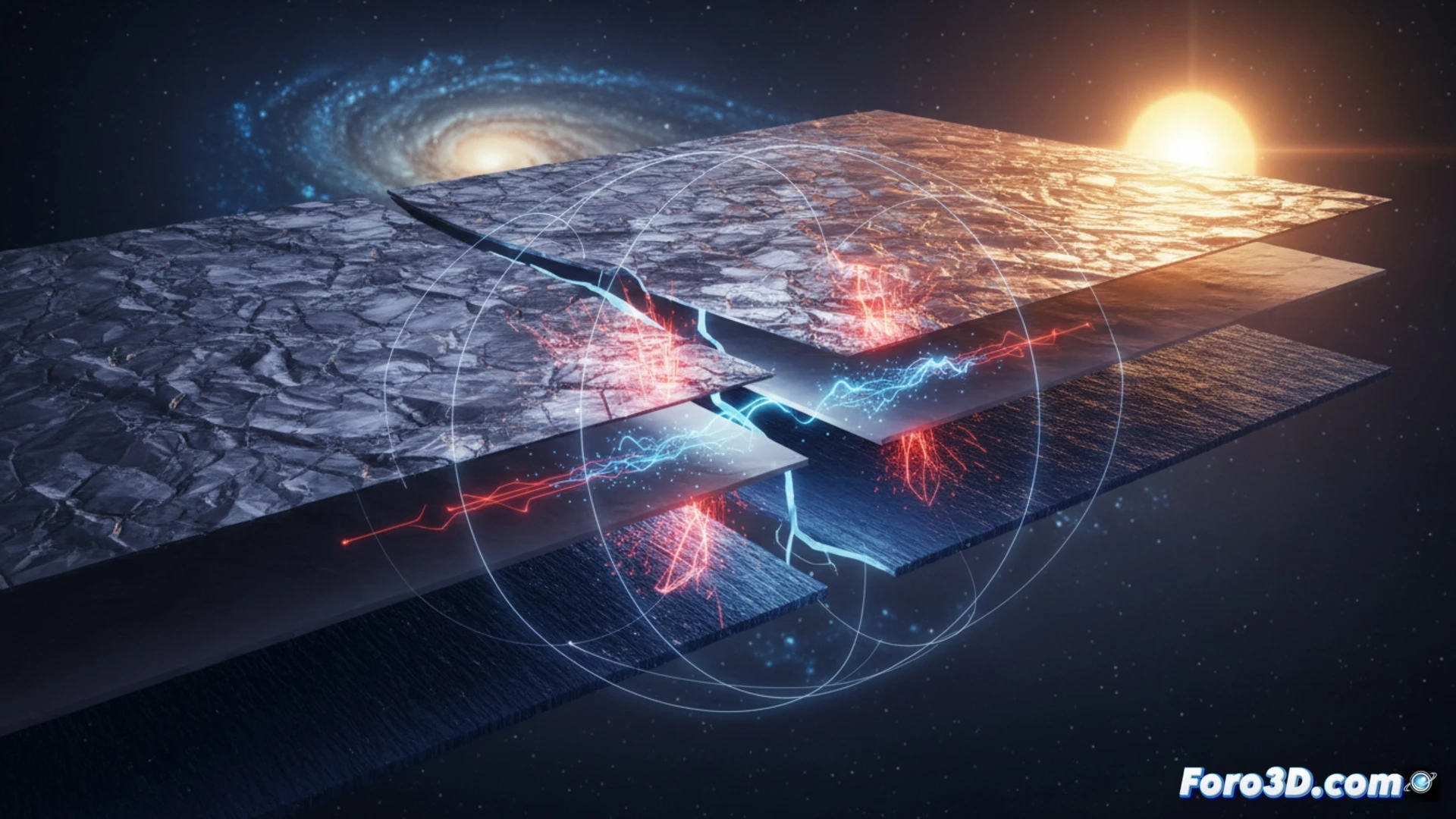
The delamination of an experimental solar sail during its deployment phase has highlighted a critical problem in flexible materials engineering: electrostatic adhesion between layers. This failure, far from being an isolated incident, represents a perfect case study for material fatigue simulation, where surface stresses and the accumulation of electrical charges generate stress points that degrade the structural integrity of the composite.
Modeling the failure in Siemens NX and Blender with RealityCapture data 🛰️
To analyze this phenomenon, an integrated workflow was employed. First, the physical prototype of the sail was digitized using RealityCapture, obtaining a high-fidelity mesh that reflected the material's surface micro-imperfections. This geometry was imported into Siemens NX for a finite element analysis, where the electrostatic forces between layers were modeled as variable distributed loads. The fatigue simulation focused on the fold and initial contact zones, identifying critical points where adhesion exceeded the material's cohesive strength. Subsequently, in Blender, the animation of the failed deployment was recreated, applying NX stress maps to visualize the progression of delamination and visually validate the fatigue data.
Lessons for flexible space structures and future simulations 🔬
This case demonstrates that fatigue in flexible materials depends not only on cyclic mechanical loading but also on surface phenomena such as electrostatics, often overlooked in traditional models. For future designs, it is recommended to include electrostatic friction coefficients and variable dielectric properties in Siemens NX simulations. The combination of RealityCapture to capture physical reality and Blender for didactic visualization of the failure allows engineers to anticipate complex failure modes, improving the robustness of solar sails before their deployment in space.
It is possible to accurately model fatigue due to electrostatic adhesion in solar sails when delamination occurs during dynamic deployment, a phenomenon difficult to replicate in traditional static or quasi-static simulations.
(PS: Material fatigue is like yours after 10 hours of simulation.)