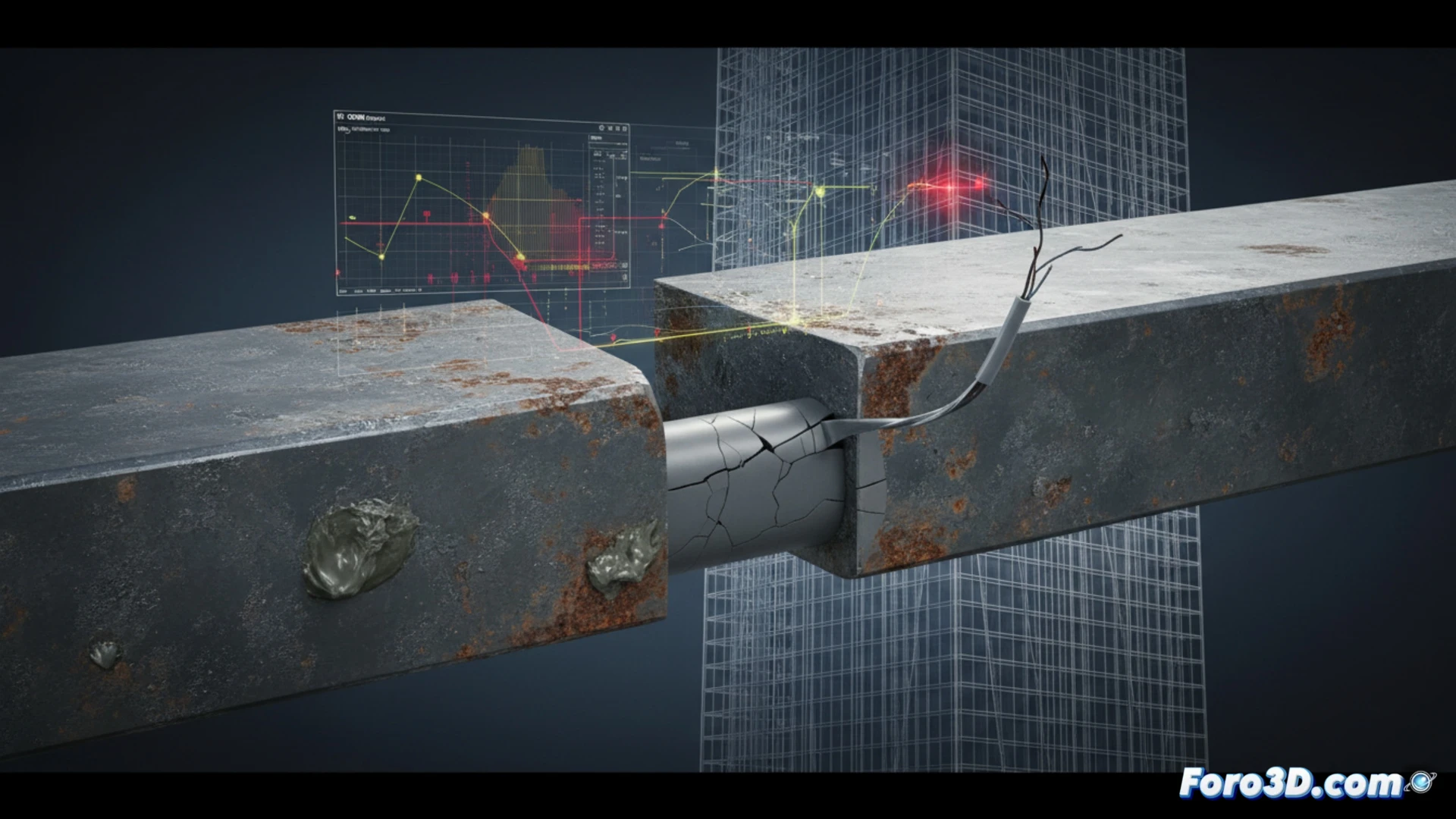
The structural health monitoring (SHM) system of a skyscraper lost the signal from its base sensors, revealing a delamination of the epoxy adhesive. The 3D scanning of the bonding areas identified that poor surface cleaning of the steel before assembly was the root cause. This failure, detected using GOM Inspect and Leica Cyclone, compromises the integrity of fatigue monitoring in the structure.
Diagnosis with 3D scanning and simulation in SAP2000 🏗️
The analysis with GOM Inspect allowed visualizing the separation of the adhesive from the metal surface, evidencing an inadequate surface preparation that generated stress concentrations at the interface. The poor cleaning caused premature fatigue of the epoxy, reducing its service life under cyclic loads. With SAP2000, we simulated the impact of signal loss on structural monitoring: without the base data, the skyscraper's fatigue model becomes blind to critical deformations in the lower floors, increasing the risk of undetected cracks.
Lessons for the durability of SHM sensors 🔍
This case demonstrates that adhesive fatigue is not just a mechanical problem, but a reflection of the assembly process quality. Post-failure 3D scanning is a key forensic tool to identify delaminations before they affect overall integrity. For engineers, the lesson is clear: rigorous surface preparation is as critical as sensor selection, since an adhesive failure silences the structural voice of the skyscraper.
What steel surface preparation techniques are critical to avoid delamination and premature failure of strain gauges in skyscraper SHM systems?
(PS: Material fatigue is like yours after 10 hours of simulation.)