A vessel with a reduced radar signature, designed to be invisible, was detected by a long-range enemy radar. Subsequent investigation, using laser reflectometry and wave simulations, revealed the cause: the radar-absorbent metamaterial panels suffered from microscopic delamination. The pathogenic agent was not ballistic impact, but environmental salinity, a silent enemy that degrades the internal structure of the composite.
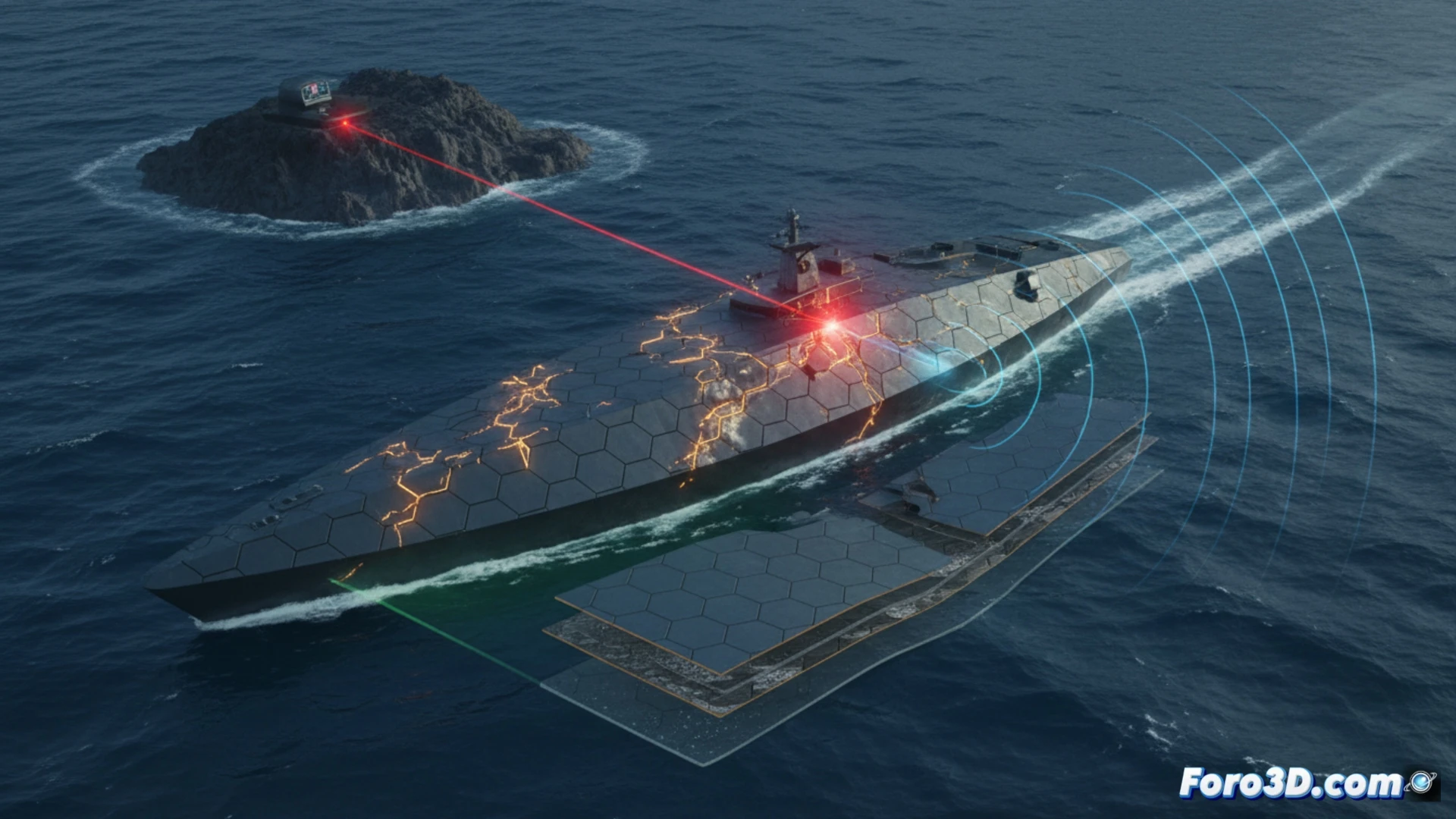
Technical workflow: from point cloud to HFSS simulation 🛠️
The forensic process began with RealityCapture to generate a precise 3D mesh of the hull from photographs and laser scans. This geometry was imported into Rhino, where the suspicious panels were isolated and the metamaterial microstructure was modeled. The critical step was the simulation in ANSYS HFSS. By applying boundary conditions that replicated saline humidity, the electromagnetic wave solver identified a deviation in dielectric permittivity. This anomaly, invisible to the human eye, corresponded to a separation between layers of just 15 microns, enough to detune the material's resonance frequency and reflect the enemy radar wave.
Towards predictive inspection based on dielectric fatigue ⚡
This case demonstrates that material fatigue depends not only on mechanical cycles, but also on chemical and electromagnetic stress. For naval maintenance, the solution is not a thicker coating, but a digital twin of the vessel. I propose integrating humidity sensors into the metamaterial matrix and feeding that data in real-time to an HFSS model. This way, delamination could be predicted before the radar signature degrades, scheduling panel replacements based on accumulated saline corrosion, not fixed calendars.
In a vessel designed for stealth, how does delamination of radar-absorbent metamaterials affect not only structural integrity, but also the resonance frequency and electromagnetic scattering pattern that enables its detection?
(PS: Material fatigue is like yours after 10 hours of simulation.)