A 3D-printed car suffered internal delamination during stress tests, revealing a critical gap in the design process. Lateral G-forces, not modeled in the simulation phase, caused layer separation in the structure. This incident underscores the need to integrate dynamic fatigue analysis into additive manufacturing, where multidirectional stresses can exceed static predictions.
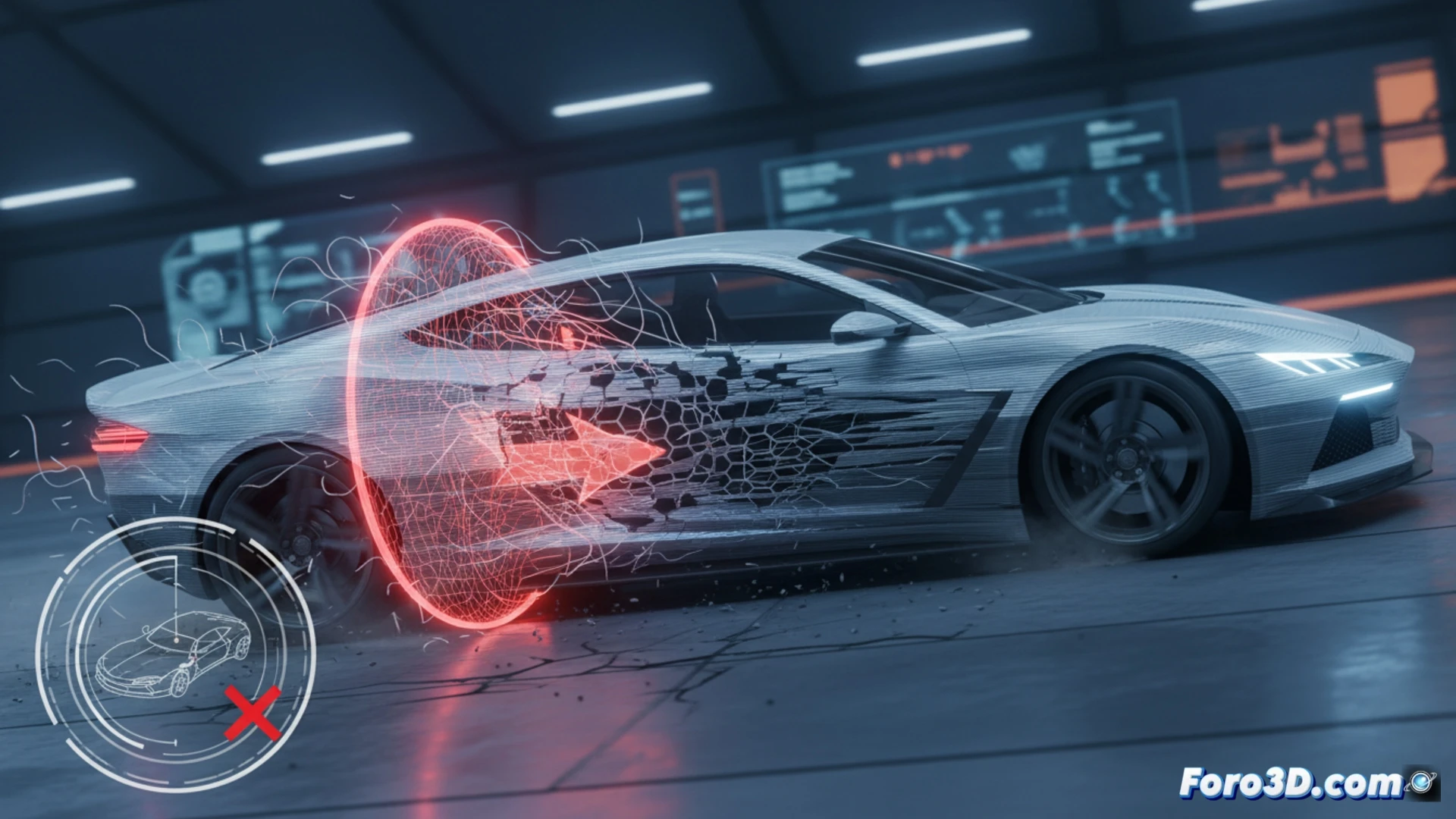
Workflow: from simulation to structural failure 🛠️
The design team used Altair Inspire for the initial simulation, focusing on vertical and torsional loads, but omitting the lateral loads generated in sharp turns. After the failure, RealityCapture was used to digitize the damaged part, creating a high-fidelity 3D model of the delaminated area. This model was imported into GOM Inspect to perform deformation and residual stress analysis, confirming that internal microcracks originated from unforeseen cyclic fatigue. The comparison between the ideal design and the actual part revealed that the orientation of the print layers was vulnerable to lateral shear stresses.
Lessons for the additive manufacturing pipeline 📐
To prevent future failures, the pipeline must include multiaxial fatigue simulations in Altair Inspire that consider dynamic lateral loads. Post-verification with GOM Inspect and RealityCapture should be performed not only on failed parts but as systematic quality control. Integrating these three programs into an iterative workflow allows identifying hidden stress points, ensuring that the lightness of the 3D design does not compromise structural integrity under real driving conditions.
How can lateral load fatigue simulation be incorporated into the design workflow of 3D-printed parts to predict and prevent delamination before physical testing?
(PS: Material fatigue is like yours after 10 hours of simulation.)