The collapse of a cross-laminated timber (CLT) pedestrian bridge during an extreme rainfall event revealed critical failures in the adhesive interface between layers. To quantify microscopic delamination, a reverse engineering workflow combining laser scanning with structural simulation was applied. This article breaks down the technical process for measuring composite material degradation and validating fatigue models under water saturation conditions.
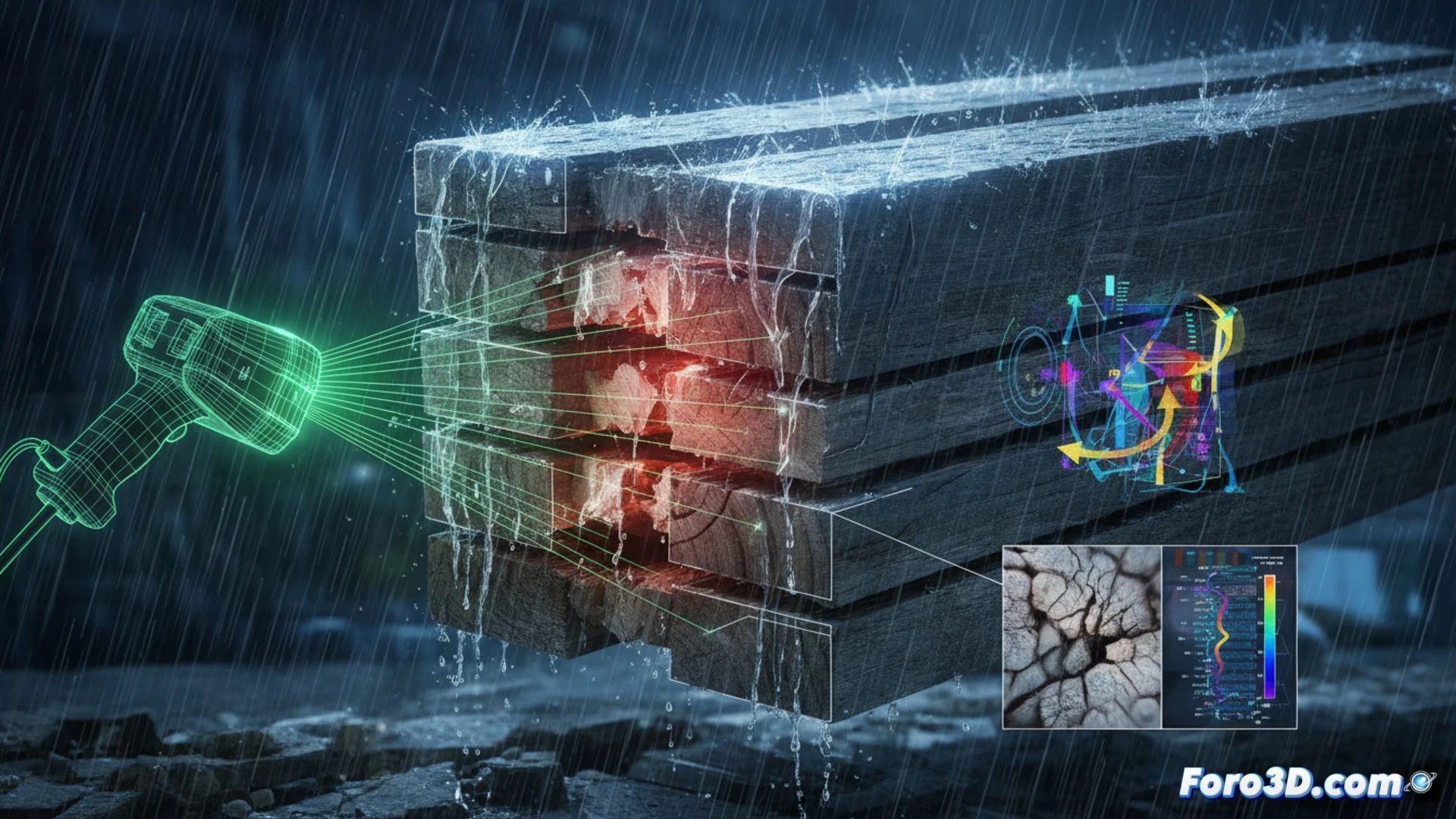
Technical Workflow: From Laser Scanning to Finite Element Analysis 🔬
The process began with capturing the geometry of the collapsed bridge using a Leica scanner, managed in Leica Cyclone to generate a high-density point cloud. This cloud was exported to CloudCompare, where a segmentation algorithm was applied to isolate areas with interlaminar separation. Point cloud comparison (M3C2) allowed detection of displacements in the micron range between the timber layers. These deformation data were input into Dlubal RFEM, where the orthotropic behavior of CLT under cyclic moisture loads was modeled. The fatigue simulation showed that shear stress at the interface exceeded the adhesive's elastic limit after 48 hours of continuous rainfall, generating progressive microcracks that led to catastrophic failure.
Lessons for Adhesive Design in Weather-Exposed CLT 🛠️
The correlation between scanning data and the RFEM model demonstrated that conventional polyurethane adhesives do not maintain their cohesive strength under swelling and shrinkage cycles. It is recommended to implement modified epoxy resin adhesives with greater resistance to hydrolysis and to conduct accelerated aging tests in a climate chamber. CloudCompare is positioned as an essential tool for non-destructive inspection, allowing engineers to detect incipient delamination before it compromises structural integrity.
As extreme weather is an increasingly common factor, what finite element simulation methodology do you recommend for modeling delamination propagation in CLT under cyclic rainfall-induced loads?
(PS: Material fatigue is like yours after 10 hours of simulation.)