Every year, thousands of surgical interventions are compromised by millimeter deviations in the scalpel's trajectory. The recent case of Scalpel Error in the Operating Room, where a poorly planned incision damaged critical vascular structures, reminds us that the 2D view of a CT scan is not enough. The solution lies not in the surgeon's hand, but in the exact replica of the patient's anatomy that we can manufacture before opening the skin.
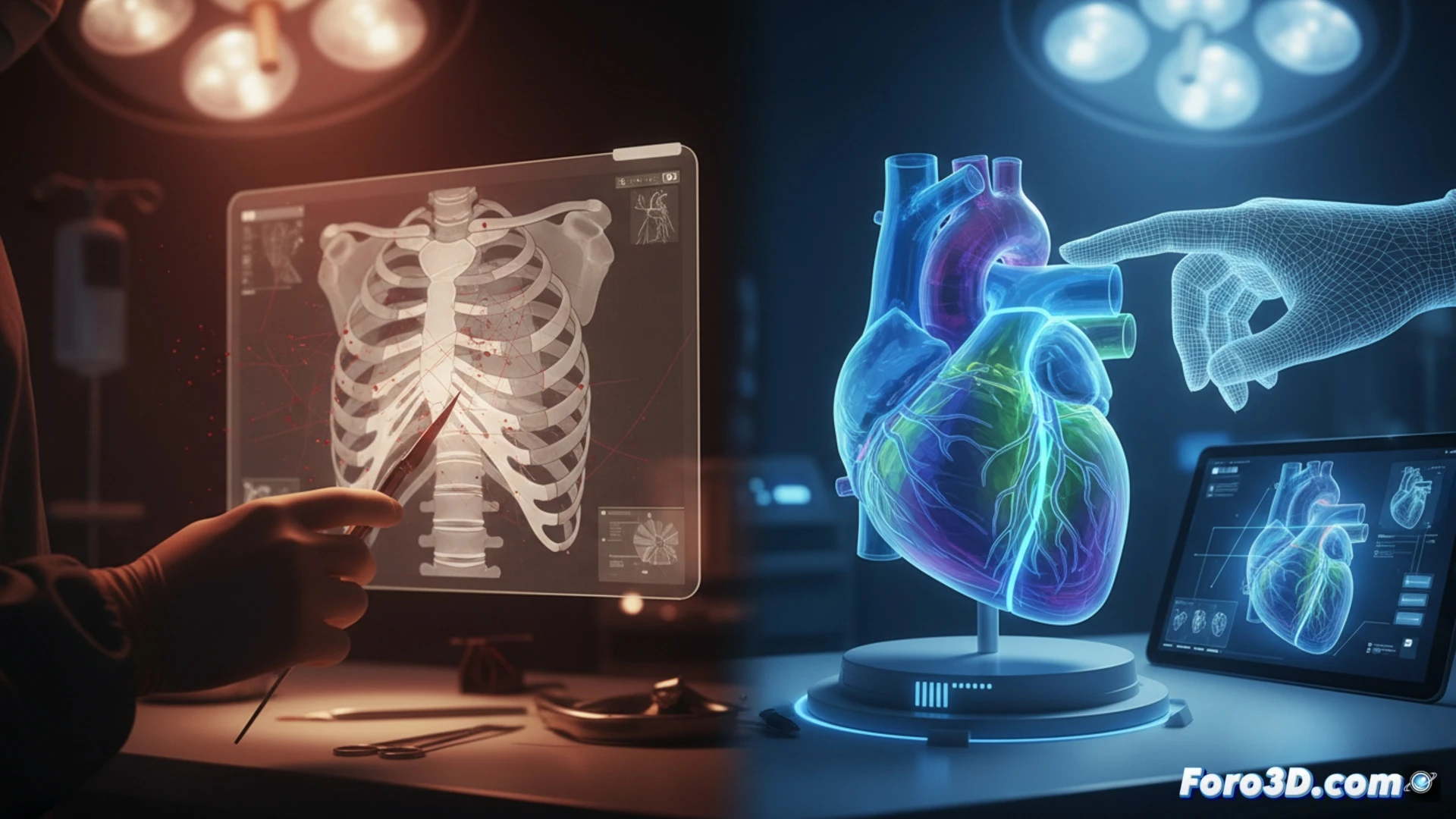
DICOM Segmentation and Prototyping for Pre-Surgical Planning 🏥
The workflow begins with the acquisition of medical images in DICOM format. Using segmentation software such as Mimics, 3D Slicer, or InVesalius, the structures of interest are isolated: tumors, vessels, and bones. This process allows for generating a virtual 3D model where the surgeon can simulate the scalpel's trajectory. Subsequently, through 3D printing with filaments like medical PLA or biocompatible resins (Formlabs Dental SG or Somos PerFORM), a high-fidelity physical model is manufactured. This model allows practicing real incisions, evaluating entry angles, and avoiding risk areas, reducing the operating room error margin to less than 1 mm.
When Practice Saves Lives: Success Stories in Complex Surgery 🧠
At La Paz University Hospital, a neurosurgery team used a 3D model of the skull base to remove a meningioma adhered to the carotid artery. The surgeon was able to rehearse the tumor dissection on the printed model, identifying the exact point where the incision needed to be tangential to avoid severing the vessel. The actual operation took 30% less time, and the patient presented no neurological deficits. Without the physical replica, the risk of a scalpel error was unacceptably high.
As a surgeon who has gone from correcting millimeter errors with the scalpel to planning every cut with 3D models, what has been the greatest technical or ethical challenge you have faced when integrating this digital precision into the real operating room?
(PS: If you print a 3D heart, make sure it beats... or at least that it doesn't cause copyright issues.)