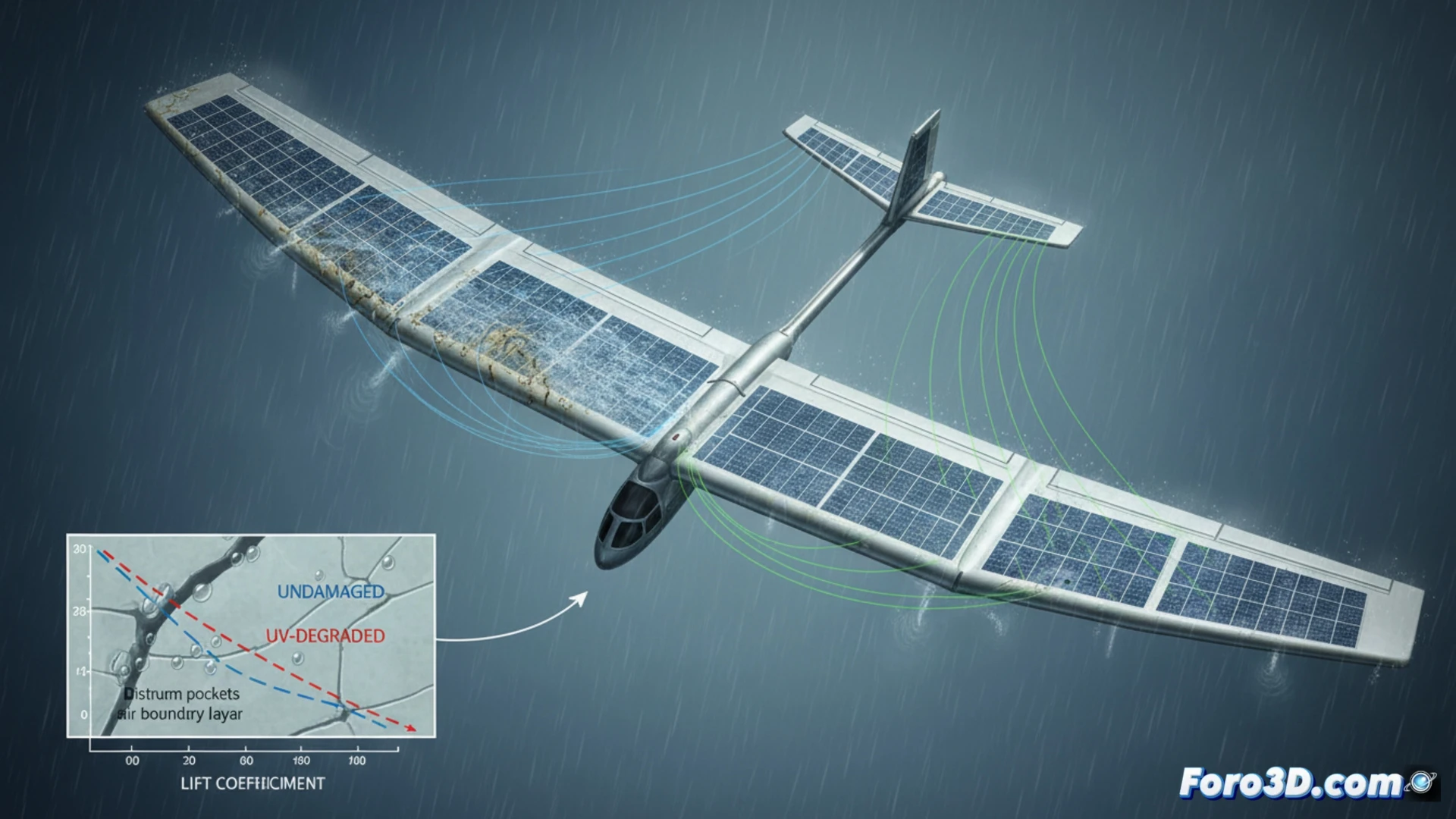
A large solar aircraft experiences a critical loss of lift during light rain, a phenomenon that defies predictions from standard aerodynamic models. The main hypothesis points to the degradation of the wing's super-hydrophobic coating, caused by prolonged exposure to ultraviolet radiation. This degradation allows the formation of a microscopic water layer that alters the laminar profile of the airflow.
Atomic-resolution 3D pipeline for forensic surface analysis 🛰️
The analysis protocol begins with capturing the wing's microtexture using GOM Inspect, generating a high-density point cloud that reveals nanometric irregularities in the coating. This data is processed in MATLAB to filter noise and extract surface roughness parameters. The correlation between roughness and loss of hydrophobicity is validated through simulations in Ansys Fluent, where a boundary layer with altered wettability properties is introduced. Results show that a reduction in the contact angle below 120 degrees triggers the transition from laminar to turbulent flow, increasing aerodynamic drag by 15%.
The hidden lesson in a raindrop 💧
This case demonstrates that material fatigue depends not only on cyclic mechanical loads but also on silent environmental stress, such as UV radiation. The synergy between CFD simulation and atomic-scale surface analysis becomes an indispensable tool for predicting failures in aeronautical components exposed to real-world conditions. Ignoring the chemical degradation of the coating can turn light rain into a catastrophic event.
How can we quantify the synergistic effect of UV radiation and humidity on the fatigue of solar wing coatings and its direct impact on the lift coefficient during light rain flight conditions?
(PS: Material fatigue is like yours after 10 hours of simulation.)