A next-generation satellite lost its beamforming capability after being exposed to extreme thermal cycles in orbit. The metamaterial antenna, designed to steer beams with nanometric precision, suffered deformations imperceptible to the naked eye but devastating to the signal phase. This article breaks down the simulation, validation, and analysis process that revealed the true cause of the failure.
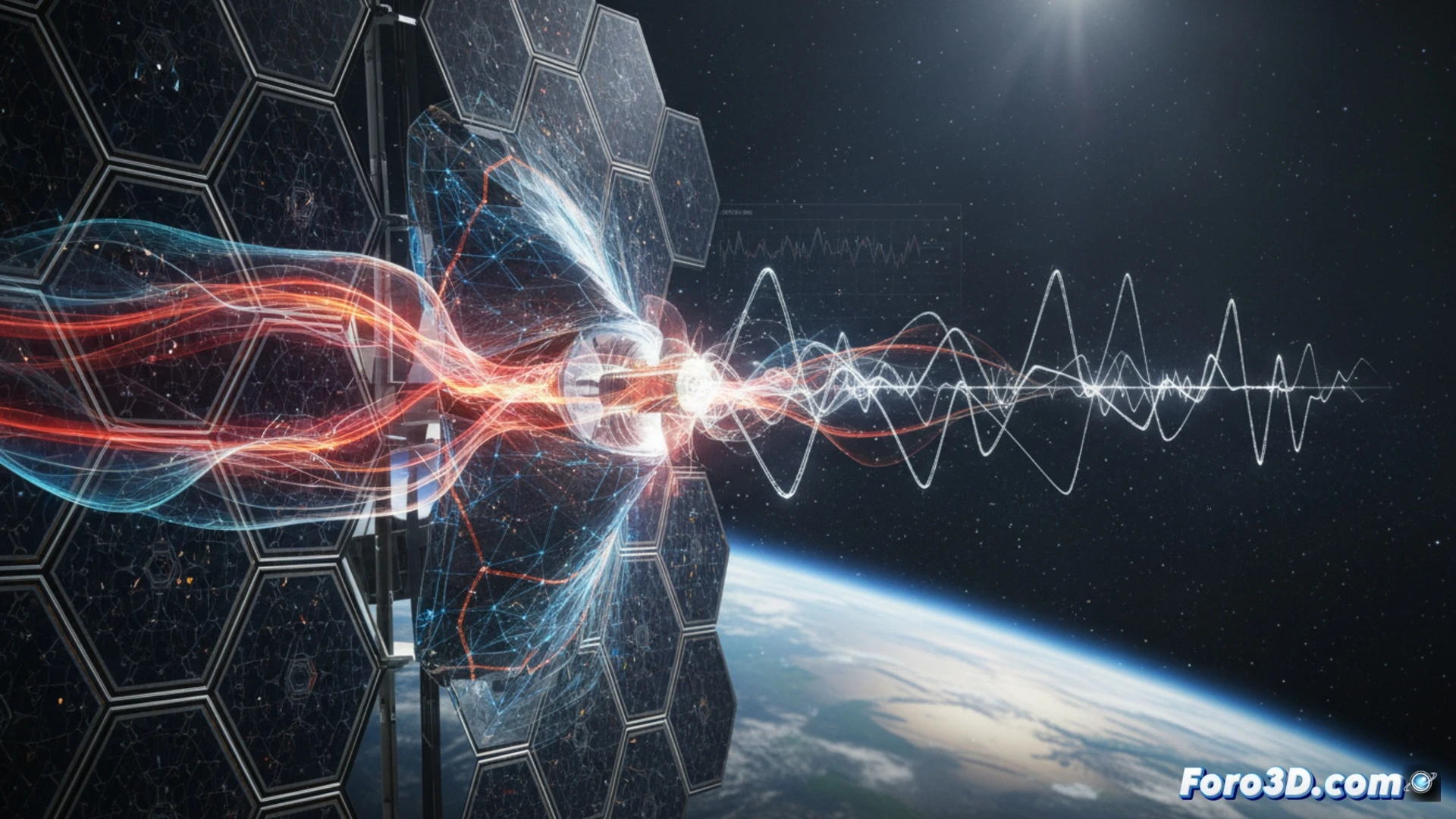
Electromechanical modeling in CST Studio Suite and validation with GOM Inspect 🛰️
The simulation team built a digital twin of the antenna in CST Studio Suite, applying thermal loads ranging from -150°C to +120°C to replicate the orbital environment. The metamaterials, composed of split-ring resonators on a dielectric substrate, exhibited anisotropic thermal expansion coefficients that distorted the periodicity of the structure. The deformed meshes were exported to GOM Inspect, where they were compared with 3D scans of the actual antenna. The correlation revealed deviations of up to 12 micrometers at the patch edges, a critical threshold that altered the excitation phase of each radiating element, reducing the main beam gain by 4.7 dB.
Processing in MATLAB reveals the invisible limit of materials 🔬
The deformation maps and thermal distributions were imported into MATLAB for a spectral phase analysis. Using a two-dimensional Fourier transform, spurious harmonics were identified that corresponded to deformation modes resonant with the 60 GHz operating frequency. The prediction algorithm determined that after 200 thermal cycles, the probability of maintaining beamforming above 90% efficiency dropped to 23%. The metamaterial fatigue was not structural, but functional: the material did not break, but it lost its ability to control the wavefront.
As a simulation engineer, which thermal fatigue parameters in the metamaterial microstructure did you consider critical for predicting the silent beamforming failure in the 6G satellite, and how did you model the accumulated deformation under extreme orbital cycles?
(PS: Material fatigue is like yours after 10 hours of simulation.)