The Ecovacs DEEBOT T30 PRO introduces an unprecedented mechanical solution in the autonomous vacuum segment: a motorized extendable arm that emerges laterally to reach edges and corners. This innovation, dubbed TruEdge technology, directly tackles the classic problem of perimeter coverage, where proximity sensors typically leave an uncleaned strip. We analyze the mechanical design and control logic that make this millimeter precision possible.
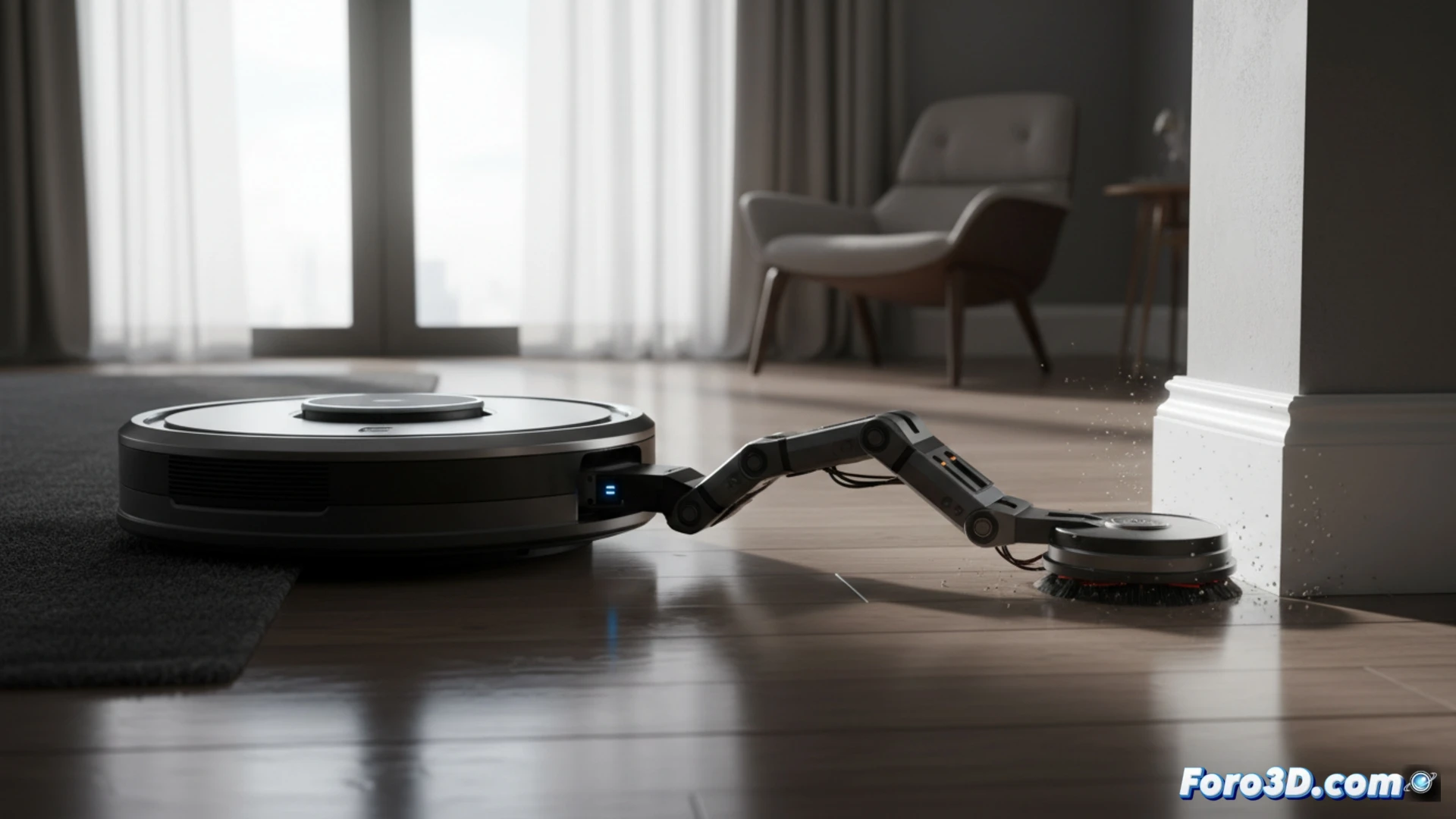
TruEdge Mechanism and Extension Dynamics 🤖
The system is based on a linear actuator integrated into the robot's chassis. When proximity sensors detect a wall or vertical obstacle, the arm deploys horizontally up to 8 centimeters, pushing the side brush to the exact edge of the wall. The joint uses a stepper motor with a position encoder, allowing fine control of contact pressure. Unlike fixed brushes that rotate at constant speed, the T30 PRO modulates brush rotation based on distance to the obstacle, avoiding abrupt impacts and maximizing particle transfer. 3D trajectory simulation shows the arm automatically retracts when approaching low furniture or cables, preventing snags through a torque sensor on the extension shaft.
Real Innovation or a Solution to an Already Solved Problem? 🧐
Compared to robots using static side brushes or laser navigation systems that optimize trajectory to cover edges, the T30 PRO introduces active movement of the cleaning element. While the Roomba j7+ relies on its camera to map and approach walls, and the Roborock S8 uses a silicone brush that flexes against edges, Ecovacs' extendable arm offers a direct mechanical solution that reduces dependence on approximation algorithms. The key question is whether this added complexity justifies the energy cost and potential actuator wear compared to passive solutions on the market.
Since the DEEBOT T30 PRO uses a motorized extendable arm to reach corners, how could this mechanical innovation be applied to industrial robotic arms to automate cleaning tasks in hard-to-reach spaces within factories or warehouses?
(PS: Simulating robots is fun, until they decide not to follow your orders.)