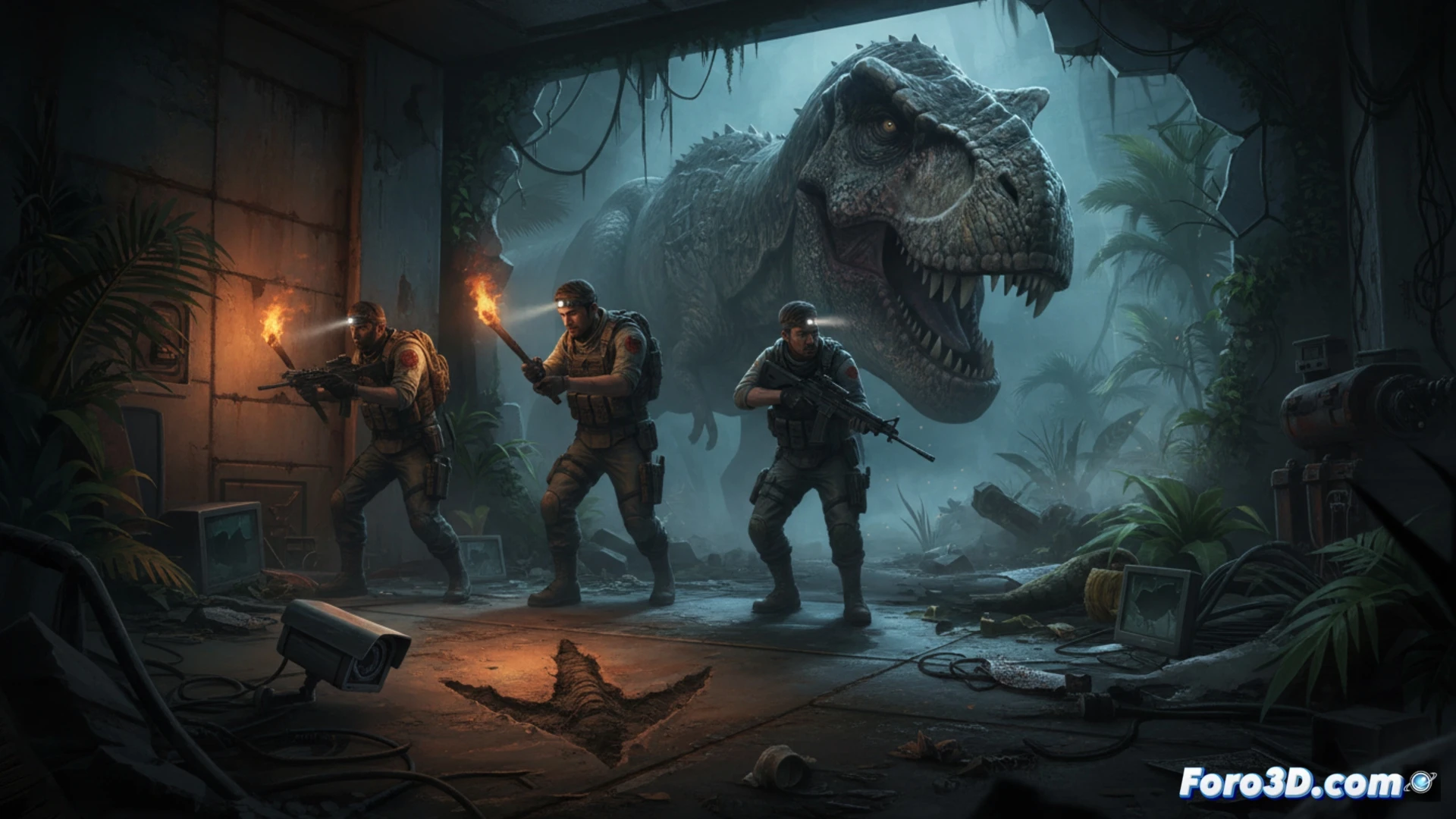
Jaw Drop Games studio has presented Deathground, a cooperative survival horror where dinosaurs are the main threat. This indie title aims to compete visually with major productions thanks to its intensive use of Unreal Engine 5. The project demonstrates that a small team can achieve a photorealistic finish by correctly applying scanning, modeling, and texturing tools along with a dynamic lighting system that generates constant environmental tension.
Asset pipeline: ZBrush, Substance 3D and Nanite 🦖
To create the dinosaurs and environments, the team begins by sculpting high-resolution models in ZBrush, capturing details of skin, scales, and wear. Then, these models are retopologized to optimize their base mesh. Texturing is done in Substance 3D Painter, where multilayer materials are generated with roughness, metallicity, and displacement maps. The key step is integration into Unreal Engine 5 using the Nanite system, which allows importing the sculpted models directly without needing to reduce polygons. This maintains the original asset quality while the engine manages the level of detail in real-time, freeing up resources for lighting. To optimize performance, it is recommended to use Lumen only for global illumination and combine pre-calculated shadows in static areas.
Environmental tension through light and sound 🎮
The oppressive atmosphere of Deathground is built with real-time lighting that prioritizes point light sources (flashlights, emergency lights) over ambient light. Lumen allows reflections and occlusion to change instantly when a dinosaur blocks a beam of light, generating visual panic. Audio design, although not the graphic focus, is equally critical: footsteps on dry leaves or distant roars blend with lighting to create tension peaks. Indie developers should prioritize a reduced number of dynamic lights and use post-processing (vignetting, grain) to hide imperfections in low-light environments, maximizing immersion without sacrificing frames.
What optimization techniques in Unreal Engine 5 did Jaw Drop Games use to achieve the photorealism of Deathground without compromising performance in scenes with multiple dinosaurs and online cooperative play?
(PS: shaders are like mayonnaise: if they break, you start all over again)