Independent video game development reaches new heights of realism with Death in the Water 2, a sequel that immerses the player in a nightmare ocean. This title, built on Unity, not only promises terror but also a top-tier technical showcase. We have analyzed the artistic pipeline behind its creatures and effects, from modeling in Blender to real-time light simulation, to understand how that visual impact that challenges current hardware is achieved.
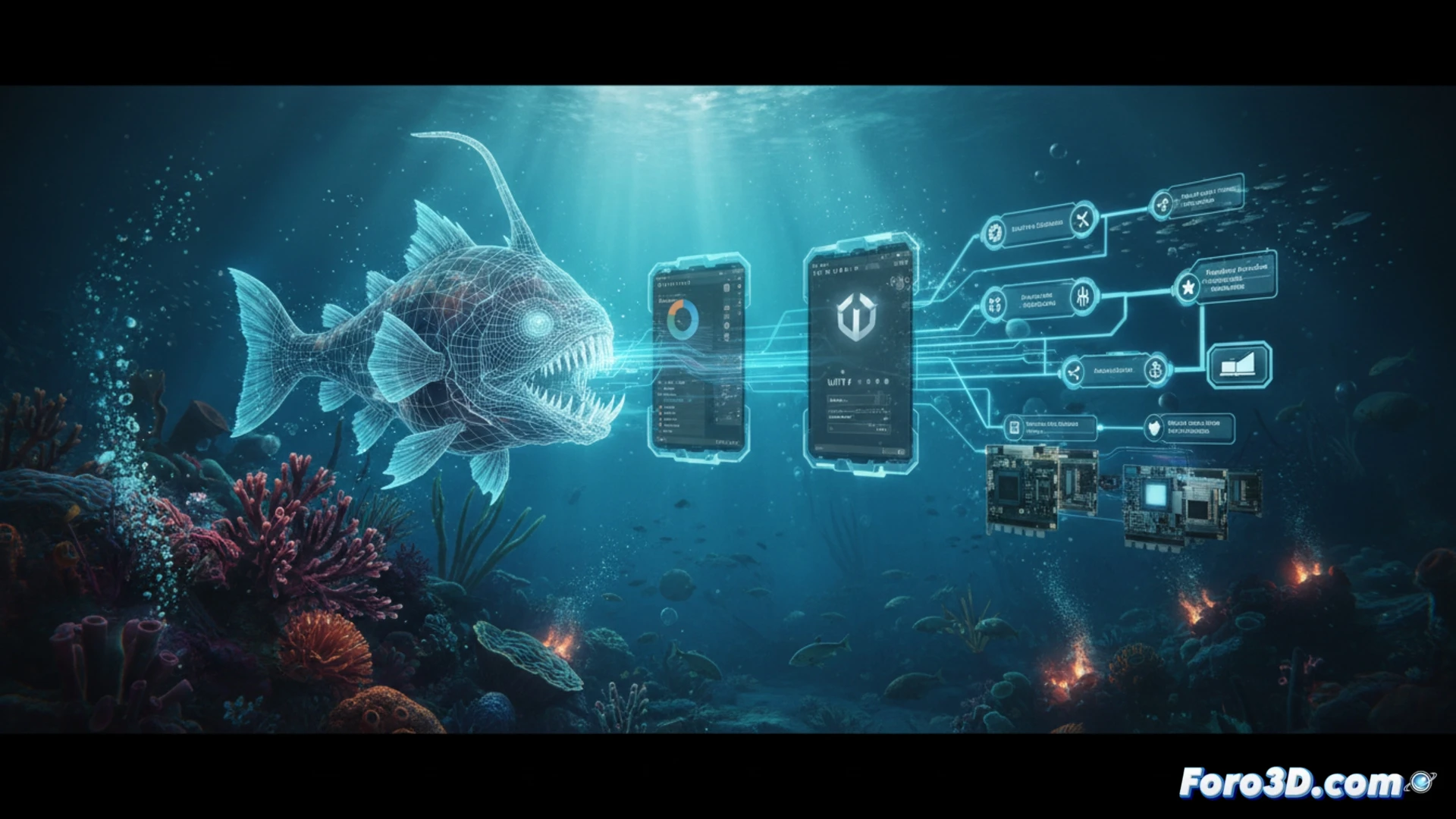
Pipeline Breakdown: Caustics, Particles, and Photorealism in Real Time 🌊
The secret of underwater realism in Death in the Water 2 lies in the combination of three technical pillars. First, Unity's caustics system, which uses custom shaders to project patterns of refracted light onto the seabed and models, simulating the dynamics of surface water. Second, the volumetric particle system, which recreates suspended sediment and plankton, giving density to the water. Third, creature modeling: the sharks and mythological monsters were sculpted in Blender with topology optimized for animation, and textured in Substance Painter using high-frequency roughness and normal maps. The key was optimization for real-time: polygon count was reduced by 40% through manual retopology, preserving details from 4K textures compressed in ASTC format to maintain smoothness on consoles and PCs.
Lessons for Developers: The Balance Between Spectacle and Performance 🎮
In an exclusive interview, the lead developer confessed that the biggest challenge was not modeling the sea monster, but ensuring its dynamic shadow did not crash the framerate. The solution was to implement aggressive LOD (Level of Detail) for particles and use baked lighting for static scenes. For independent creators, the lesson is clear: realism in Unity does not depend on the most powerful hardware, but on intelligent management of visual resources. Death in the Water 2 demonstrates that, with a disciplined workflow between Blender, Substance Painter, and the engine, an ocean of terror can be created that runs on mid-range equipment.
What shading and post-processing techniques did the Death in the Water 2 team use in Unity to simulate light dispersion and suspended particles underwater, and how did they optimize performance to maintain real-time realism?
(PS: shaders are like mayonnaise: if they break, you start all over again)