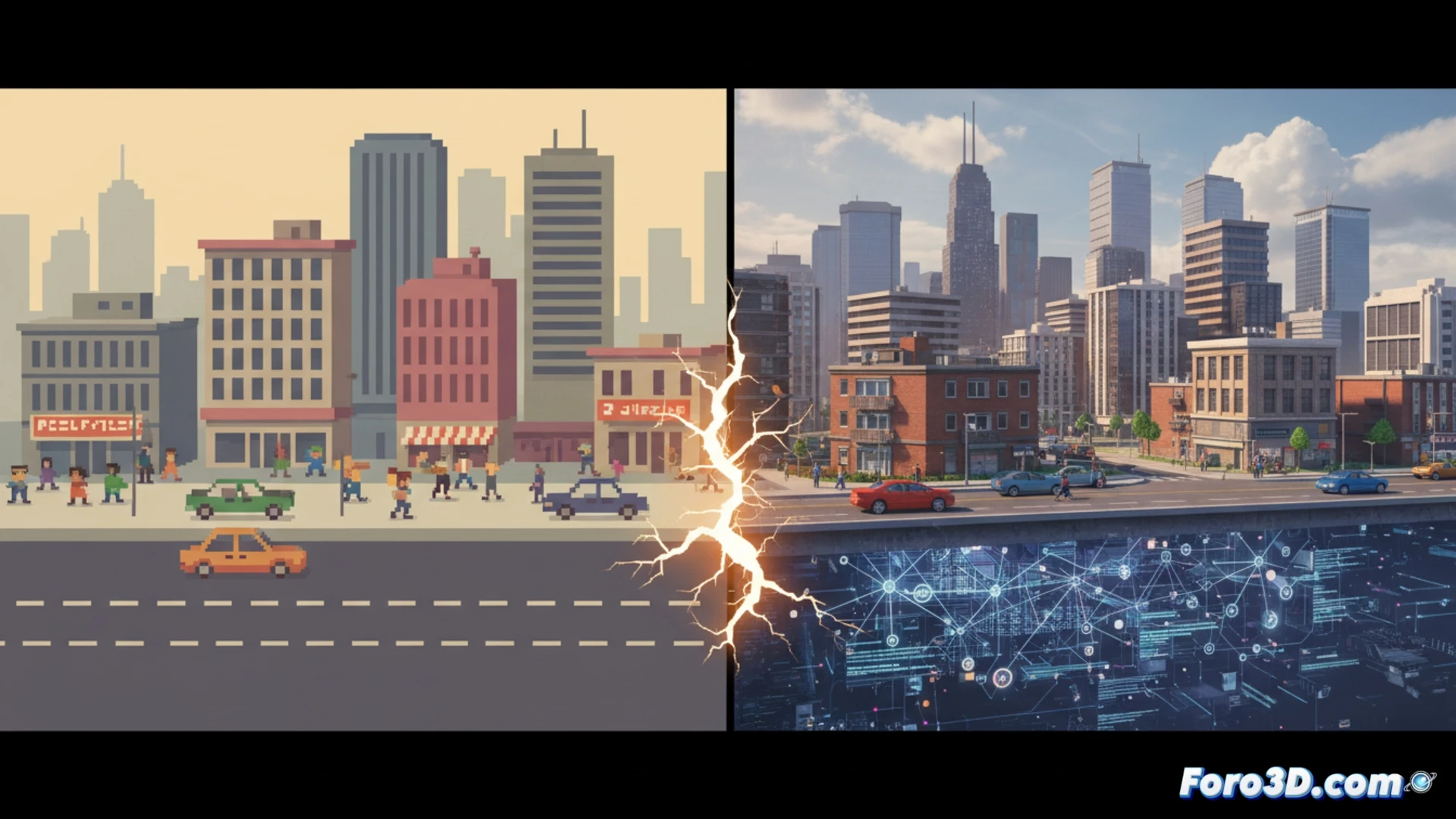
Streets of Rogue 2 represents a milestone in the technical evolution of immersive simulators. The studio has abandoned the static pixel art of the first installment to embrace a massive open world in a top-down perspective, developed entirely in Unity. This change not only implies a visual redesign but a deep restructuring of the physics engine and asset management, where every player interaction with the environment must be calculated in real-time without sacrificing performance.
Physics optimization and asset pipeline in Unity 🎮
The main technical challenge has been implementing complex physics systems on a massive map from a top-down view. In Unity, the team had to optimize the use of colliders and rigidbodies to avoid engine overload when hundreds of objects interact simultaneously (explosions, vehicles, NPCs). To achieve this, spatial partitioning and dynamic LOD techniques for physical objects were employed. In the graphical workflow, Adobe Photoshop has played a crucial role: the original sprites of characters and props have been redrawn in high resolution to then be imported as 2D texture atlases in Unity, while scene elements (buildings, vegetation) have been modeled as flat 3D objects with pre-calculated lighting to maintain the top-down aesthetic without losing depth.
Lessons for indie developers in Unity 🛠️
The transition of Streets of Rogue 2 demonstrates that scaling a project from pixel art to an open world is not just a matter of increasing asset resolution. The biggest lesson lies in memory management and the object lifecycle. By prioritizing asynchronous loading of map chunks and deactivating physics for objects outside the player's field of view, the team has managed to maintain a stable frame rate. For developers working with Photoshop and Unity, this case confirms that pre-production of assets with separate layers (environment, characters, effects) streamlines the implementation process in the engine, reducing compilation times and real-time overlay errors.
What specific technical challenges in Unity did the team face when migrating from a 2D pixel art environment to a 3D open world, and how did they solve problems such as procedural generation, performance, and adaptive AI without losing the essence of the original immersive simulator
(PS: game jams are like weddings: everyone is happy, nobody sleeps, and you end up crying)