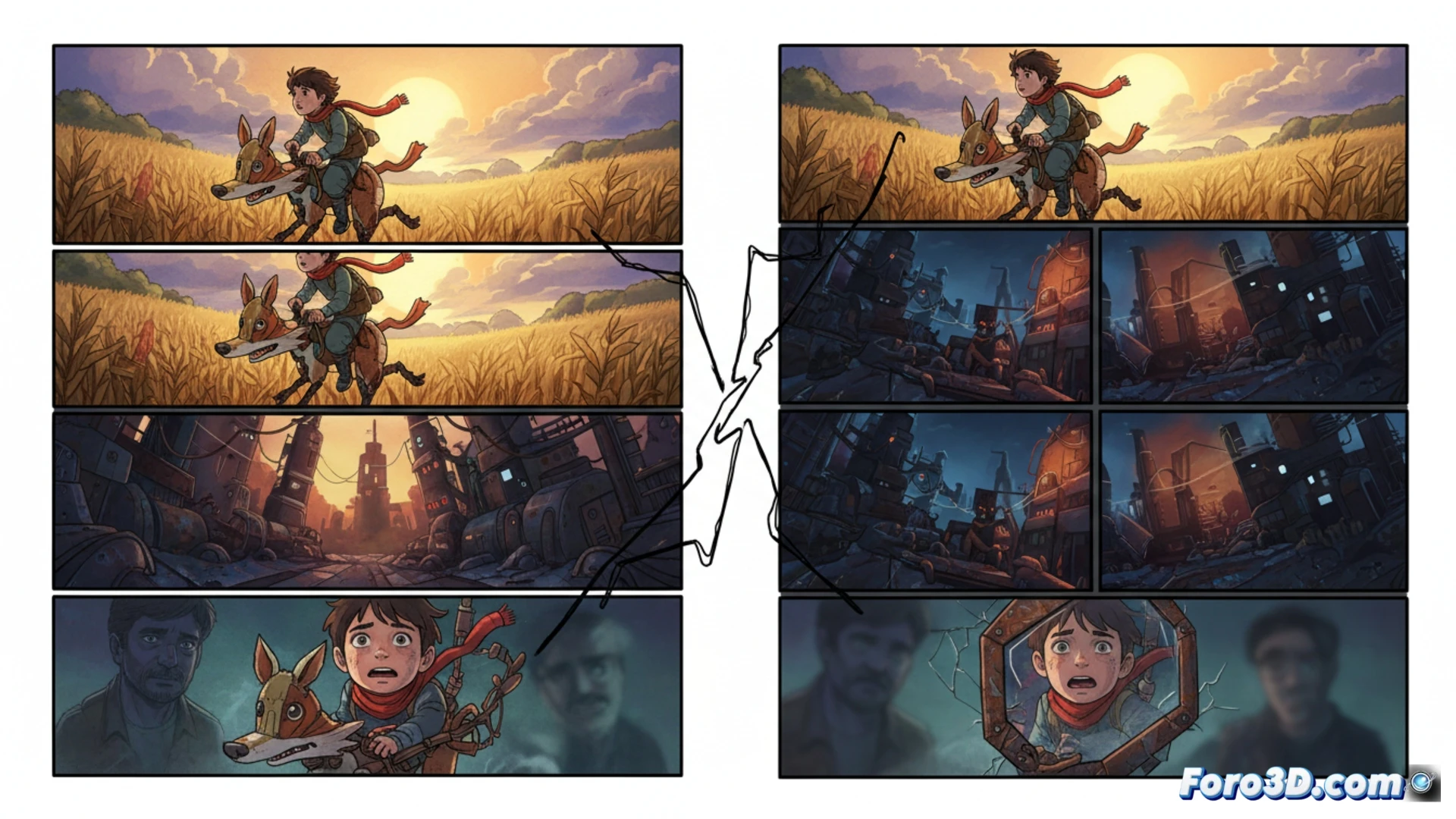
The comic Middlewest, by Skottie Young and Jorge Corona, presents a fascinating challenge for any previsualization professional. Its universe, which blends the rural aesthetic of the American Midwest with junk-punk technology and inherited, destructive magic, demands a hybrid visual treatment. For a hypothetical film adaptation, the 3D storyboard cannot simply replicate settings; it must capture the tension between the bucolic and the sinister, between Ghibli's expressiveness and the angularity of family trauma.
Lighting and framing for emotional junk-punk 🎬
Corona's visual palette is characterized by hard contrasts and angular silhouettes reminiscent of German Expressionism, but with the organic fluidity of Miyazaki. In 3D previsualization, lighting should prioritize diegetic light sources (junk car headlights, will-o'-the-wisps) to generate elongated shadows that isolate the protagonist, Abel. Framing should replicate the power narrative: low-angle shots for the father, who dominates the space as a mechanical threat, and wide open shots showing the oppressive vastness of the cornfields. The camera must move with an organic cadence, simulating a nervous pulse, to translate the comic's rhythm of action and silence panels.
Destructive heritage as camera language ⚡
Abel's power is not a simple special effect; it is an extension of his anguish. In previsualization, this power must manifest through the deformation of the 3D environment. By using fluid simulation and procedural destruction techniques, the storyboard can show how the character's rage distorts the geometry of barns and silos, turning the familiar into the threatening. The greatest technical achievement would be to avoid the clean shine of epic fantasy; instead, the texture should be dirty, metallic, and rusted, where magic feels like a painful short circuit, not a heroic flash.
How can the emotional narrative and color use of Middlewest's panels be translated into the planning of framing and visual rhythm in a 3D storyboard without losing the expressive essence of the original comic.
(PS: Previz in film is like the storyboard, but with more possibilities for the director to change their mind.)