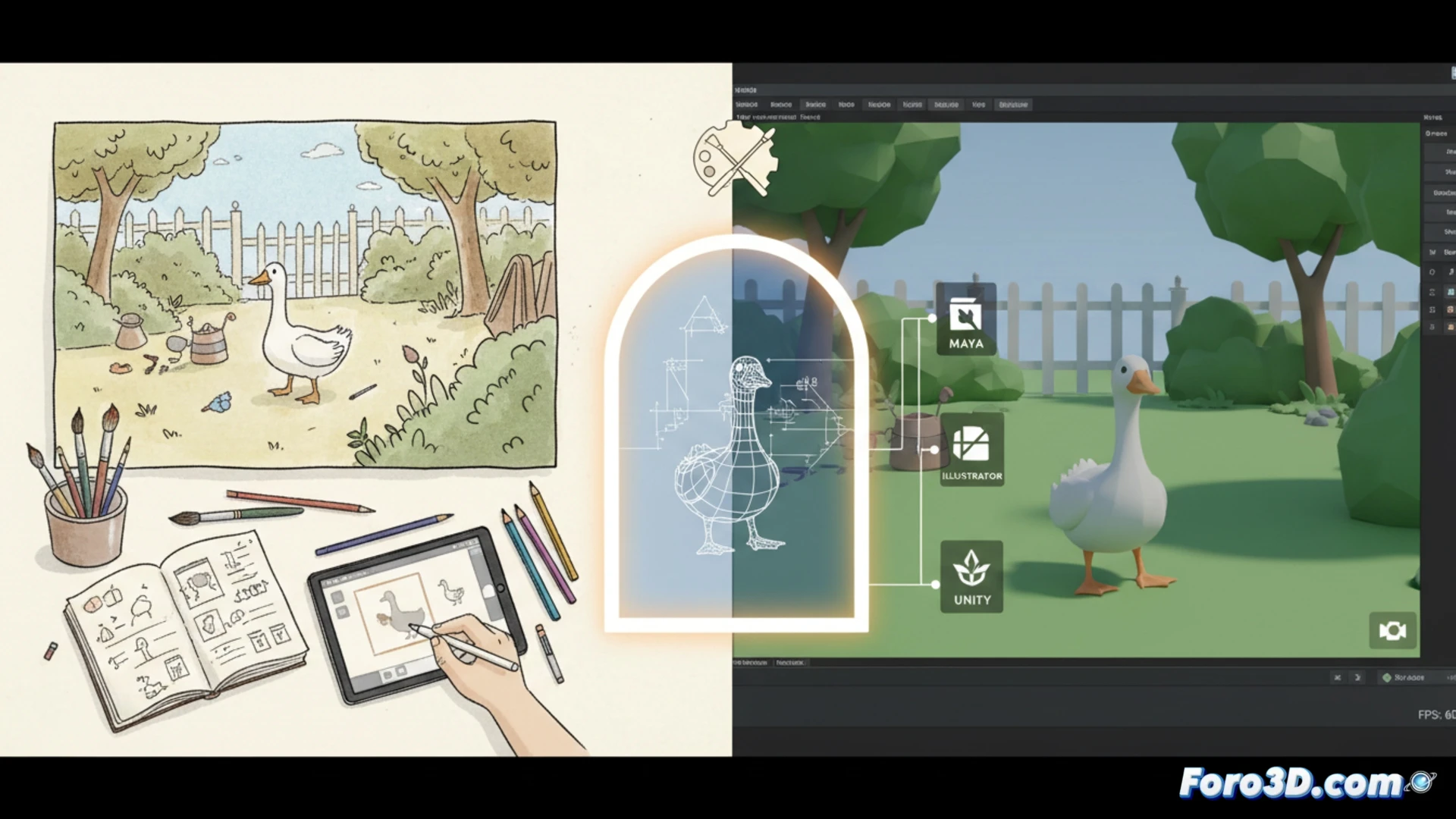
The indie phenomenon Untitled Goose Game captivated not only with its absurd humor but also with its impeccable art direction. Behind its children's book aesthetic lies a precise technical workflow combining Autodesk Maya, Adobe Illustrator, and Unity. We analyze how this trio of tools allowed House House to create a world of flat colors and clean lines, optimized for real-time rendering without losing its illustrative essence.
Flat Shaded Modeling and the Color Pipeline 🎨
The process begins in Maya, where models are built with simple geometry and low polygon density, avoiding smooth bevels to maintain the characteristic flat shading. Each character and object is exported with a mesh that relies exclusively on the engine's lighting to define its faces. The color palette is defined beforehand in Illustrator, creating a color guide that is applied directly to materials in Unity. This separation of tasks allows artists to work in a familiar vector environment, while programmers adjust the engine's lighting response in real time, making colors appear hand-painted rather than generated by complex shaders.
Optimization and Visual Coherence in Real Time ⚙️
The key to success lies in the pipeline's coherence. By not using detailed textures or normal maps, the game drastically reduces video memory consumption, allowing even modest hardware to render scenes with multiple objects. Illustrator not only defines colors but also establishes contrast and saturation rules that are directly translated into material parameters in Unity. The result is a world where every element, from the village fountain to the goose, adheres to the same visual logic, demonstrating that a strong artistic identity does not require an AAA engine, but rather disciplined technical planning.
As art director at House House, what was the biggest technical challenge when translating your 2D conceptual illustrations into a 3D engine like Unity without losing the expressiveness and flat color palette that define the game's aesthetic?
(PS: 90% of development time is polishing, the other 90% is fixing bugs)