The study has revealed Summum Aeterna, a prequel that redefines the visual identity of the franchise. Abandoning the somber tone of Aeterna Noctis, the new title bets on a vibrant palette and a stylized 2D style that evokes action comics. This change not only affects the aesthetic but also redefines combat mechanics, relying on constant particle effects to enhance the feeling of speed and chaos on the Unity engine.
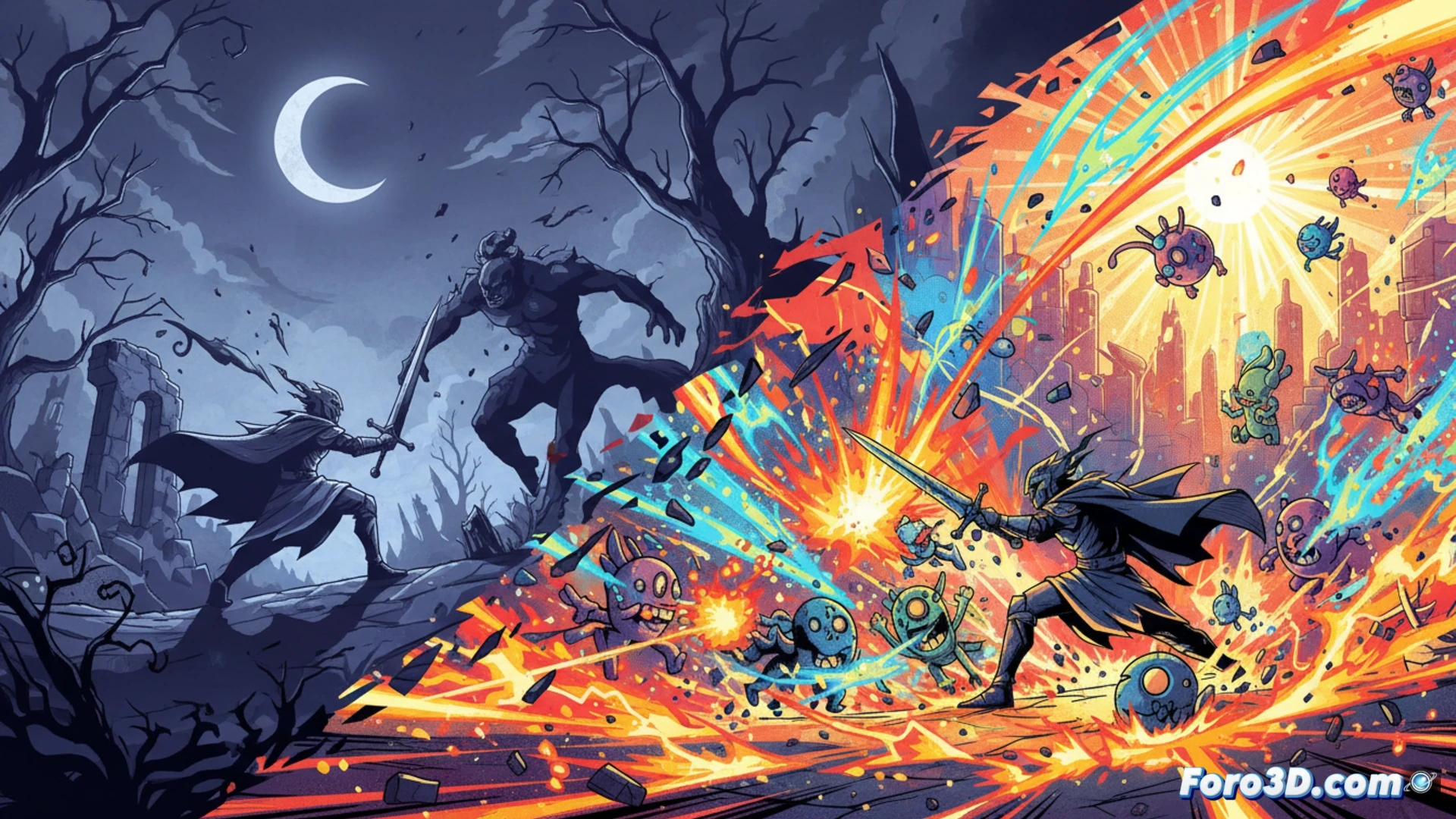
Technical pipeline: Unity, Aseprite, and Photoshop in action 🛠️
To achieve this artistic leap, the team combines three key tools. Photoshop is used for concept art and defining the saturated color palette, establishing the lighting keys for each scenario. Aseprite comes into play for pixel art and frame-by-frame animation of characters and enemies, allowing granular control over sprites. Finally, Unity orchestrates everything: the particle system fires constantly during combat, demanding careful optimization. For indie developers, a critical tip is to use Unity's Sprite Atlas and limit the number of simultaneous particles on screen through object pooling, avoiding performance spikes.
The risk of visual saturation in frantic combat ⚡
While the comic style and constant particles reinforce the identity of Summum Aeterna, excess can clutter the screen. Frantic combat loses readability when every hit generates an explosion of color. The key lies in contrast: using complementary colored particles (like yellow on a purple background) and reducing their opacity. In Unity, adjusting the blend mode of particle materials to Additive helps ensure that flashes do not obscure the player, maintaining visual clarity without sacrificing spectacle.
What technical and artistic challenges did the team face when migrating from the somber style of Aeterna Noctis to the vibrant palette of Summum Aeterna in Unity, and how did this affect the workflow of shaders and 2D lighting?
(PS: game jams are like weddings: everyone is happy, no one sleeps, and you end up crying)