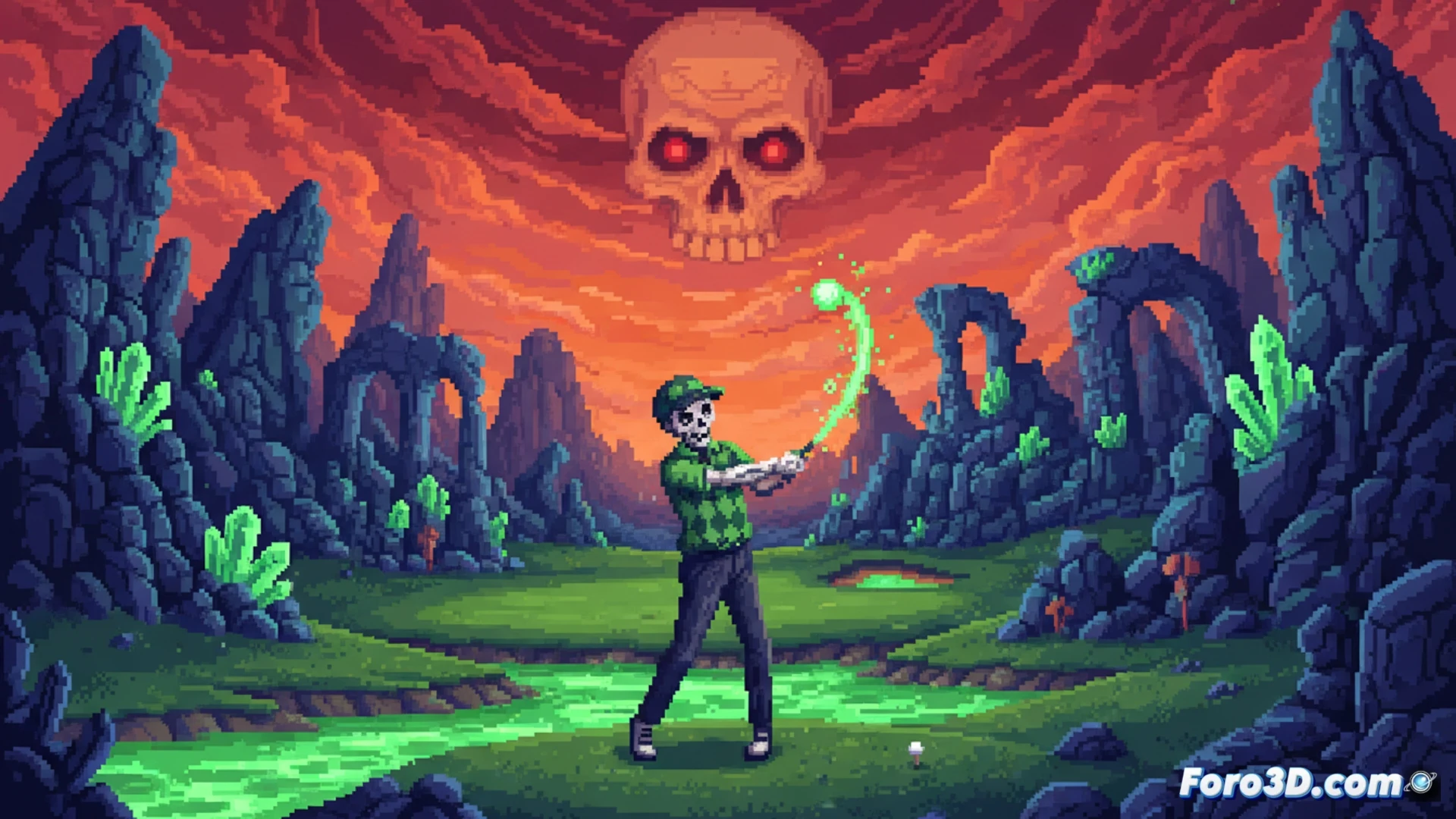
The development of Cursed to Golf demonstrates how the combination of Unity and Aseprite can generate a vibrant and functional 2D arcade aesthetic. This indie title bets on colorful and saturated pixel art, but its true technical appeal lies in the use of multiple parallax layers and visual effects that transform each stroke into a supernatural spectacle. For indie developers, analyzing its workflow reveals keys to creating depth without sacrificing performance.
Technical Implementation: Parallax Layers and Post-Processing in Unity 🎮
The visual depth in Cursed to Golf is achieved through a multi-layer parallax system managed directly from the Unity Editor. The backgrounds are divided into flat sprites with different scrolling speeds, creating the illusion of a 3D world. For special ability effects, such as lightning or explosions, particles with custom shaders and intensive use of the Post-Processing Stack v2 are employed. Effects like Bloom and chromatic aberration are activated at key moments to provide visual feedback to the player. The key is to use low-resolution Render Textures for these effects, maintaining stable performance on consoles without losing the chromatic saturation of the pixel art.
Lessons for Indies: How to Optimize Visual Chaos Without Losing Identity 🎯
The biggest technical challenge for a game with so many effects is avoiding visual saturation and frame drops. The developers of Cursed to Golf optimize their sprites in Aseprite by limiting the color palette per layer, which reduces the weight of textures in GPU memory. Additionally, in Unity, they recommend disabling Anti-aliasing to preserve the sharpness of the pixel art and using the Culling Group to hide distant parallax layers during fast-motion sequences. This balance between aesthetics and performance is the standard every indie should strive for when publishing on multiple platforms.
How did they manage in Cursed to Golf to synchronize the parallax effect in Unity with the pixel art animation from Aseprite to maintain arcade gameplay without sacrificing performance in multi-layer 2D scenes?
(PS: optimizing for mobile is like trying to fit an elephant into a Mini Cooper)