The independent studio behind Cuffbust has achieved a remarkable balance: a minimalist art style that hides an advanced destruction physics engine in Unreal Engine 5. Far from hyper-realistic shooters, this prison escape game demonstrates that cutting-edge technology can serve clean, straightforward game mechanics. We analyze how they achieve this technical feat with UE5 and Maya.
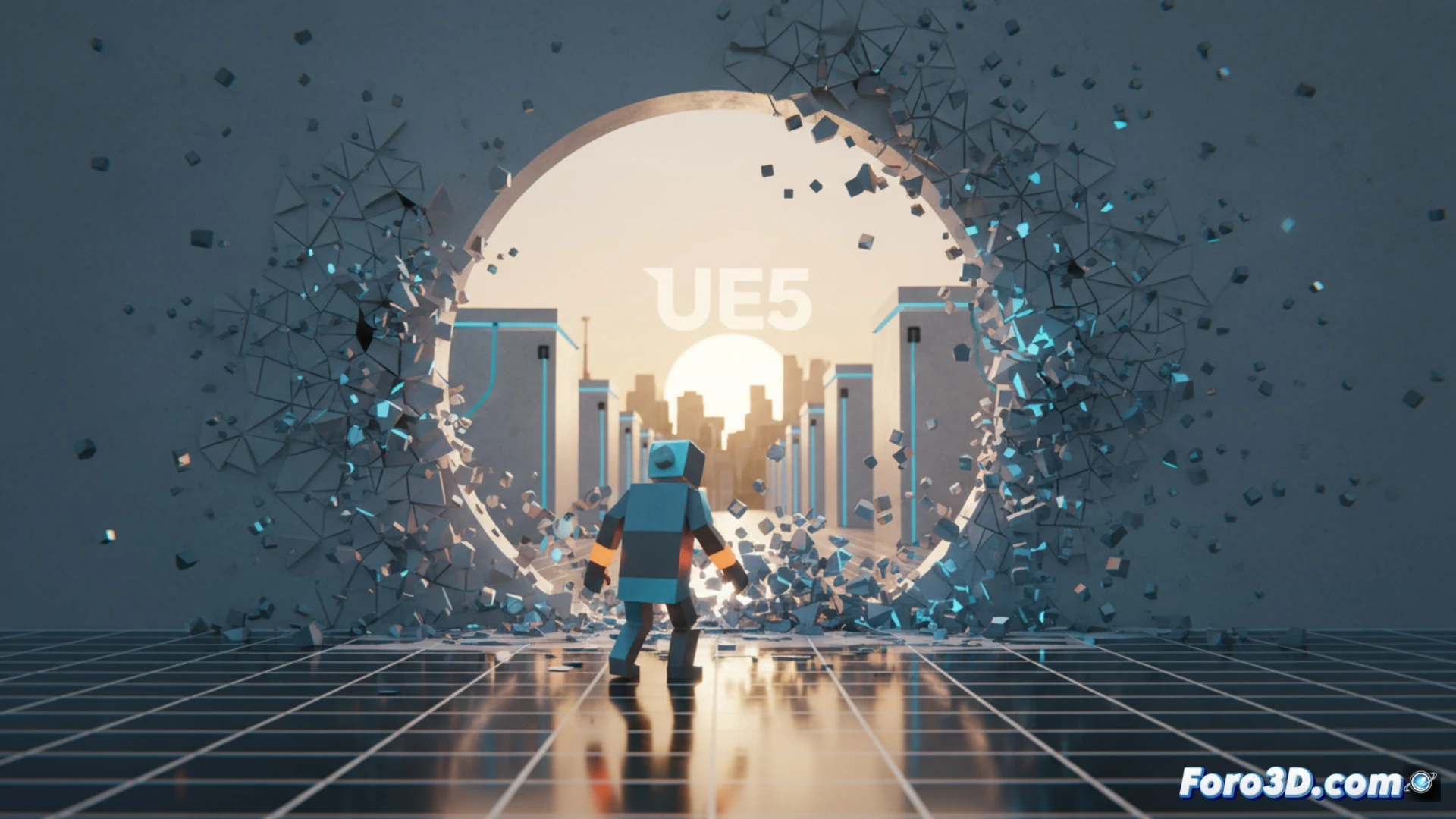
Workflow between Maya and UE5 for destructible assets 🔧
The Cuffbust pipeline begins in Maya, where assets are modeled with simple base geometry. The key lies in pre-fragmentation: each object is divided into smaller parts using procedural fracture tools. These fragments are imported into Unreal Engine 5 as static meshes grouped in a destruction blueprint. To optimize performance, the team applies aggressive LODs from Maya and uses the Chaos Physics system in UE5 to calculate breaks in real-time. Collisions are simplified to convex shapes, and impact effects are triggered with low-polygon particles. The result is reactive destruction that barely impacts the frame rate, even in scenarios with multiple collapsing walls.
Lessons for indie developers on destruction and gameplay 🎯
The Cuffbust case reminds us that destruction should not be an end in itself, but a design tool. Indie developers should prioritize gameplay over realism: fragment only the objects the player can use to escape or distract guards. Using asymmetric physics (objects that always break in the same way) reduces computational load and facilitates testing. Additionally, combining custom sound with minimal visual effects creates a sense of impact without cluttering the screen. Constant optimization from the prototype phase is the only way to maintain fluidity in a game with complex physics.
How does Cuffbust manage to implement an efficient procedural destruction system in Unreal Engine 5 that, despite its visual minimalism, maintains immersion and tactical impact in prison escapes without sacrificing performance?
(PS: shaders are like mayonnaise: if they break, you start all over again)